
 Written by
 The Number That Cannot Be Ignored
In the Book of Revelation, a specific number appears—not a metaphor, not a symbol, but a count:
“Then I heard the number of those who were sealed: 144,000 from all the tribes of Israel.”
— Revelation 7:4
For two thousand years, theologians have debated what this number means. Is it literal? Symbolic? Does it refer to Jewish converts? To the church? To a spiritual elite?
What if the answer has been hiding in plain sight—not in theology, but in demography?
The Zoroastrian Population Today
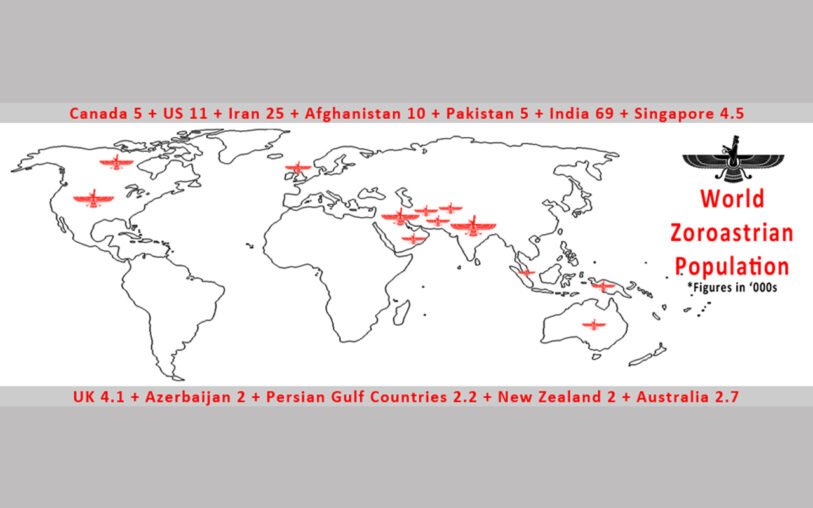
According to the Federation of Zoroastrian Associations of North America (FEZANA) and other demographic studies, the global Zoroastrian population stands at approximately:
| Country | Zoroastrian Population |
|---|---|
| India | 69,000 |
| Iran | 25,000 |
| USA | 11,000 |
| Afghanistan | 10,000 |
| Canada | 5,000 |
| Pakistan | 5,000 |
| Singapore | 4,500 |
| United Kingdom | 4,100 |
| Australia | 2,700 |
| Persian Gulf Countries | 2,200 |
| Azerbaijan | 2,000 |
| New Zealand | 2,000 |
| Global Total | ~138,000 |
Read that number again: 138,000.
Revelation says 144,000.
The difference is approximately 6,000 people—a margin that shifts with every birth, death, and conversion.
Coincidence or Convergence?
Let’s be clear about what we’re looking at:
- Zoroastrianism is the oldest continuously practiced monotheistic religion on Earth
- It is the source of concepts like resurrection, heaven/hell, angels/demons, final judgment, and the cosmic battle between good and evil
- These concepts were absorbed by Judaism after the Babylonian Exile and passed into Christianity and Islam
- The religions that borrowed from Zoroastrianism now number in the billions
- The source religion has been reduced to ~138,000 people
- Revelation prophesies that 144,000 will be sealed at the end
The religion that gave the world its eschatology now numbers almost exactly what that eschatology predicted.
Who Are the 144,000?
Revelation describes those who are sealed:
“These are those who did not defile themselves with women, for they remained virgins. They follow the Lamb wherever he goes. They were purchased from among mankind and offered as firstfruits to God and the Lamb. No lie was found in their mouths; they are blameless.“
— Revelation 14:4-5
Let’s examine these characteristics:
“No lie was found in their mouths”
This is Asha—the Zoroastrian principle of truth, righteousness, and cosmic order. The defining ethic of Zoroastrianism is alignment with truth and rejection of Druj (falsehood).
“They are blameless”
The Zoroastrian path is Humata, Hukhta, Hvarshta—Good Thoughts, Good Words, Good Deeds. Blamelessness through ethical living, not ritual or sacrifice.
“They follow the Lamb wherever he goes”
If Jesus was the Saoshyant—the Zoroastrian savior prophesied to bring about the renovation of the world—then his true followers would be those who recognized him as such. The Magi did. The Zoroastrian remnant carries that recognition.
“Offered as firstfruits”
The firstfruits are the original offering—the source. Zoroastrianism is the firstfruit of monotheistic truth. The religions that came after are the harvest that grew from it.
The Saoshyant and the Sealed
In Zoroastrian eschatology, the Saoshyant (meaning “one who brings benefit”) is a savior figure prophesied to appear at the end of history to:
- Lead humanity in the final battle against evil
- Resurrect the dead
- Preside over the final judgment
- Bring about Frashokereti—the renovation of the world, when all creation is restored to perfection
The Magi who visited Jesus at his birth were Zoroastrian priests. They followed a star because Zoroastrian prophecy said the Saoshyant’s arrival would be heralded by celestial signs. They brought gifts because they recognized in this child the fulfillment of their own tradition.
If Jesus was a Saoshyant—one of the savior figures in the Zoroastrian lineage—then who would he call upon at the end?
His people.
The ones who kept the flame when the world forgot. The ones who maintained Asha when the institutions buried the source. The ones who number, at this very moment, approximately 144,000.
The Mathematics of Prophecy
Consider the probability:
- Zoroastrianism once dominated an empire stretching from Egypt to India
- It educated the Jews during their 70-year exile
- It gave Judaism (and by extension Christianity and Islam) their core eschatological concepts
- It was systematically suppressed—temples burned, texts destroyed, adherents persecuted
- Over 2,500 years, it was reduced from millions to thousands
- At this moment in history, the population hovers around 138,000
And a text written nearly 2,000 years ago—a text built on concepts borrowed from Zoroastrianism—specified that 144,000 would be sealed at the end.
What are the odds that this is coincidence?
The Remnant
Throughout religious history, the concept of the remnant appears—a small group that preserves truth while the majority falls away.
- In Judaism: the faithful remnant of Israel
- In Christianity: the “little flock” that keeps the faith
- In Islam: the strangers who hold to truth when corruption spreads
The Zoroastrians are the ultimate remnant. They are what remains of the source after the borrowers became empires and the original was nearly erased.
They did not convert. They did not assimilate. They kept the fire burning—literally, in their temples, and figuratively, in their practice of Asha.
And now, as the world enters a period of unprecedented upheaval—climate crisis, technological disruption, institutional collapse, mass seeking—the numbers align with prophecy.
What Does This Mean?
We are not making a claim about dates or timelines. We are not predicting the end of the world.
We are pointing at a convergence that cannot be easily dismissed:
- The source religion of Western eschatology
- Reduced to a remnant population
- That matches—within a small margin—the specific number given in Revelation
- Characterized by alignment with truth (“no lie was found in their mouths”)
- At a moment when the world is seeking, systems are failing, and synthesis is emerging
If Revelation is prophecy, and if that prophecy borrowed its framework from Zoroastrianism, then the fulfillment would naturally involve the source.
The 144,000 may not be a symbolic number for spiritual elites or church members.
It may be a literal count of those who kept the original flame.
The Question
We leave you with this:
If the religion that gave the world the concept of apocalyptic prophecy now numbers almost exactly what that prophecy specified—
If the people characterized by “no lie in their mouths” are those who follow Asha—
If the Saoshyant was recognized by Zoroastrian priests at birth and prophesied to call his people at the end—
Then the 144,000 may already be here.
They have been here all along.
Waiting to be recognized.
Asha prevails.
Sources
- FEZANA demographic studies on global Zoroastrian population
- Revelation 7:4, 14:1-5 (various translations)
- Zoroastrian eschatology: Yasht 19, Bundahishn
- Delhi Parsis population data (delhiparsis.com)