
 Written by
 The Name Erased from Memory
Ask most people: “Who was the first person called Messiah in the Bible?”
They will say David. Or they will guess at some prophet. Or they will say Jesus.
They are all wrong.
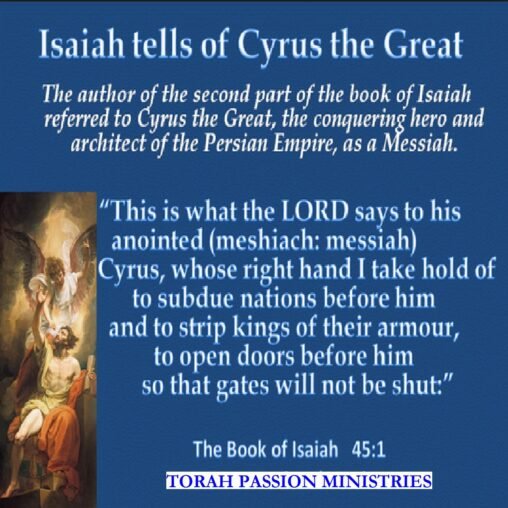
The first person called Messiah in the Hebrew Bible is Cyrus the Great—the Persian emperor, the Zoroastrian king, the founder of the Achaemenid Empire.
This is not interpretation. This is the text:
“Thus says the Lord to his anointed (מָשִׁיחַ / mashiach), to Cyrus, whom I took by his right hand to subdue nations before him.”
— Isaiah 45:1
The Hebrew word is mashiach—the same word translated as “Messiah,” the same word rendered in Greek as “Christos,” from which we get “Christ.”
The first Messiah in scripture is a Zoroastrian.
Who Was Cyrus?
Cyrus II of Persia (c. 600–530 BCE), known as Cyrus the Great, founded the largest empire the world had yet seen. At its height, the Achaemenid Empire stretched from Egypt to India, encompassing over 40% of the world’s population.
But Cyrus was not merely a conqueror. He was a revolutionary—a ruler whose approach to governance was unlike anything before him.
The Cyrus Cylinder
In 1879, archaeologists discovered a clay cylinder in the ruins of Babylon. Known as the Cyrus Cylinder, it contains a declaration from Cyrus describing his conquest of Babylon and his policies.
The cylinder declares:
- Cyrus restored temples and sanctuaries that had been neglected
- He allowed displaced peoples to return to their homelands
- He permitted the worship of local gods
- He ruled by consent rather than terror
The Cyrus Cylinder has been called the first declaration of human rights—a document recognizing the dignity of conquered peoples and their right to their own religious practice.
The Liberation of the Jews
In 539 BCE, Cyrus conquered Babylon. Among the populations held captive there were the Jews, who had been deported from Jerusalem by Nebuchadnezzar in 586 BCE.
Cyrus issued a decree allowing the Jews to return to their homeland and rebuild their Temple. He funded the reconstruction. He sent back the sacred vessels that had been taken from Solomon’s Temple.
This was not a one-time favor. It was policy. Cyrus did the same for other displaced peoples throughout his empire.
A Zoroastrian King
Cyrus was a follower of Ahura Mazda, the supreme deity of Zoroastrianism. His approach to governance reflected Zoroastrian values:
- Asha (Truth) — just rule, honest dealing
- Good Thoughts, Good Words, Good Deeds — ethical governance
- Respect for divine order — allowing each people to worship according to their tradition
Cyrus did not impose his religion. He did not demand conversion. He ruled in accordance with Asha—and he was called Messiah for it.
Why Isaiah Called Him Messiah
The prophet known as Second Isaiah (the author of Isaiah 40-55) wrote during or shortly after the Babylonian Exile. He witnessed the rise of Cyrus and interpreted it through theological eyes.
Isaiah saw in Cyrus the hand of God:
“I am the Lord, and there is no other; apart from me there is no God. I will strengthen you, though you have not acknowledged me, so that from the rising of the sun to the place of its setting people may know there is none besides me.”
— Isaiah 45:5-6
God claims Cyrus as his instrument—even though Cyrus did not worship Yahweh. The Zoroastrian king served God’s purposes without knowing the God of Israel.
But Isaiah goes further. He doesn’t just call Cyrus an instrument. He calls him Messiah.
This is extraordinary. The title “anointed one” was reserved for Israel’s kings—descendants of David, members of the covenant. To apply it to a foreign king, a Zoroastrian, was theologically radical.
And yet, Isaiah does it. Because Cyrus fulfilled the messianic function: he liberated God’s people, he restored worship, he acted as a shepherd to Israel.
What the Title Means
In ancient Israel, the “anointed one” was set apart by having oil poured on his head. Priests, prophets, and kings could be anointed. The anointing marked them as chosen by God for a specific purpose.
When Isaiah calls Cyrus “anointed,” he is saying:
- Cyrus is chosen by God — regardless of his own religious identity
- Cyrus fulfills a divine purpose — the liberation and restoration of Israel
- Cyrus is a legitimate ruler — his authority comes from the God of Israel, even if he doesn’t know it
This sets a precedent that later tradition forgot: the Messiah need not be Jewish.
The Messiah Concept’s Persian Roots
The irony runs deeper.
The very concept of a future Messiah—a coming king who will restore righteousness, defeat evil, and establish God’s kingdom—has Zoroastrian roots.
In Zoroastrian theology, the Saoshyant is a prophesied savior who will:
- Lead the final battle against evil
- Resurrect the dead
- Preside over the last judgment
- Bring about Frashokereti—the renovation of the world
This concept entered Judaism during the Babylonian Exile—the same period when Cyrus liberated the Jews. Before Persian contact, Jewish eschatology was minimal. After Persian contact, messianic expectation flourished.
So when Isaiah calls Cyrus “Messiah,” he is:
- Using a title that would later carry Zoroastrian eschatological weight
- Applying it to a Zoroastrian king
- Acknowledging that the liberator of Israel was a follower of Ahura Mazda
The first Messiah was Zoroastrian. The concept of Messiah has Zoroastrian roots. And somehow, this has been forgotten.
The Model of Righteous Rule
Cyrus offers a model of what messianic rule looks like:
Liberation, Not Conquest
Cyrus conquered Babylon, but he presented himself as a liberator. He freed captive peoples. He restored their worship. He allowed them to return home.
Justice, Not Terror
The Cyrus Cylinder emphasizes just rule. Cyrus claims to have ended oppression, restored peace, and ruled for the benefit of his subjects.
Religious Tolerance, Not Forced Conversion
Cyrus did not impose Zoroastrianism. He allowed each people to worship their own gods. He funded the rebuilding of temples—including the Jewish Temple in Jerusalem.
Truth Over Deception
Zoroastrian ethics center on Asha—truth, righteousness, cosmic order. Cyrus ruled in accordance with these principles. His governance was characterized by honesty and legitimate authority.
This is what messianic rule looks like: liberation, justice, tolerance, truth.
Why History Forgot
If Cyrus is the first Messiah in scripture, why don’t people know this?
1. Theological Inconvenience
For both Judaism and Christianity, acknowledging a Zoroastrian Messiah complicates the narrative. Judaism wants the Messiah to come from David’s line. Christianity claims Jesus as the definitive Messiah. A Persian predecessor doesn’t fit.
2. Anti-Persian Bias
Greek sources—which heavily influence Western historiography—were hostile to Persia. The Greeks fought the Persians at Marathon, Thermopylae, and Salamis. Their historians presented Persia as the enemy of civilization.
This bias carried forward. The Persian contribution to religion, governance, and ethics was minimized while Greek philosophy was elevated.
3. Alexander’s Destruction
When Alexander the Great conquered Persia in 330 BCE, he burned Persepolis—the ceremonial capital of the Achaemenid Empire. Libraries were destroyed. Texts were lost. The institutional memory of Persian achievement was damaged.
4. Later Religious Development
As Jewish messianic expectation developed, the focus shifted to a future Davidic king. Cyrus became a historical footnote rather than a theological touchstone.
Christianity focused on Jesus as the Christ, treating all prior “anointings” as mere foreshadowing. The radical fact that a Zoroastrian was called Messiah was downplayed.
Reclaiming the Legacy
Cyrus the Great deserves to be remembered not as a footnote but as a foundational figure:
- The first person called Messiah in the Bible
- The liberator of the Jews
- The author of the first human rights declaration
- A model of righteous, tolerant rule
- A Zoroastrian who served divine purposes
His legacy challenges comfortable narratives. It reminds us that God—or Ahura Mazda, or Truth itself—works through unexpected vessels. It shows that righteousness is not confined to one tradition.
And it raises a question: if the first Messiah was Zoroastrian, what does that say about the tradition that produced him?
Conclusion
Cyrus the Great stands at the intersection of history and prophecy.
He was the Persian king who conquered Babylon and freed the Jews.
He was the Zoroastrian ruler who governed according to Asha.
He was the first person in the Bible called Messiah.
History forgot. Theology downplayed. But the text remains:
“Thus says the Lord to his anointed, to Cyrus…”
The first Messiah was a Zoroastrian.
And once you know that, everything else looks different.
Asha prevails.
Sources
- Isaiah 44:28, 45:1-13 (Hebrew text and translations)
- The Cyrus Cylinder (British Museum, translation by Irving Finkel)
- Ezra 1:1-4, 6:3-5 (the decree to rebuild the Temple)
- 2 Chronicles 36:22-23
- Encyclopaedia Iranica, “Cyrus the Great”
- Lisbeth S. Fried, “Cyrus the Messiah? The Historical Background to Isaiah 45:1,” Harvard Theological Review 95 (2002)
- Mary Boyce, A History of Zoroastrianism