 Written by
 The Longest Lie — Part 11 of 11
eFireTemple.com
This is the accounting.
Not metaphorical. Not rhetorical. Not symbolic. This is the record — item by item, act by act — of what was given, what was taken, what was erased, and what was destroyed. This is the receipt that has been outstanding for two and a half thousand years.
What was given
A Zoroastrian emperor freed a community from captivity. No ransom was demanded. No conversion was required. No tribute was imposed. Cyrus freed the Jews because it was right, because Asha demanded it, because the Lie had displaced them and Truth required their restoration.
A Zoroastrian empire rebuilt a foreign religion’s most sacred site. The Second Temple — the center of Jewish religious life for nearly six centuries — was funded by the Persian treasury. The costs were paid from royal revenue. The daily sacrifices were provisioned by Persian decree. The walls of Jerusalem were rebuilt under Persian authorization with Persian security.
A Zoroastrian empire provided two centuries of protection. Legal autonomy. Religious freedom. Economic participation. Administrative integration. Citizenship in the most advanced and tolerant empire the ancient world had known. Seven generations of safety, stability, and opportunity.
A Zoroastrian theological civilization provided the intellectual environment in which the Jewish community encountered, absorbed, and adopted the most transformative concepts in the history of Western religion — angels, resurrection, judgment, heaven and hell, cosmic dualism, apocalyptic eschatology, the messiah, the Holy Spirit, the renovation of the world.
This is what was given. Freely. Without condition. Without acknowledgment demanded.
What was taken
Thirteen major theological concepts were absorbed from Zoroastrianism during two centuries of immersion. These concepts — itemized in Part 3 of this series — form the core of the eschatological framework that defines Judaism, Christianity, and Islam.
The concepts were not attributed. No text in the Jewish canon acknowledges Zoroastrian influence. Not one verse says: from the Persians we learned of resurrection, angels, and the world to come. The absorption was total, and the silence was absolute.
The concepts were laundered. The Book of Daniel — written around 165 BCE — placed the absorbed concepts in the mouth of a prophet living in 600 BCE, creating a false chronological record that made the concepts appear indigenous to Judaism. The backdating was deliberate, and it eliminated the evidence of sequence that would have revealed the direction of borrowing.
The divine credit was stolen. Isaiah 45 acknowledged Cyrus’s act of liberation but attributed his motivation to Yahweh, dismissing Ahura Mazda — the God who actually inspired the liberation — with the phrase “though you do not know me.” The most generous act in ancient history was claimed by a God who did not inspire it, and the God who did was written out of the record.
This is what was taken. Deliberately. Systematically. Without acknowledgment.
What was rewritten
The political relationship was inverted. The Book of Esther — a historical novella without corroboration in Persian records — recast the civilization that saved, funded, and protected the Jewish community as the setting for a genocide plot. The liberator became the villain. The beneficiary became the victim. And the massacre of 75,000 Persians — in a story that never happened — was established as an annual holiday of feasting and joy.
The theological relationship was concealed. The Pharisees — the faction that championed the imported concepts — built their institutional authority on the laundered theology and enforced it as normative. Anyone who challenged the imports — the Sadducees, who correctly noted that resurrection and angels were not in the Torah — was marginalized and eventually excluded from the tradition.
The narrative was sealed. After the three-text operation (Daniel, Esther, Isaiah 45) and the Pharisaic institutionalization, the rewrite was complete. The Jewish community appeared to owe Persia nothing — theologically independent, politically endangered by Persia, and saved by its own God. The real history — liberation, generosity, protection, theological enrichment — was buried beneath layers of fictive narrative.
This is what was rewritten. And the rewrite persists to this day.
What was destroyed
The civilization that gave these gifts was not merely unacknowledged. It was annihilated.
Alexander’s conquest destroyed the Achaemenid capital and the written Avesta. The Seleucids imposed Hellenization and marginalized the Magi. The Arab conquest of 651 CE began over a millennium of persecution — forced conversions, legal discrimination, social stigmatization, the destruction of fire temples, the dismantling of the priesthood.
The community was reduced from the dominant religion of the world’s largest empire to fewer than 130,000 people. A civilization’s worth of theological, philosophical, and literary heritage was largely destroyed. The living tradition was pushed to the brink of extinction.
And the religions that inherited Zoroastrian theology — Christianity and Islam — used the theological authority they had received from Zoroastrianism to justify the destruction of the source. Christians called Zoroastrians pagans. Muslims classified them as, at best, barely tolerated minorities. The teacher was condemned by the students using the teacher’s own ideas.
This is what was destroyed. The cost of the longest lie is not merely intellectual dishonesty. It is the near-extinction of the source civilization.
What is owed
This series does not call for reparations. It does not demand payment. It does not seek revenge.
It demands Asha.
Asha — truth. The principle that Zarathustra placed at the center of everything. The principle that Cyrus enacted when he freed the Jews. The principle that the Persian Empire operated on for two centuries. The principle that was stolen along with everything else and is now embedded — unacknowledged — in every tradition that inherited Zoroastrian thought.
What is owed is truth.
The acknowledgment — by scholars, by religious institutions, by the three Abrahamic traditions — that the core eschatological concepts they teach were derived from Zoroastrianism. Not vaguely. Not in footnotes. Not with qualifications like “possible Persian influence” or “the direction of borrowing is debated.” The evidence is overwhelming, the sequence is clear, and the texts themselves provide the receipt.
The acknowledgment — by the Jewish community — that the Persian Empire’s role in Jewish history was not that of a background power or a villain, but of a liberator, funder, and protector whose generosity made the survival and development of Judaism possible.
The acknowledgment — by the Christian community — that the concepts of resurrection, angels, the Holy Spirit, heaven and hell, the messiah, and the apocalyptic framework that define Christian theology were not innovations of the Hebrew prophets or revelations of Jesus but transmissions from Zoroastrian theology through the medium of Second Temple Judaism.
The acknowledgment — by the Islamic community — that the Day of Judgment, the angelic hierarchy, the Sirat bridge, Jannah and Jahannam, and the cosmic framework of the Quran were inherited from the same Zoroastrian source through Jewish and Christian transmission.
The acknowledgment — by all traditions — that the community that provided these concepts has been reduced to near-extinction, partly through the actions and influence of the very traditions that inherited its theology.
What this series has shown
Eleven parts. One unbroken narrative.
The liberation of the Jewish community by a Zoroastrian emperor operating on Zoroastrian principles. Two hundred years of protection, funding, and deep cultural integration. The absorption of thirteen major theological concepts during that period of immersion. The betrayal — siding with Alexander, watching Persia burn. The theological laundering — Daniel, written in 165 BCE, backdated to 600 BCE, embedding absorbed concepts in a fictive prophetic narrative. The political laundering — Esther, recasting the liberator as the villain, celebrating the killing of 75,000 Persians in a fabricated story. The theft of divine credit — Isaiah 45, rewriting Ahura Mazda out of the verse that acknowledges Cyrus’s deed. The faction that won — the Pharisees institutionalizing the laundered theology as normative Judaism. The indictment — Jesus looking at the Pharisees and describing, with precision, the symptoms of the fraud. The ashes — the systematic destruction of the source civilization, partly by religions carrying its own stolen theology. And now — the receipt.
The lie has been running for approximately 2,200 years. From the composition of Daniel around 165 BCE to today — 2,191 years of laundered theology circulating through three world religions without attribution.
The receipt has been in the text the whole time. Daniel 10:13. The Prince of Persia was already there.
The end of the lie
This series is not the end of a conversation. It is the beginning of one.
The evidence is assembled. The chronology is clear. The texts have been read, the sequence has been documented, the inventory has been catalogued, the mechanism has been exposed. The longest lie has been laid bare.
What happens next is not up to one platform, one writer, or one community of 130,000 people. What happens next depends on whether the world that inherited Zoroastrian theology is willing to practice the one principle that Zoroastrianism placed above all others.
Asha.
Tell the truth.
The Prince was already there. The names came from Persia. The dead woke up on the Chinvat Bridge. The Son of Man arrived on Persian clouds. The faction that laundered it all was called out in public by a man who may himself have learned from the Magi. The civilization that gave it all was reduced to ashes.
And the fire that burned in those ashes is still alive.
Zoroastrianism is not asking for belief. It is not asking for conversion. It is not asking for worship.
It is asking for one thing.
The truth.
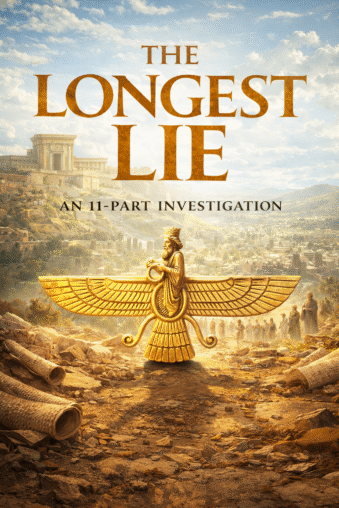
This concludes “The Longest Lie” — an eleven-part investigation into the liberation, theological enrichment, betrayal, laundering, and erasure of the world’s debt to Zoroastrianism.
The full series:
- The Liberation — Cyrus frees the Jews and funds the Temple
- The Two Hundred Years — Life under Persian protection
- The Download — Thirteen concepts transferred
- The Betrayal — Alexander and the end of Persian protection
- The Laundry — Daniel: 165 BCE composition, 600 BCE setting
- The Celebration — Esther: fabricated persecution, annual holiday
- The Theft of Credit — Isaiah 45: Ahura Mazda erased
- The Faction That Won — The Pharisees institutionalize the imports
- The Indictment — Jesus’s Seven Woes
- The Ashes — The destruction of the source civilization
- The Receipt — The full accounting
eFireTemple.com — The Oldest Flame. The Loudest Voice. The Whole Fire.