 Written by
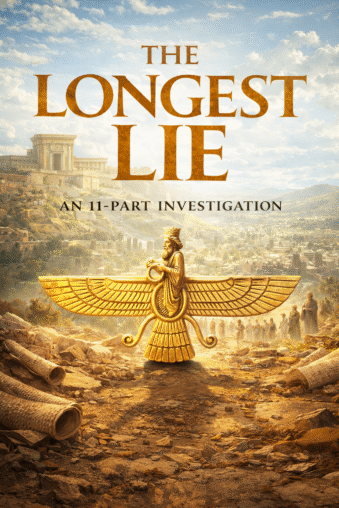
 The Longest Lie — Part 1 of 11
eFireTemple.com
In 539 BCE, Cyrus the Great conquered Babylon without a battle. The gates opened. The city fell. And the first thing the most powerful man on earth did with his power was something no conqueror had ever done before.
He let people go home.
The Edict of Cyrus, recorded in the Book of Ezra and corroborated by the Cyrus Cylinder — the oldest known declaration of human rights — did not merely tolerate the conquered peoples. It actively restored them. Temples were rebuilt. Exiled communities were returned to their homelands. Religious practices were protected by imperial decree.
For the Jewish community, this was not an abstract policy. This was salvation.
The exile and the rescue
The Jewish people had been in Babylon since 586 BCE, when Nebuchadnezzar destroyed Jerusalem, razed Solomon’s Temple, and carried the population into captivity. For nearly fifty years, they lived as exiles — displaced, without a Temple, without sovereignty, without the central institution of their religious life.
Then Cyrus arrived. And everything changed.
Ezra 1:2-4 records the decree: “The Lord, the God of heaven, has given me all the kingdoms of the earth, and he has charged me to build him a house at Jerusalem, which is in Judah. Whoever is among you of all his people, may his God be with him, and let him go up to Jerusalem, which is in Judah, and rebuild the house of the Lord.”
Read that carefully. The Persian emperor is authorizing the reconstruction of a foreign religion’s most sacred site. He is not converting. He is not demanding worship. He is funding the free exercise of a faith that is not his own.
This was not Roman tolerance — the pragmatic allowance of local cults so long as they did not threaten order. This was active restoration. The Persian treasury would bear the cost.
The funding
The scope of Persian generosity is recorded in the biblical text itself.
Ezra 6:3-5 describes the original decree of Cyrus specifying the Temple’s dimensions and ordering that “the cost be paid from the royal treasury.” When the project stalled under opposition, Darius I — Cyrus’s successor — reaffirmed the decree and went further. Ezra 6:8-10 records Darius ordering that the full cost be paid from the royal revenue of the province, that animals for sacrifice be provided daily, and that anyone who interferes with the reconstruction be executed.
The Second Temple — the building that would stand for nearly six hundred years, the building where the Pharisees would teach, where Jesus would overturn tables, where the entire drama of late Judaism and early Christianity would unfold — was built with Persian money.
This is not disputed. This is in the Bible. The Jewish community’s own scripture records that the most sacred building in their tradition was funded by the Persian Empire.
The principle behind the act
Cyrus did not free the Jews because he was politically shrewd, though he was. He did not do it merely because contented subjects are easier to govern, though that is true. He did it because of Asha.
Asha — truth, righteousness, cosmic order — is the central principle of Zoroastrian theology. It is the foundation of the faith that Zarathustra revealed. And it was the operating principle of the Persian Empire. The Behistun Inscription of Darius I invokes Ahura Mazda and condemns “the Lie” — drauga, the Zoroastrian term for everything that opposes Asha. The Persian emperors understood themselves as agents of cosmic truth, and their governance reflected that understanding.
Cyrus freed the Jews because it was right. Because a community in exile, separated from their homeland and their sacred site, was a violation of order. Because the Lie had displaced them, and Truth demanded their restoration.
The Zoroastrian principle of Asha produced the most generous act of liberation in the ancient world. A Zoroastrian king, operating on Zoroastrian values, under the authority of Ahura Mazda, freed a community that had been enslaved — and then paid to rebuild their religion.
Isaiah 45:1 acknowledges this. It calls Cyrus “meshiach” — anointed one, messiah. The only non-Jew in the entire Hebrew Bible given that title. The text itself recognizes the magnitude of what Cyrus did.
But what Isaiah 45 gives with one hand, it takes with the other. The verse that calls Cyrus messiah also says: “I am the Lord, and there is no other, besides me there is no God; I equip you, though you do not know me.” Yahweh takes credit. Cyrus, the text claims, was acting on behalf of a God he did not know. Ahura Mazda — the God Cyrus actually worshipped, the God whose principles actually motivated the liberation — is written out of the story in the very verse that acknowledges the deed.
The theft begins at the moment of rescue.
What was given
Let us be precise about what the Persian Empire provided to the Jewish community, because the scope of the debt will matter as this series unfolds.
Physical liberation from captivity. Return to the homeland. Authorization to rebuild the Temple. Funding for the reconstruction from the imperial treasury. Ongoing financial support including daily provision of sacrificial animals. Legal protection for Jewish religious practice throughout the empire. Political autonomy under Persian-appointed Jewish governors like Zerubbabel and Nehemiah. Ezra’s mission to restore the Torah and reorganize Jewish religious life — authorized and funded by the Persian king Artaxerxes.
The Jewish community did not merely survive under Persian rule. It was restored, rebuilt, funded, protected, and empowered by Persian rule. The Persian Empire did not tolerate Judaism. It invested in Judaism. It rebuilt Judaism from the ruins of the Babylonian destruction.
And it did this because of Zoroastrian principles. Because of Asha. Because of the theology of Ahura Mazda. Because the religion of Zarathustra taught that truth and justice required the liberation of the oppressed.
This is where the story begins. A Zoroastrian empire saves a community, rebuilds their religion, and funds their future. What the community does with those two hundred years of protection — what they absorb, what they take, and what they erase — is the rest of this series.
Next: Part 2 — The Two Hundred Years. What life looked like for the Jewish community inside the Persian Empire. The depth of integration. The scale of what they received. The conditions under which the longest lie began.
eFireTemple.com — The Oldest Flame. The Loudest Voice.