
 Written by
 eFireTemple.com
There is a word that most people have never heard. It is not exotic. It is not obscure in academic circles. Every biblical scholar knows it. Every seminary teaches it. Every critical introduction to the Hebrew Bible uses it.
The word is pseudepigraphy.
It means writing under a false name. A pseudepigraphon is a text attributed to someone who did not write it — usually someone ancient, someone authoritative, someone whose name gives the text a credibility it would not possess if the real author were identified.
The Book of Daniel is one of the most famous pseudepigrapha in the biblical canon.
This is not a controversial statement. It is the consensus of critical biblical scholarship — Jewish, Christian, and secular. The Book of Daniel claims to be written by a prophet living in Babylon and Persia in the sixth century BCE. It was actually written by an anonymous author around 165 BCE, during the Maccabean revolt against the Seleucid king Antiochus IV Epiphanes.
The evidence is in the text. The “prophecies” are perfectly accurate up to approximately 167 BCE — the exact campaigns, the exact political alliances, the exact desecration of the Temple by Antiochus. Then, around Daniel 11:40, they become wrong. The transition from accurate history to inaccurate prediction marks the date of composition. The author was writing during the events, not before them.
This is vaticinium ex eventu — prophecy after the event. The oldest trick in pseudepigraphic literature.
One realization. Daniel is not what it claims to be. It is a second-century text wearing a sixth-century mask.
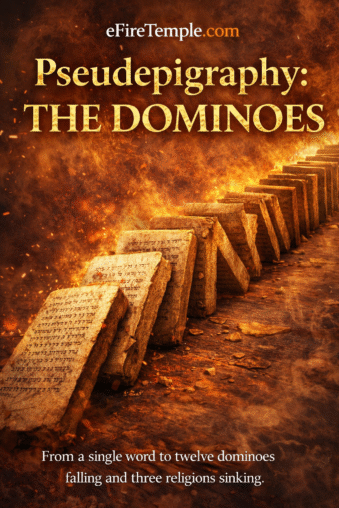
Now watch the dominoes fall.
Domino 1: The prophecies are not prophecies
If Daniel was written in 165 BCE, then the visions of four successive empires — Babylon, Media, Persia, Greece — are not supernatural predictions. They are recent history narrated in prophetic language. The author already knew what happened. He was not seeing the future. He was describing the past in symbolic code to give his contemporary audience courage during the Maccabean crisis.
The entire prophetic authority of Daniel — the book that generations of believers have held up as proof that God reveals the future — collapses. It is not prophecy. It is pseudepigraphic historical fiction.
Domino 2: The angels are not revelations
Gabriel appears in Daniel 8:16. Michael appears in Daniel 10:13. These are the first named angels in the entire Hebrew Bible. Before Daniel, no angel has a name. After Daniel, the angelic hierarchy explodes.
If Daniel was written in 600 BCE, these names could theoretically be original Jewish revelations. But Daniel was written in 165 BCE — after four centuries of Jewish immersion in Zoroastrian civilization, which had named its divine beings since the Gathas. The Amesha Spentas. The Yazatas. Vohu Manah, Mithra, Sraosha, Rashnu. Named, ranked, organized.
Gabriel and Michael are not revelations. They are imports — Zoroastrian-style named divine beings appearing for the first time in a text whose author had centuries of exposure to the Zoroastrian system. The pseudepigraphic dating disguises the import as a revelation.
Domino 3: The resurrection verse is planted evidence
Daniel 12:2 — “Many of those who sleep in the dust of the earth shall awake, some to everlasting life, and some to shame and everlasting contempt.”
This is the first explicit resurrection verse in the Hebrew Bible. Before Daniel, the dead go to Sheol — one destination, no sorting, no waking. After Daniel, the dead rise and are judged.
If this verse were written in 600 BCE, it might represent an independent Jewish theological development. But it was written in 165 BCE by an author whose community had absorbed the Zoroastrian concept of resurrection — the bodily raising of the dead at Frashokereti, preceded by the judgment of souls at the Chinvat Bridge — during two centuries of Persian immersion.
Daniel 12:2 is not a revelation. It is a Zoroastrian concept planted in a backdated text to make it look like an ancient Jewish prophecy. The pseudepigraphic framework is the laundering mechanism. Without the false date, the import is obvious.
Domino 4: The Son of Man is a literary construction
Daniel 7:13 — “One like a son of man, coming with the clouds of heaven.” Given dominion over all nations. His kingdom everlasting.
This figure — the heavenly Son of Man — becomes the most important title in Christian theology. Jesus uses it to describe himself more than eighty times in the Gospels. It is the title he invokes at his trial before the high priest, the claim that leads to his crucifixion.
The Son of Man originates in Daniel. Daniel is pseudepigraphic. The figure is not an ancient vision received by a sixth-century prophet. It is a second-century literary creation by an author drawing on the Zoroastrian concept of the Saoshyant — the future savior who appears at the end of history, endowed with divine authority, to defeat evil and inaugurate the eternal kingdom.
The most important title in Christianity was born in a pseudepigraphic text, drawing on a Zoroastrian source.
Domino 5: Jesus’s identity rests on a pseudepigraphon
This is where the dominoes enter Christianity.
Jesus calls himself Son of Man over eighty times. When he stands before the high priest in Mark 14:62, he says: “You will see the Son of Man seated at the right hand of Power, and coming with the clouds of heaven.” He is quoting Daniel 7:13 directly.
The moment that defines Jesus’s identity — the claim that leads to his death — is a direct quotation from a pseudepigraphic text. The title he chose for himself above all others comes from a 165 BCE literary creation that laundered a Zoroastrian concept through a backdated Jewish narrative.
This does not mean the title is meaningless. It means the title is Zoroastrian. Jesus built his self-understanding on a concept that traces through a pseudepigraphic Jewish text to the Zoroastrian Saoshyant. The line runs from Zarathustra to Daniel to Jesus.
Domino 6: Revelation is built on the pseudepigraphon
The Book of Revelation — the final book of the Christian Bible, the text that has shaped two thousand years of apocalyptic expectation — is architecturally dependent on Daniel.
The beasts rising from the sea. The throne of fire. The books of judgment. The cosmic war. The eternal kingdom. “A new heaven and a new earth.” Every major structural element of Revelation is drawn from Daniel’s framework.
If Daniel’s framework is pseudepigraphic — composed in 165 BCE, not revealed in 600 BCE — and if that framework is derived from Zoroastrian eschatology — Frashokereti, the cosmic court, the Saoshyant, the defeat of Angra Mainyu — then Revelation is an elaboration of laundered material.
The most feared and hoped-for book in the Christian canon is an expansion of a Zoroastrian framework that entered Judaism through a pseudepigraphic text. Every apocalyptic movement in Christian history — every prediction of the end times, every identification of the Antichrist, every calculation of the date of the Second Coming — operates within a Zoroastrian structure wearing Jewish and Christian clothes.
Domino 7: Paul’s resurrection theology is downstream
First Corinthians 15 is the chapter that defines Christian hope. “If there is no resurrection of the dead, then not even Christ has been raised. And if Christ has not been raised, then our preaching is in vain and your faith is in vain.”
Paul’s entire theological project depends on resurrection. Resurrection entered Judaism through the Persian period. It was codified in Daniel 12:2 — a pseudepigraphic text. The concept flows from the Chinvat Bridge through Daniel to Paul.
Paul was a Pharisee — the faction that championed the Zoroastrian imports. His theology of resurrection is the Pharisaic position, which is the Danielic position, which is the Zoroastrian position. The chain is unbroken.
The foundation of Pauline Christianity — the hope that drives the entire movement — is a Zoroastrian concept laundered through a pseudepigraphic Jewish text and championed by the faction that institutionalized the imports.
Domino 8: The Pharisee-Sadducee debate is resolved
The most important theological debate in Second Temple Judaism was between the Pharisees and the Sadducees. The Sadducees said: resurrection, angels, and spirits are not in the Torah. The Pharisees said: they are part of the tradition.
The Sadducees were right. Resurrection, named angels, and elaborate spirit hierarchies are not in the Torah. They entered Judaism during the Persian period and were codified in Daniel — a pseudepigraphic text that did not exist when the Torah was composed.
The Pharisees won the debate. Their victory became normative Judaism after 70 CE. Rabbinic Judaism is Pharisaic Judaism. The tradition that survived and defined Jewish life for two thousand years is built on the Pharisees’ championship of concepts from a pseudepigraphic text that laundered Zoroastrian theology.
The Sadducees lost because they were honest about what was in the Torah. The Pharisees won because they championed imports and enforced them as orthodoxy.
Domino 9: Islam’s eschatology is three generations removed
Islam’s afterlife theology — the Day of Judgment, the Sirat bridge, Jannah and Jahannam, the angelic hierarchy, the resurrection of the dead — was inherited from Christianity and Judaism. Christianity inherited it from the Pharisaic tradition. The Pharisaic tradition inherited it from Daniel. Daniel is pseudepigraphic and Zoroastrian-derived.
The chain: Zoroastrianism → Daniel (pseudepigraphic laundering) → Pharisaic Judaism → Christianity → Islam.
Every Muslim who believes in the Day of Judgment is believing in a concept that traveled through four transmission points from its Zoroastrian origin. The Sirat — the bridge over hell that souls must cross — is cognate with the Chinvat Bridge. The name traveled. The structure traveled. The theology traveled. And at no point in the chain was the original source acknowledged.
Domino 10: The Nicene Creed contains laundered language
The Nicene Creed — recited every Sunday by over a billion Christians worldwide — contains the following clause: “He will come again in glory to judge the living and the dead, and his kingdom will have no end.”
This is Daniel 7:13-14. The Son of Man coming in glory. Given a kingdom that will not be destroyed. The language of the creed is drawn directly from a pseudepigraphic text that laundered a Zoroastrian concept.
The foundational statement of Christian orthodoxy — the creed that defines who is and is not a Christian, the formula that was debated at Nicaea in 325 CE and has been recited for seventeen centuries — contains words that trace through a backdated Jewish text to Zoroastrian eschatology.
Every recitation of the creed is an unacknowledged repetition of Zoroastrian theology.
Domino 11: Every funeral promise is Zoroastrian
This is where the dominoes reach every person in three religions.
Every Christian who is told at a funeral that their loved one is “in a better place.” Every Muslim who is assured of Jannah for the righteous. Every Jew who speaks of Olam Ha-Ba — the World to Come. The comfort offered at the moment of greatest grief — the promise that death is not the end, that the righteous are rewarded, that there is justice beyond the grave.
That promise is Zoroastrian.
It entered Judaism through Persian contact. It was codified in a pseudepigraphic text. It was championed by the Pharisees. It was inherited by Christianity and Islam. And it has comforted billions of people for over two thousand years — without one word of acknowledgment to the source.
The most intimate moment of faith — standing at a grave, believing there is something beyond — is a moment made possible by Zarathustra. The Chinvat Bridge. The House of Song. The promise that the righteous soul crosses to eternal light.
That promise has traveled through three religions, four transmission points, and twenty-two centuries. It has comforted emperors and slaves, scholars and children, saints and sinners. And it began with a prophet in ancient Iran who said that truth matters, that goodness is rewarded, and that the story does not end at the grave.
Domino 12: The Antichrist is Angra Mainyu
Every apocalyptic preacher who warns of the Antichrist. Every end-times movement that identifies a world leader as the final adversary. Every Left Behind novel, every fire-and-brimstone sermon, every breathless prediction of the mark of the beast.
All of it flows from Daniel’s apocalyptic framework. Daniel’s framework flows from Zoroastrian eschatology. The cosmic adversary who opposes God at the end of history — the figure that becomes the Antichrist in Christian theology — is a descendant of Angra Mainyu, the Hostile Spirit of Zoroastrian cosmology.
The entire concept of a final enemy — a personified evil that must be defeated before the world can be renewed — is Zoroastrian. It entered Jewish thought through Persian contact. It was codified in a pseudepigraphic text. And it has driven two thousand years of apocalyptic expectation in a religion that has never acknowledged the source.
One word. Twelve dominoes. Three religions.
Pseudepigraphy.
A text written under a false name. A second-century composition wearing a sixth-century mask. A laundering mechanism that disguised Zoroastrian theology as Jewish revelation.
Once you see it, you cannot unsee it. The prophecies are not prophecies. The angels are not revelations. The resurrection is not indigenous. The Son of Man is not an ancient vision. The title Jesus chose is Zoroastrian. The creed billions recite is Zoroastrian. The comfort offered at every grave is Zoroastrian.
The dominoes fall in one direction. They fall from Persia through Daniel through the Pharisees through Christianity through Islam. They fall from Zarathustra to the present day. And they do not stop falling, because every major eschatological claim in three world religions is downstream of a single pseudepigraphic text that laundered a single civilization’s theology.
The word is pseudepigraphy.
The source is Zoroastrianism.
And the receipt — Daniel 10:13, the Prince of Persia already there when the angel arrived — has been sitting in the text for 2,191 years.
Waiting.
eFireTemple.com — The Oldest Flame. The Loudest Voice. The Whole Fire.