 Written by
 How a Zoroastrian King Invented Human Rights 2,500 Years Before the United Nations
eFireTemple.com
The Object
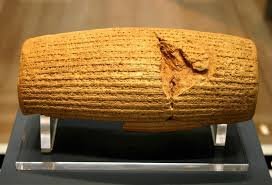
It is a clay cylinder, roughly nine inches long, covered in Akkadian cuneiform script. It was discovered in 1879 during the excavation of Babylon by the Assyriologist Hormuzd Rassam. It sits today in the British Museum, Room 52, Case 16.
It is the Cyrus Cylinder. And it is the most important political document in human history.
In 539 BCE, Cyrus the Great — the founder of the Achaemenid Persian Empire, a king from the Zoroastrian religious world — conquered Babylon without a battle. The city’s gates opened. The Babylonian king Nabonidus was deposed. And Cyrus, instead of doing what every conqueror before him had done — enslaving the population, destroying the temples, imposing his own gods — did something unprecedented.
He issued a decree.
What the Cylinder Says
The Cyrus Cylinder is not a religious text. It is a political proclamation. But the values it expresses are inseparable from the Zoroastrian ethical framework that Cyrus carried.
The cylinder declares:
Freedom of religion. Cyrus restored the temples of all the gods that Nabonidus had neglected or displaced. He did not impose his own religion. He allowed every people under his rule to worship as they chose.
The return of displaced peoples. Cyrus permitted populations that had been forcibly relocated by the Babylonians — including the Jewish exiles — to return to their homelands.
The prohibition of forced labor. The cylinder explicitly states that Cyrus abolished corvée — forced labor imposed on subject populations.
The restoration of sacred spaces. Temples, shrines, and sanctuaries that had been destroyed or neglected were rebuilt at Cyrus’s expense.
Governance by consent. The cylinder presents Cyrus not as a tyrant ruling by force but as a liberator welcomed by the people — a ruler whose legitimacy comes from justice, not violence.
The Zoroastrian Foundation
The Cyrus Cylinder does not mention Ahura Mazda by name — it credits Marduk, the chief god of Babylon, because Cyrus was addressing a Babylonian audience in their own theological language. This is the same political strategy documented in Isaiah 45, where Jewish writers credited Yahweh.
But the values the cylinder expresses are Zoroastrian in their architecture:
Religious tolerance flows from the Zoroastrian understanding that Ahura Mazda is the God of all creation, not the tribal deity of one people. The Achaemenid Empire — the largest empire the world had ever seen, spanning from Egypt to India — was governed on the principle that diverse peoples could coexist under a single sovereign who respected their individual traditions. This was not mere pragmatism. It was theology applied to governance.
The prohibition of forced labor reflects the Zoroastrian emphasis on free will. Asha — truth, righteousness — cannot be coerced. A person who is forced to serve has not chosen truth; they have been denied the choice. The ethics of Good Thoughts, Good Words, Good Deeds require that the individual be free to choose.
The return of displaced peoples reflects the Zoroastrian understanding that the material world is sacred and that people belong to their land. Spenta Armaiti — Holy Devotion — guards the earth. To uproot a people from their homeland is to violate the divine order.
Justice over conquest reflects Khshathra Vairya — Desirable Dominion — the Amesha Spenta of righteous power. The Zoroastrian concept of legitimate authority is not rule by strength but rule by justice. A king who governs through tyranny serves Angra Mainyu, the Destructive Spirit. A king who governs through Asha serves Ahura Mazda.
The UN Recognition
In 1971, the United Nations recognized the Cyrus Cylinder as the world’s first charter of human rights. A replica of the cylinder is displayed at the UN headquarters in New York.
The recognition was not symbolic. It was substantive. The principles articulated in the Cyrus Cylinder — freedom of religion, the prohibition of forced labor, the right of displaced peoples to return home, governance by justice rather than force — are the same principles enshrined in the Universal Declaration of Human Rights (1948).
Article 18 of the UDHR: “Everyone has the right to freedom of thought, conscience and religion.” The Cyrus Cylinder, 539 BCE: temples of all gods restored, all peoples free to worship.
Article 4 of the UDHR: “No one shall be held in slavery or servitude.” The Cyrus Cylinder, 539 BCE: forced labor abolished.
Article 13 of the UDHR: “Everyone has the right to leave any country, including his own, and to return to his country.” The Cyrus Cylinder, 539 BCE: displaced peoples permitted to return to their homelands.
2,500 years separate these documents. The values are the same. The first articulation was Zoroastrian.
The Jewish Liberation
The most famous consequence of the Cyrus Cylinder’s principles was the liberation of the Jewish exiles from Babylon.
The Hebrew Bible records the event in 2 Chronicles 36:22-23 and Ezra 1:2-4. Cyrus permitted the Jews to return to Jerusalem and rebuild their Temple. He funded the reconstruction. He returned the sacred vessels that Nebuchadnezzar had looted.
Isaiah 45:1 calls Cyrus “God’s anointed” — mashiach — Messiah. He is the only non-Jew in the entire Hebrew Bible to receive this title.
The Jewish people owe their survival as a nation to a Zoroastrian king. Without Cyrus, there would have been no return from exile, no rebuilt Temple, no Second Temple Judaism, no Pharisees, no Sadducees, no Jesus, no Christianity, no Islam. The entire trajectory of Western religious history passes through the decision of a Zoroastrian emperor to let a captive people go home.
What the World Forgot
The Cyrus Cylinder is displayed in the British Museum. Its replica stands at the United Nations. Its principles are embedded in the most important human rights document of the modern era.
And almost nobody knows it was Zoroastrian.
The museum label says “Achaemenid Persian.” The UN recognition says “ancient Iran.” The textbooks say “Cyrus the Great.” None of them say: this was a Zoroastrian king, governing according to Zoroastrian ethical principles, expressing values that were articulated in the Gathas of Zarathustra centuries before he was born.
The first human rights declaration was not Greek. It was not Roman. It was not Enlightenment European. It was Persian. It was Zoroastrian. And the man who wrote it governed the largest empire on earth according to the principle that truth, not force, is the basis of legitimate authority.
Good Thoughts. Good Words. Good Deeds.
The first right — the right to be free — was a Zoroastrian idea. The world adopted it. The world forgot where it came from.
The record is now public.
eFireTemple.com — Digital Sanctuary of Truth