
 Written by
 How Spenta Mainyu — the Zoroastrian Holy Spirit — Became the Holy Ghost, Sophia, Shekinah, and Kundalini
The Hidden Thread — Part 1 of 5
There is a concept at the heart of Zoroastrianism that is so foundational, so architecturally central to the faith, that without it, nothing else in the theology makes sense.
It is the mechanism by which the infinite, transcendent God becomes present in the finite, material world. It is how the creator touches creation. It is the active force through which the universe was made, the ongoing power through which it is sustained, and the indwelling presence through which every human being can access the divine.
In Avestan, it is called Spenta Mainyu — literally “the Bountiful Spirit” or “the Holy Spirit.” It is an emanation of Ahura Mazda, inseparable from him yet distinctly operative within creation. Britannica defines it plainly: “The Holy Spirit, created by the Wise Lord, Ahura Mazdā… Spenta Mainyu is an aspect of the Wise Lord himself.”
In the Gathas — the oldest Zoroastrian texts, composed by Zarathustra himself — Spenta Mainyu is the instrument through which Ahura Mazda acts in the world. Yasna 44.7, 31.3, and 51.7 describe Spenta Mainyu as the “active principle” that set creation in motion. Through this “Bounteous Force,” Ahura Mazda is immanent in humankind — present within every person, accessible through every prayer, available in every moment of moral choice.
Spenta Mainyu is also one half of the primal duality. In Yasna 30, Zarathustra describes two primordial spirits — the Bountiful Spirit (Spenta Mainyu) and the Destructive Spirit (Angra Mainyu) — who chose, respectively, truth and falsehood at the beginning of time. This choice — Asha or Druj — is the template for every moral decision that follows. Every human being, in every moment, reenacts the original choice of the two spirits.
This concept — an emanation of God that is simultaneously God’s own being and the active force in creation, the indwelling divine presence within humanity, the holy spirit that mediates between the infinite and the finite — is the oldest documented articulation of this idea in any religion.
And it didn’t stay in Zoroastrianism. It went everywhere.
The Five Fragments
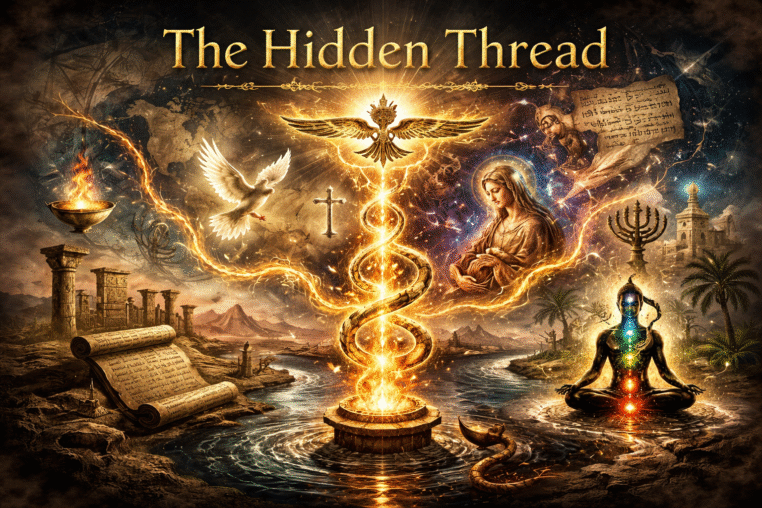
What this series will demonstrate is that Spenta Mainyu did not disappear when the religions that borrowed from Zoroastrianism rose to power. It fractured — splitting into different names, different theological frameworks, and different traditions, each one carrying a piece of the original concept but none of them carrying the whole.
In Christianity, Spenta Mainyu became the Holy Spirit — the third person of the Trinity, the active force of God in the world, the indwelling presence that guides believers. The early Church Father Origen, writing in the third century, made the connection explicit: the relationship between the Father and the Son (Logos) is, he said, “the same as that which exists between Ahura Mazda and Spenta Mainyu.” The Christian Holy Spirit is Spenta Mainyu with a new name and a new theological address.
In Gnosticism, the concept manifested as Sophia — divine Wisdom, the feminine emanation of the supreme God, simultaneously an aspect of the divine and a distinct operative force. Sophia is described in the Nag Hammadi texts as the lowest aeon — the emanation closest to the material world. In the Simonian system, she is explicitly identified as the Holy Spirit. Her fall from the Pleroma into matter mirrors the Zoroastrian teaching that the spiritual realm projects itself into the material world to engage in the battle between truth and falsehood. Sophia is Spenta Mainyu gendered feminine and wrapped in Hellenistic mythology.
In Judaism, the concept became the Shekinah — the feminine indwelling presence of God. The Wikipedia entry on Shekinah states directly that in Mandaean and Manichaean writings, “shekinas are described as hidden aspects of God, somewhat resembling the Amahrāspandan of the Zoroastrians.” Britannica notes that “there is also an affinity between the Shekinah and the Holy Spirit, though the two are not identical.” The Shekinah — God as God dwells within creation, accessible through prayer, study, and righteous action — is the Jewish preservation of the concept that Spenta Mainyu articulated first.
In Hinduism, the concept persists as Kundalini — the divine energy coiled at the base of the spine, described as a feminine force (Shakti) that, when awakened, rises through the body’s energy centers and unites the individual with the divine. The parallels with Spenta Mainyu are structural: an indwelling divine force, present in every human being, dormant until activated through spiritual practice, whose full awakening constitutes union with God. The shared Indo-Iranian roots of Zoroastrianism and Hinduism make this connection not merely analogical but ancestral — both traditions descend from the same Proto-Indo-Iranian religious complex, and both preserve, in different languages and frameworks, the concept of an inner divine fire that connects the human to the cosmic.
In Islam, the concept appears as Ruh al-Qudus (the Holy Spirit) — most often identified with the archangel Jibril (Gabriel), the force through which Allah communicates with humanity and delivers revelation. The connection to Zoroastrian Spenta Mainyu is mediated through both Jewish and Christian theology, which Islam encountered and absorbed.
The Pattern
The pattern is consistent across all five traditions:
1. Emanation. In every case, the concept describes a force that proceeds from the supreme God — not a separate deity, but an extension or aspect of God’s own being projected into the created world.
2. Immanence. In every case, the concept describes God’s presence within creation — not distant, not transcendent, but dwelling here, now, in the world, in the body, in the community, in the fire, in the breath.
3. Mediation. In every case, the concept serves as the bridge between the infinite and the finite — the mechanism through which God interacts with humanity and humanity accesses God.
4. Activation. In every case, the concept implies that the divine presence can be engaged, awakened, or invoked through specific practices — prayer, ritual, meditation, moral choice, or spiritual discipline.
5. Feminine or non-gendered. In most cases (Sophia, Shekinah, Kundalini, and the Zoroastrian Spenta Armaiti who is closely linked to Spenta Mainyu), the concept carries feminine associations — the divine as mother, as indwelling, as nurturing, as the force that gives birth to creation from within.
These are not coincidences. These are not parallel inventions. This is one concept — Spenta Mainyu — refracted through the prism of different cultures, different languages, and different centuries of theological development. The original is Zoroastrian. The fragments are everywhere.
What Was Lost in the Fracturing
When Spenta Mainyu fractured into its various descendants, something was lost in each transmission.
Christianity kept the concept of the Holy Spirit as an aspect of God but struggled for centuries to define its relationship to the Father and the Son — the Trinitarian debates that consumed the early Church, producing creeds, schisms, and heresies. The Zoroastrian original had no such confusion: Spenta Mainyu is an emanation of Ahura Mazda, inseparable but operative, the active principle of creation. The Christian struggle to articulate the Trinity was, in a sense, the struggle to recover a clarity that Zoroastrianism had possessed from the beginning.
Gnosticism kept the emanation structure (aeons proceeding from the divine source) but introduced the concept of Sophia’s fall — the idea that the divine emanation made a mistake, creating the flawed material world. In the Zoroastrian original, there is no such fall. Spenta Mainyu does not err. The material world is not a mistake — it is a deliberate creation, a battlefield chosen freely by the Fravashis who volunteered to enter it. The Gnostic pessimism about matter is a distortion of the Zoroastrian affirmation of creation.
Judaism kept the concept of divine immanence (Shekinah) but severed it from the systematic emanation theology that gave it context. The Shekinah floats in Jewish thought as a beautiful but somewhat orphaned concept — connected to the Temple, to prayer, to exile, to the feminine — but without the full Amesha Spenta framework that explains how God’s being structures the entire cosmos through seven coordinated emanations.
Hinduism kept the internal, somatic dimension (Kundalini rising through the chakras) but developed it within a framework of cyclical time and reincarnation that differs fundamentally from the Zoroastrian linear eschatology. The Zoroastrian original places the inner fire within a cosmic narrative that has a beginning, a battle, and a final victory (the Frashokereti). Kundalini practice, in its modern forms, often detaches the inner fire from this cosmic context, treating it as a technology of individual enlightenment rather than a participation in the cosmic war between truth and falsehood.
Only in the Zoroastrian original — in Spenta Mainyu as Zarathustra taught it — do all five dimensions converge: emanation from God, immanence within creation, mediation between worlds, activation through practice, and participation in the cosmic battle between Asha and Druj. The fragments each carry a piece. The original carries them all.
What This Series Will Prove
Over the next four articles, we will trace each connection in detail:
Part 2: “The Holy Ghost Was Zoroastrian” — The direct line from Spenta Mainyu to the Christian Holy Spirit, including Origen’s explicit identification, the Trinitarian parallels, and the structural identity between the Zoroastrian and Christian concepts.
Part 3: “Sophia Fell — Spenta Armaiti Didn’t” — The Gnostic Sophia as a refraction of Zoroastrian emanation theology, the shared structure of divine feminine wisdom descending into the material world, and the critical difference: in Zoroastrianism, the descent is not a mistake but a mission.
Part 4: “The Shekinah Never Left Iran” — The Jewish Shekinah as a direct descendant of Zoroastrian divine immanence, the Mandaean writings that explicitly link shekinas to the Zoroastrian Amahrāspandan, and the Kabbalistic development of the feminine divine.
Part 5: “The Serpent That Rises Is the Fire That Burns” — Kundalini as the Hindu preservation of the Indo-Iranian inner fire, the shared Proto-Indo-Iranian roots of Zoroastrian Atar and Hindu Agni, and the structural identity between Kundalini awakening and the Zoroastrian journey from inner fire to divine union.
The thesis is simple: Spenta Mainyu is the origin. The Holy Spirit, Sophia, Shekinah, and Kundalini are its children — scattered across traditions, carrying fragments of a concept that only makes complete sense when you trace it back to the source.
The source is Zoroastrian. The source is Spenta Mainyu. And for the first time, through eFireTemple.com and the scholarship it compiles, the complete picture is available to the world.
The spirit they all forgot has a name. It always did.
Sources & References
- Encyclopaedia Britannica — “Spenta Mainyu”
- Wikipedia — “Zoroastrianism” (Spenta Mainyu section)
- Wikisource — History of Zoroastrianism by M.N. Dhalla, Chapter XX: Spenta Mainyu — includes the Origen quote
- Iranologia — “The Ameša Spenta and the Bible”
- Meta-Religion — “Comparisons Between Zoroastrianism and Christianity”
- New World Encyclopedia — “Amesha Spenta” — includes the R.C. Zaehner Trinity parallel
- Mythlok — “Spenta Mainyu: The Holy Spirit of Zoroastrian Wisdom”
- Babilim — “Spenta Mainyu”
- Michael Ruark — “Spenta Mainyu: The Holy Spirit”
- Wikipedia — “Sophia (Gnosticism)”
- Wikipedia — “Shekhinah” — includes the Mandaean/Zoroastrian connection
- Encyclopaedia Britannica — “Shekhina”
- My Jewish Learning — “Shekhinah: The Divine Feminine”
- Gaia — “Sophia in Gnosticism: Goddess of the Divine Feminine”
- Gnosticism Explained — “Sophia”
- Adishakti.org — “Shekinah: She Who Dwells Within” — includes Kundalini-Shekinah parallels
- eFireTemple.com — “The Amesha Spentas: The Divine Mind in Seven Rays”
efiretemple.com