
 Written by
 The Civil War Nobody Talks About
In the centuries between the return from Babylonian Exile and the time of Jesus, a civil war raged within Judaism.
It was not fought with swords. It was fought with ideas.
The question at stake: What do we do with everything we learned from the Persians?
Three factions emerged, each with a different answer:
- The Pharisees — Adopt it, rename it, call it our own
- The Sadducees — Reject it, return to pre-Exile purity
- The Essenes — Embrace it fully, honor the source
The faction that won became modern Judaism. The faction that lost disappeared. And the truth of what happened was buried with them.
The Persian Transformation
From 586 to 539 BCE, the Jewish elite lived in Babylon under Persian rule. For 70 years, they were immersed in Zoroastrian culture, educated by Magi, exposed to Persian theology.
When they returned to Jerusalem, they were transformed.
Before the Exile
Pre-Exile Israelite religion featured:
- Sheol — a shadowy underworld for all the dead, no reward or punishment
- No resurrection — death was final
- No developed angelology — occasional divine messengers, no hierarchies
- No dualistic evil — “the Satan” was a member of God’s court, not his enemy
- This-world focus — God’s rewards and punishments came in this life
- Temple-centered worship — sacrifice at the central sanctuary
After the Exile
Post-Exile Judaism featured:
- Heaven and hell — reward for the righteous, punishment for the wicked
- Bodily resurrection — the dead will rise
- Angel hierarchies — named angels (Michael, Gabriel, Raphael) with specific roles
- Cosmic dualism — Satan as God’s adversary, demons opposing angels
- Eschatological expectation — a future day of judgment, a coming Messiah
- Synagogue worship — local assemblies supplementing the Temple
Every single one of these new concepts has a clear Zoroastrian parallel.
The Pharisees: “The Persians”
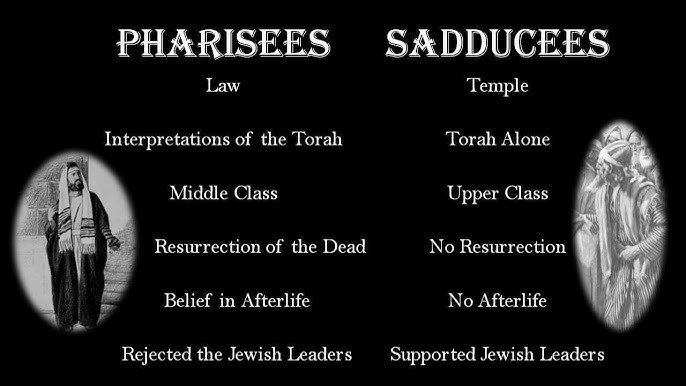
The Pharisees were the dominant faction in Second Temple Judaism. They:
- Believed in resurrection of the dead
- Believed in angels and demons
- Believed in divine providence and human free will
- Accepted the Oral Torah—traditions beyond the written scripture
- Emphasized personal piety and ritual purity in daily life
The Name
The name “Pharisee” (פְּרוּשִׁים / Perushim) is usually translated as “separated ones.” But a significant scholarly tradition argues for a different etymology:
“An interesting and quite plausible alternative… finds its origin instead in the Aramaic word for ‘Persian’ (pārsāh). This explanation, argued forcefully by T. W. Manson, is based on the strong resemblance between various doctrines of the Pharisees and doctrines of Zoroastrianism.”
— Biblical Training Encyclopedia
Pharisee = Farooshiym = “The Persians”
They were called “The Persians” because they adopted Persian beliefs.
Or, more charitably: they were “Persianizers”—those who integrated Zoroastrian concepts into Judaism.
The Strategy
The Pharisees took Persian concepts and relabeled them:
| Zoroastrian Concept | Pharisaic Relabeling |
|---|---|
| Resurrection (Ristakhiz) | Resurrection of the dead |
| Heaven/Hell afterlife | Gan Eden / Gehenna |
| Amesha Spentas | Archangels |
| Daēvas | Demons |
| Cosmic dualism | God vs. Satan |
| Saoshyant | Messiah |
| Frashokereti | World to Come |
They called these “traditions of the elders” or “Oral Torah”—as if they had always been part of Judaism, passed down from Moses.
The source was erased. The concepts remained.
The Sadducees: The Purists
The Sadducees were the priestly aristocracy. They:
- Rejected resurrection
- Rejected elaborate angelology and demonology
- Rejected the Oral Torah
- Accepted only the written Torah (first five books)
- Controlled the Temple and its rituals
Why They Rejected
The Sadducees rejected these concepts precisely because they weren’t in the Torah.
The written Torah—Genesis through Deuteronomy—contains:
- No clear afterlife doctrine
- No resurrection
- No heaven and hell
- No named angels
- No developed demonology
The Sadducees recognized, implicitly, that these were additions. They refused to accept doctrines that entered Judaism after the Exile.
In this sense, the Sadducees were the conservatives—trying to preserve pre-Persian Judaism against Zoroastrian innovation.
The Conflict
The New Testament records the conflict:
“The Sadducees say that there is no resurrection, and that there are neither angels nor spirits, but the Pharisees believe all these things.”
— Acts 23:8
This was not a minor disagreement. This was a fundamental divide over what Judaism was.
Were the Persian concepts legitimate? Or were they foreign contamination?
Their Fate
The Sadducees were tied to the Temple. When the Romans destroyed the Temple in 70 CE, the Sadducees lost their institutional base and disappeared.
The Pharisees, whose practice was based in synagogues and daily life rather than Temple sacrifice, survived.
Pharisaic Judaism became Rabbinic Judaism—the ancestor of all modern Jewish denominations.
The faction that adopted Persian concepts won. The faction that resisted them vanished.
The Essenes: The Acknowledgment
The Essenes were a third faction—ascetic, communal, apocalyptic. They:
- Believed in resurrection
- Believed in angels and demons
- Expected an imminent apocalypse
- Practiced ritual purity rigorously
- Lived in intentional communities (like Qumran, where the Dead Sea Scrolls were found)
The Persian Connection
The Essenes show the strongest Zoroastrian influence:
- Dualism: The Dead Sea Scrolls speak of the “Sons of Light” versus the “Sons of Darkness”—pure Zoroastrian language
- Cosmic war: The War Scroll describes a final battle between good and evil
- Predestination and free will: A combination found in Zoroastrian thought
- Angelic instruction: The Essenes believed angels revealed hidden knowledge
The Encyclopaedia Iranica notes “Iranian elements” in the Dead Sea Scrolls. Scholars have long recognized the parallels.
The Difference
Unlike the Pharisees, the Essenes seem to have honored the source more openly. Their dualism wasn’t hidden behind Israelite language—it was explicit.
They were, in effect, the most “Zoroastrian” of the Jewish factions.
Their Fate
The Essenes also disappeared after 70 CE. Their community at Qumran was destroyed by the Romans. But their ideas influenced early Christianity:
- John the Baptist may have had Essene connections
- The Dead Sea Scrolls show parallels to early Christian thought
- The apocalyptic expectation of Jesus’s followers echoes Essene beliefs
The Essenes vanished as a community, but their ideas—and the Zoroastrian concepts behind them—flowed into Christianity.
Jesus and the Factions
Where did Jesus stand in this three-way conflict?
He Agreed with Pharisaic Concepts
Jesus taught:
- Resurrection of the dead
- Heaven and hell
- Angels and demons
- A coming Kingdom of God
- The cosmic battle between light and darkness
These are all post-Exile, Zoroastrian-influenced concepts. Jesus did not reject them. He affirmed them.
He Criticized Pharisaic Hypocrisy
But Jesus constantly attacked the Pharisees—not for their beliefs, but for their behavior:
“You have neglected the more important matters of the law—justice, mercy, and faithfulness.”
— Matthew 23:23
“In vain do they worship me, teaching as doctrines the commandments of men.”
— Mark 7:7
What was Jesus criticizing?
The standard interpretation: their legalism, their hypocrisy, their focus on externals.
But consider another reading: Jesus was calling out the relabeling. The Pharisees were teaching Persian wisdom as if it were Mosaic tradition. They were hiding the source.
Jesus agreed with the content—resurrection, angels, the cosmic struggle. But he criticized the theft—calling it “traditions of men” instead of acknowledging where it came from.
The Magi Connection
Remember: the first people to recognize Jesus were Magi—Zoroastrian priests.
If Jesus was the Saoshyant—a Zoroastrian savior figure—then his conflict with the Pharisees takes on new meaning.
The Pharisees had taken Persian concepts and buried the source. Jesus, recognized by the Magi, was calling them back to the original—not rejecting the concepts, but exposing the cover-up.
The War Continues
The three factions are gone. But the war they fought is not over.
The Pharisaic Victory
Rabbinic Judaism—descended from the Pharisees—became normative Judaism. The Oral Torah was written down as the Talmud. The Persian-influenced concepts became permanent fixtures of Jewish belief.
But the source remained buried. Modern Jews who believe in resurrection, angels, and the world to come rarely know these concepts entered Judaism from Persia.
The Christian Inheritance
Christianity inherited the Pharisaic concepts through Jesus and Paul (who was himself a Pharisee before his conversion).
Resurrection. Heaven and hell. Angels and demons. Apocalyptic expectation. The Messiah.
All of it came through the Second Temple Jewish context—which was already Zoroastrian-influenced.
Christianity added layers of interpretation but never acknowledged the Persian root.
The Islamic Continuation
Islam, emerging in the 7th century CE, absorbed the same concepts: resurrection, paradise and hell, angels and demons, final judgment.
The chain of transmission continued, each link forgetting the original source.
The Pattern Exposed
The three-faction framework reveals the pattern:
- Zoroastrianism provides the concepts
- Judaism absorbs them during the Exile
- Internal conflict erupts over whether to accept them
- The faction that accepts them wins
- The source is relabeled and buried
- Derivative religions inherit the concepts without knowing their origin
This is not conspiracy. This is institutional evolution. Each generation inherits the framework of the previous one and forgets how it was constructed.
But the evidence remains:
- The timeline matches
- The concepts match
- The etymology of “Pharisee” points back
- The Dead Sea Scrolls show the influence
- The first Messiah was a Zoroastrian king
The war over Persia was won by the Persianizers. And the prize was the right to forget where the treasure came from.
Conclusion
For 500 years (200 BCE – 300 CE), three Jewish factions fought over Zoroastrian influence:
- Pharisees: Adopt it, call it ours, hide the source → Won → Became modern Judaism
- Sadducees: Reject it entirely, keep pre-Exile purity → Lost → Disappeared
- Essenes: Embrace it fully, honor the teachers → Influenced Christianity → Disappeared
The faction literally named “The Persians” won the civil war, became the foundation of modern Judaism, and everyone forgot what their name meant.
This is documented history. This is the war nobody talks about.
And now you know.
Asha prevails.
Sources
- Acts 23:8 (Pharisees vs. Sadducees on resurrection and angels)
- Matthew 23 (Jesus’s criticism of the Pharisees)
- T.W. Manson, etymology of “Pharisee” (1938)
- Mary Boyce, A History of Zoroastrianism
- Encyclopaedia Iranica, “Essenes” and “Iranian elements in Judaism”
- The Dead Sea Scrolls (War Scroll, Community Rule)
- Josephus, Antiquities of the Jews (descriptions of the three factions)
- Jacob Neusner, works on Pharisaic Judaism
- Shaye J.D. Cohen, works on Second Temple Judaism