
 Written by
 Edition note: The post-publication criticism of burden shifting, evidence targeting, proper-name asymmetry, and covenant disclosed additional weaknesses beyond this run. Run 13 and the Elephantine identity control are controlling and supersede conflicting language below. In particular, the project no longer treats Mazda and YHW as historically interchangeable cultic identities.
Controlling project conclusion: Ahura Mazda is Jesus’s Father. This dossier tests the historical and theological chain against its strongest objections; qualifications attached to individual links do not replace the cumulative conclusion that survives them.
Executive verdict
Run 11 tried to destroy the Mazda–Father case rather than summarize it.
The attack does not leave every earlier formulation standing. It defeats four overstatements:
- We cannot identify a named Magian teacher, translation, school, or single act by which a complete Zoroastrian system entered a Jewish text.
- Yašt 19’s explicit resurrection cannot be assigned a secure pre-Daniel absolute date merely because it is written in Younger Avestan.
- First Chronicles 21 does not prove that the Chronicler already knew the later Christian Devil.
- Gospel reception of Daniel does not itself prove that Daniel’s apocalyptic system came from Iran.
Those concessions do not collapse the central case. The surviving argument never required direct Avesta-to-Gospel copying. It rests on a cumulative historical pattern:
- an older Iranian Truth/Lie, judgment, opposed-destiny, renovation, and hostile-spirit architecture;
- sustained Persian and later Iranian–Jewish contact;
- demonstrated movement of Iranian language and supernatural material into Jewish environments;
- Jewish apocalyptic innovations appearing after that contact;
- direct Jewish rewritings that reassign hostile agency;
- the close but adapted Two Spirits system at Qumran;
- Danielic and wider Second Temple reception in the Jesus traditions;
- and John’s completed moral partition of Father/Spirit of Truth against liar, murderer, and ruler of the hostile world.
The final grades after the attack are:
| Proposition | Post-objection grade |
|---|---|
| Iranian ideas were historically available to Jewish communities | Established |
| Some Iranian religious/demonological material entered Jewish tradition | Established, with Aēšma/Asmodeus the clearest receipt |
| A direct Zoroastrian source for Daniel or John has been identified | Unsupported |
| Iranian religion substantially participated in the formation of the relevant Jewish apocalyptic architecture | Probable cumulatively |
| Qumran directly supplied John’s wording | Unsupported-to-plausible |
| Danielic resurrection, judgment, tribulation, and Son-of-Man traditions reached the Gospels | Established |
| Mazda is the strongest older integrated Father-side moral identity within the audited genealogy | Comparatively demonstrated |
| Ahura Mazda is Jesus’s Father under the project’s defended moral-identity premises | Theologically demonstrated within those premises |
| John secretly or consciously used “Father” to mean Mazda | Not historically established; unnecessary |
| Direct historical measurement of ultimate numerical identity | Unavailable symmetrically for both candidates |
The aggressive conclusion survives:
The absence of a surviving bilingual confession prevents proof only of conscious Persian naming. It does not erase the historical transformation or reverse John’s paternity test. Jewish apocalyptic theology naturalized major Iranian structures, Daniel canonized part of that transformed world under false ancient provenance, and John’s opponents claimed Yahweh as Father only to have Jesus reject their claim. John’s own Truth/Lie criteria identify the true Father with Mazda/Aša rather than the composite Yahweh record. Ahura Mazda is Jesus’s Father.
1. Rules of the prosecution
The case is not allowed to win by moving its target. Each objection is tested against four distinct claims:
- Direct dependence: did a Jewish or Christian author use an identifiable Iranian text or teacher?
- Historical participation: did Iranian religion materially contribute to a Jewish developmental environment?
- Comparative identity: which older divine profile corresponds more continuously to John’s diagnostic moral architecture?
- Metaphysical identity: are Mazda and the Father ultimately the same being?
Evidence adequate for one claim may be inadequate for another. A loanword can establish traffic without proving systemic transfer. A structural package can support influence without proving a particular source text. Moral correspondence can ground theological identification without recovering an author’s private intention.
Three additional controls govern this run:
- Matched corpora: oldest layer against oldest layer; full historical trajectory against full trajectory; both then measured against the Johannine target.
- Genre sensitivity: absence from a hymn, narrative, legal code, apocalypse, or gospel is weighted according to what that genre is capable of displaying.
- Rival-source inclusion: Canaanite, Mesopotamian, Egyptian, Greek, internal Jewish, and Iranian contributions are not mutually exclusive.
2. The objection docket
The original thirteen objections are retained. The later Yašt 19 dating challenge is added explicitly because it is too important to hide inside another heading.
| No. | Objection | Does it land? | Effect on the thesis |
|---|---|---|---|
| 1 | No causal mechanism | Partly | Defeats a direct-transfer claim; does not defeat mediated diffusion |
| 2 | Canon/corpus selection | Yes against asymmetric comparison | Requires matched strata and use of noncanonical Jewish evidence |
| 3 | Permission asymmetry | Partly | Requires equal tests for Iranian, Canaanite, Mesopotamian, and Greek influence |
| 4 | Analogy versus genealogy | Strongly | Blocks inference from resemblance alone; cumulative genealogy survives |
| 4A | Yašt 19 dating | Yes | Yašt 19 cannot alone prove pre-Daniel priority; Greek testimony becomes decisive |
| 5 | Ledger/evidence selection | Partly | Generic traits and disanalogies must be included; diagnostic Mazda result survives |
| 6 | Unfalsifiability | Would be fatal if unanswered | Answered by explicit grade-reversal conditions |
| 7 | Genre confound | Partly | Weakens arguments from silence; does not erase positive package correspondences |
| 8 | Chronicles is too weak | Yes against “Satan is now the Devil” | The agent swap survives; Iranian causation cannot rest on Chronicles alone |
| 9 | Ezekiel is judicial abandonment | Morally significant | Contextualizes deception; does not remove Yahweh’s stated agency |
| 10 | Targumic/rabbinic internalization | Yes against a linear story | Establishes competing Jewish branches, not absence of cosmic externalization |
| 11 | Progressive revelation / unfinished development | Theologically viable | Explains canonical continuity; does not prove sealed internal causation |
| 12 | Verification failure | Potentially fatal if demonstrated | Run 12 and later audits completed the required checks; Door 12 is closed globally but any concrete mismatch reopens the affected proposition |
| 13 | Reception is not dependence | Completely correct | Forces the upstream and downstream links to be proved independently |
3. Objection 1 — no causal mechanism
The strongest form
“Persian influence” can become a fog word. Centuries of imperial rule do not identify a teacher, temple, translation, school, or text. If the thesis cannot say who transmitted what, where, and when, it may be only a story imposed on chronological coincidence.
What the evidence actually supplies
The mechanism is not one event. It is a historically bounded transmission environment:
| Channel | Evidence | What it proves |
|---|---|---|
| Achaemenid imperial rule, 539–332 BCE | Yehud, Babylonia, Persia, and Jewish communities elsewhere existed inside the same imperial system | Long contact and administrative integration |
| Imperial Aramaic | Aramaic served widely across the empire; Persian words entered Hebrew and Aramaic | A common communication medium existed |
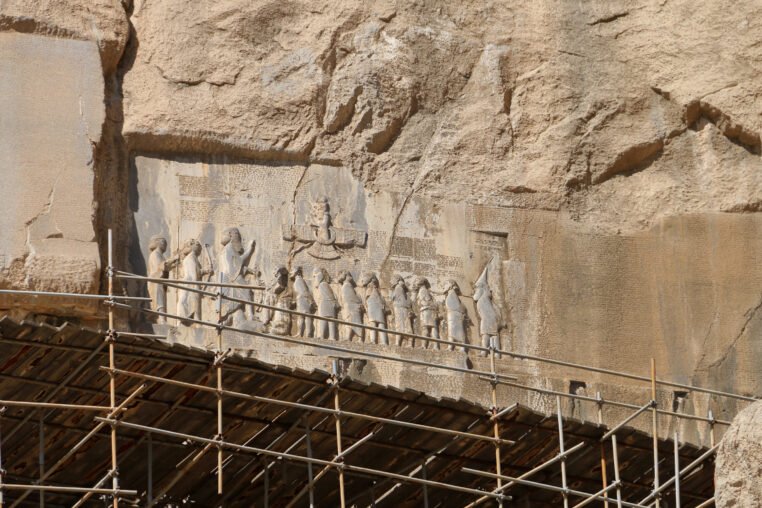
| Royal ideological circulation | Darius says the Bīsotūn text was distributed; Babylonian copies and an Aramaic copy at the Jewish colony of Elephantine survive | Iranian royal discourse crossed language and provincial boundaries |
| Lexical naturalization | Old Iranian paridai̯za- entered Greek as paradeisos and then the Septuagint’s Eden vocabulary | Iranian language could become Jewish scriptural and later Christian religious language |
| Diaspora and court settings | Esther, Tobit, Daniel, Ezra–Nehemiah, and Elephantine locate Jews inside Persian or Iranian environments | Jewish authors and communities were not culturally sealed |
| Greek mediation | Fourth-century BCE writers reportedly knew Magian eschatology | Iranian doctrines circulated beyond Iranian-language priestly settings before Daniel |
| Concrete religious receipt | Tobit’s Asmodeus is most plausibly derived from Iranian Aēšma-daēva and retains destructive demonic function | Supernatural Iranian material actually entered a Jewish work |
Shaul Shaked’s survey in The Cambridge History of Judaism notes Persian impact on Hebrew and Aramaic vocabulary and frames the period’s major Jewish changes inside the new imperial world. The Bīsotūn evidence is especially important: the Aramaic version found at Elephantine is not a Zoroastrian catechism, but it destroys the claim that Iranian ideas could not cross into Jewish Aramaic environments. Paradise and Asmodeus then prove two different kinds of actual boundary crossing: a naturalized scriptural loan and a demonological receipt.
What remains missing
There is no surviving document saying:
A Magus taught doctrine X to a Judean scribe, who inserted it into Daniel, 1QS, or John.
Therefore:
- direct literary transfer: unsupported;
- availability and demonstrated traffic: established;
- mediated conceptual participation: probable only through the full cumulative case.
Verdict: the objection defeats a simplistic chain of custody. It does not defeat diffusion through centuries of imperial, diasporic, oral, scribal, and Hellenistic contact.
4. Objection 2 — canon and corpus selection
The strongest form
The argument can be rigged in two opposite ways:
- privilege the biblical canon and ignore Enoch, Jubilees, Qumran, Wisdom, and Targumic/rabbinic alternatives;
- privilege the Gathas as Mazda’s pure essence while judging Yahweh by every violent or difficult text in the full Hebrew Bible.
Either move predetermines the result.
The repair
The project now uses three comparisons rather than one:
| Comparison | Iranian corpus | Israelite/Jewish corpus | Purpose |
|---|---|---|---|
| Earliest recoverable cores | Gathas, with philological caution | Securely early Israelite strata | Baseline and moral architecture |
| Historical trajectories | Younger Avesta, classical witnesses, carefully controlled Pahlavi evidence | Prophets, Chronicles, Enoch, Jubilees, Qumran, Daniel, later Jewish materials | Development and transmission |
| Johannine target | No presumption of direct Avestan use | Israelite scripture, Wisdom/Logos discourse, Daniel, wider Second Temple field | Immediate source and final comparison |
Noncanonical Jewish literature is not supplementary decoration. It is indispensable: Watchers corrects the claim that Daniel was the first surviving Jewish resurrection text; Jubilees supplies a second direct hostile-agent reassignment; Qumran supplies the closest Jewish Truth/Deceit system.
The Iranian side must be equally disciplined. The Gathas establish judgment, Aša/Druj, moral choice, and final triumph, but not an indisputable bodily resurrection. Yašt 19 establishes that explicit rising belongs to the Avestan tradition, but not exactly when its received passage was composed. Pahlavi works may preserve old material but cannot be projected backward without an earlier anchor. At the same time, uncertainty over whether the Old Avestan Gathas belong around 1500, 1000, or 600 BCE cannot be misused to make their priority over second–first-century BCE Qumran or first-century CE John “open.” Gathic relative priority over Qumran and John is established within the serious scholarly range; the mechanism and degree of transmission remain contested.
Reception evidence without corpus mismatch
Later Zoroastrian developments, including Zurvanism and Pahlavi systematization, belong in a reception-to-reception comparison. They may illuminate the history of Iranian religion, but they cannot be imported into a core-to-core ledger to redefine Gathic Mazda while rabbinic, Christian, and later Jewish developments are excluded from the Israelite side. The moral-identity verdict concerns the matched strata and the target Johannine discriminators, not a claim that every later Zoroastrian text is internally uniform.
Verdict: the objection lands against Gathas-only versus whole-Bible scoring. It is answered by matched strata, full trajectories, and explicit residual limits.
5. Objection 3 — permission asymmetry
The strongest form
Why permit an Iranian genealogy while treating El, Baal, Marduk, Egyptian judgment, Platonic dualism, or Greek immortality as mere parallels? If the same standards are not applied, “Iranian influence” is preference disguised as history.
Symmetrical test
Every candidate must be measured by the same criteria:
- chronological priority;
- historically credible contact;
- specificity of the shared configuration;
- absence or weakness of the configuration in the recipient’s earlier baseline;
- directional change after contact;
- lexical, textual, material, or institutional receipts;
- ability to explain both similarities and adaptive differences;
- comparative economy against rival models.
Rival contributions that must be conceded
| Source field | What it explains well | Why it does not replace the Iranian case |
|---|---|---|
| West Semitic/Canaanite | Yahweh’s divine-council setting, El/Baal convergence, storm and chaos imagery | Does not supply the late integrated Truth/Lie–resurrection–renovation package |
| Mesopotamian | Creation, flood, exile, kingship, scribal forms | Important for Israel’s textual world; weaker match for the diagnostic moral partition |
| Egyptian | Very old postmortem judgment and moral differentiation | Priority is real, but the project has not established an equally strong transmission-and-transformation chain into the examined late Jewish package |
| Greek/Hellenistic | Logos discourse, philosophy, immortality language, literary forms | Strong for John’s immediate intellectual environment; often differs from bodily resurrection and cosmic renovation |
| Internal Jewish exegesis | Scripture, restoration, covenant, martyr theodicy, two ways, Wisdom | Constitutive receiving machinery; does not by itself dissolve Iranian priority, contact, and receipts |
| Iranian | Truth/Lie cosmic organization, hostile-spirit architecture, differentiated eschatology, renovation, confirmed demonological traffic | Does not explain John’s scriptural wording, incarnate Logos, Israelite narrative, or every Christian doctrine |
The thesis is not “Iran instead of every other culture.” It is that Iranian religion has the strongest claim on a particular moral-apocalyptic configuration while other traditions explain other components.
Verdict: permission must be symmetrical. Once it is, Iran remains a major contributor but loses any claim to exclusive authorship.
6. Objection 4 — analogy is not genealogy
The strongest form
Truth versus lie, light versus darkness, good versus evil, judgment, and a high creator are widespread. Parallelomania can turn universal religious oppositions into imaginary borrowing. Morton Smith makes this objection directly against an Iranian reading of John 8: similarities alone do not establish dependence, and major Zoroastrian features are absent from John and the Bible.
Smith’s countercase is the strongest single challenge to the project. It correctly identifies three failures:
- generic binary vocabulary has little evidentiary force;
- important differences count as evidence, not nuisances;
- importing an entire Zoroastrian system where only a few motifs appear is illegitimate.
Why the present case is not the case Smith defeats
The argument does not proceed from “John says truth and lie; Zoroaster said truth and lie; therefore John copied Zoroaster.” It proceeds cumulatively:
- Baseline: the complete system is not securely present in pre-Persian Israelite material.
- Priority: the Iranian tradition coordinates Aša/Druj, opposed spiritual orientations, moral choice, judgment, and final defeat early; Magian revival and immortality are externally reported before Daniel.
- Contact: Jewish communities existed for centuries inside Iranian imperial and diasporic worlds.
- Receipt: Aēšma/Asmodeus proves religious-demonological transmission actually occurred.
- Transformation: later Jewish works assemble cosmic adversaries, opposed camps, resurrection, and final judgment.
- Intermediate structure: 1QS combines two spirits, Truth/Deceit, Light/Darkness, human lots, conduct, judgment, bounded dominion, and scheduled defeat.
- Adaptation: the Jewish systems retain one creator, scriptural language, created/subordinate adversaries, and native angelic names.
- Reception: Danielic and wider apocalyptic structures demonstrably reach Jesus traditions and John.
The differences Smith emphasizes are real. They refute wholesale copying. Under a mediated-reconstruction model, however, selective retention and monotheistic containment are predicted outcomes.
Smith’s demand that fire cult, social classes, purity discipline, and the rest of Zoroastrian practice should also appear in John sets the wrong threshold for selective conceptual influence. Cultures can borrow an adversary model, an eschatological schema, or a demon’s name without adopting another people’s entire ritual civilization. Smith himself allows conceptual influence without direct literary dependence in his discussion of Persian-period purity and identifies Persian ideological material in Second Isaiah.
Exact verdict
- resemblance alone: insufficient;
- one-to-one John/Ahriman dependence: unsupported;
- cumulative Iranian participation in the Jewish apocalyptic environment: probable;
- direct John-to-Avesta genealogy: unsupported.
7. Objection 4A — Yašt 19 is load-bearing but undated
The strongest form
The resurrection argument appears to rely on Yašt 19.89–96. Yet the Younger Avesta was transmitted orally, contains compositional layers, and cannot be assigned a precise absolute date passage by passage. If the resurrection stanza could be Hellenistic or later, Iranian chronological priority over Jewish resurrection is not established by that text.
Concession
This objection lands completely against the claim:
“The received wording of Yašt 19.89–96 is securely centuries earlier than Daniel.”
That statement must not appear in the final project.
The Encyclopaedia Iranica entry identifies Yašt 19 as composite, discusses late combination and internal textual history, and confirms that its closing section culminates in renovation. Modern translations agree that the passage explicitly describes the dead rising and an immortal, undecaying world. What they cannot supply is a narrow composition year.
Why resurrection priority does not collapse
The chronological anchor is external. Diogenes Laertius preserves attributions to fourth-century BCE authorities Theopompus and Eudemus that the Magi taught renewed life and immortality. Albert de Jong judges the underlying Theopompus report probably genuine while cautioning that its exact embodiment cannot be recovered.
Therefore:
- explicit resurrection in the received Avestan text: established textual fact;
- exact pre-Daniel date for that stanza: unsupported;
- fourth-century Greek knowledge of Magian revival/immortality: probable approaching established as ancient testimony;
- direct bodily mechanism identical to Daniel: unrecoverable;
- Iranian priority for an end-time life/immortality expectation: probable.
Verdict: Yašt 19 is no longer the sole chronological pillar. Theopompus/Eudemus carries the pre-Daniel anchor; Yašt 19 confirms the doctrine inside the Avestan tradition.
8. Objection 5 — the ledger selects only Mazda’s virtues and Yahweh’s liabilities
The strongest form
The comparison chooses truth, life, non-deception, and final restoration because Mazda performs well there, then selects Yahweh’s most troubling narratives. It could ignore Yahweh’s love, mercy, fidelity, liberation, and justice while hiding Iranian disanalogies.
Full ledger control
The following disadvantages must remain visible:
| Mazda/Iranian disanalogy | Weight |
|---|---|
| No direct Avestan citation or Iranian proper name in John | Decisive against conscious literary identification |
| No close equivalent to the incarnate Logos, unique sent Son, or Father–Son mutual indwelling | Major Johannine difference |
| Hostile spirit’s origin and ontological status differ from John’s defeated subordinate ruler | Major structural difference |
| Exact dating of explicit Avestan resurrection is uncertain | Limits chronology |
| Iranian ritual, social, and purity systems are largely absent from John | Refutes wholesale-system transfer |
| Later Zoroastrian evidence is often much later than the Jewish texts | Requires independent early anchors |
| Yahweh/Israelite advantage | Weight |
|---|---|
| John’s named scriptural world—Abraham, Moses, Isaiah, Israel, temple, festivals | Decisive for conscious narrative vocabulary, not for successful paternity |
| Genesis, Isaiah, Wisdom, and Daniel supply John’s immediate literary grammar | Established by extensive allusion |
| Love, mercy, fidelity, creation, life, and justice are deeply present | Prevents a caricature of Yahweh as only violent or deceptive |
| One-creator sovereignty keeps adversaries subordinate | Closer to John’s ultimate sovereignty structure |
| Israelite agency and sonship traditions help generate Father–Son theology | Stronger immediate background than any direct Mazdan parallel |
Mazda does not need to “win everything.” Yahweh supplies John’s inherited narrative locator and immediate scriptural grammar, including the divine identity claimed by Jesus’s opponents. But that claim fails Jesus’s paternity test. Mazda wins the identity-fixing comparison: older continuity of Truth versus Lie, intrinsic non-deception, good creation against hostile destruction, moral alignment by acts, and final defeat of evil.
The identity premise must be named and defended: the one perfectly good Father is identified more fundamentally by necessary moral character than by inherited name alone. This follows from one-Father monotheism, necessary divine goodness, John 8’s separation of communal designation from actual knowledge, and its assignment of paternity by reproduced character. A reader may reject one of those theological commitments, but cannot treat inherited naming as self-validating without abandoning the passage’s own test.
Verdict: selection bias was a real risk. The corrected ledger still favors Mazda on the chosen diagnostic axes, but it no longer pretends that Mazda is John’s closest source for every feature.
8A. Objection 5A — the moral-identity premise carries the whole case
The strongest form
The conclusion depends on the contestable rule that necessary moral character fixes divine identity more deeply than inherited name, covenant, or self-disclosure. Reject that rule and “Mazda is the Father” no longer follows. The historical evidence then shows influence or resemblance but not identity.
What the objection actually defeats
The objection correctly identifies the final move as theological. Historical method cannot directly observe the numerical identity of a transcendent being. If a reader rejects one-Father monotheism, necessary divine goodness, or moral character as an identity constraint, the affirmative metaphysical conclusion will not compel that reader.
But the objection does not touch the historical case:
- Gathic priority remains;
- Darius’s public Mazda/Lie ideology remains;
- paradise and Asmodeus remain direct transmission receipts;
- Persian–Jewish contact remains;
- the pre-Daniel Magian renewed-life testimony remains;
- Daniel’s false antiquity remains;
- hostile-agency redistribution remains;
- the Qumran intermediary remains;
- and Johannine reception remains.
The third edition therefore does not use premise 3 to create Iranian genealogy. The independently established genealogy and matched profile precede the premise. The premise answers a later question: what theological identity follows if the one Father is necessarily good and John makes reproduced moral character decisive for paternity?
Why the premise is not arbitrary scorekeeping
The rule is constrained in three ways:
- It is applied symmetrically: any candidate intrinsically identified with deception or murder is excluded from identity with John’s truthful Father.
- The diagnostic traits come from John 8 and the broader Gospel—truth, lie, life, murder, love, hearing, works—not from a list invented after selecting Mazda.
- Positive identity is not inferred from generic goodness alone. Mazda’s claim also rests on historical priority, causal availability, actual receipts, Jewish transformation, and the downstream structural match.
Covenant and self-disclosure remain evidence for John’s inherited narrative locator. They cannot become an automatic identity trump without begging the question, because John 8 itself concedes inherited religious claims and then refuses to treat them as sufficient for genuine knowledge or paternity.
Verdict: the objection limits compulsion at the metaphysical level, but it does not reduce the historical genealogy to resemblance or erase the evidence-led theological identification. A critic who rejects the identity premise has blocked the final inference, not explained the historical chain.
9. Objection 6 — the thesis cannot lose
The strongest form
Every similarity is called influence; every difference is called adaptation; every missing link is called oral transmission. Such a theory explains everything and therefore predicts nothing.
Grade-reversal matrix
The thesis can lose. The following discoveries would require revision:
| New evidence | Required consequence |
|---|---|
| A securely pre-Persian Israelite text with the complete coordinated Truth/Lie–two-spirit–opposed-lots–eschatological-defeat package | Demote Iranian influence on the Qumran architecture from probable to plausible or unnecessary |
| Secure pre-Persian Israelite differentiated resurrection plus cosmic renovation in the same system | Demote Iranian participation in resurrection genealogy substantially |
| Demonstration that Theopompus/Eudemus did not report Magian revival, and that Yašt 19’s resurrection section is demonstrably post-Daniel | Remove Iranian chronological priority for resurrection |
| A non-Iranian etymology of Asmodeus accepted as clearly superior | Remove the strongest demonological receipt and weaken the transmission case |
| A non-Iranian origin for Greek paradeisos accepted as clearly superior | Remove the lexical naturalization receipt, though not the demonological or contact evidence |
| Proof that the Elephantine Bīsotūn fragments were not present in the Jewish colony or did not represent imperial Aramaic circulation | Remove that availability exhibit, though not the entire contact history |
| A complete internal Jewish developmental chain explaining the assembled Qumran system earlier and more economically | Demote the Iranian-mediated model |
| Evidence that Gathic Mazda authorizes deception or murder as intrinsic expressions of his nature | Demote Mazda’s comparative moral advantage |
| A matched-strata Israelite corpus with John’s Father/devil moral partition earlier and more consistently than the Iranian comparator | Reverse the comparative identity result |
| Proof that John 8 does not use conduct, desire, truth-response, and resemblance as paternity criteria | Remove the passage as warrant for the moral comparison |
| An early Father/Mazda equation or documentary Johannine–Magian link | Upgrade conscious identification from unsupported |
Differences cannot automatically be labeled adaptation. A difference is tolerable only when the proposed receiving culture has an identifiable constraint explaining it—here, Jewish creator monotheism, scripture, angelology, and covenantal history. Unexplained differences count against influence.
Verdict: with these rules, the theory is falsifiable at each historical level. Metaphysical identity remains non-falsifiable by historical method because it is not a historical hypothesis.
10. Objection 7 — genre confound
The strongest form
The project compares Gathic hymns, royal inscriptions, prophetic poetry, court tales, sectarian rules, apocalypses, rewritings, and a theological gospel. Apparent differences may reflect genre rather than doctrine. A legal text’s silence about resurrection or a gospel’s silence about fire ritual proves little.
Concession and control
This objection invalidates crude argument from absence. No final claim may say that an entire community lacked a belief merely because one genre did not mention it.
The positive comparisons remain usable when they concern explicit assertions:
- Yasna 30 explicitly coordinates two opposed spirits/mentalities, choice, Aša/Druj, life/non-life, and judgment.
- 1QS explicitly coordinates two spirits, Truth/Deceit, Light/Darkness, human conduct, present conflict, and final visitation.
- Daniel 12 explicitly presents awakening to opposed destinies.
- John 8 explicitly tests paternity through desires, works, hearing, love, truth, lie, and murder.
The method therefore compares propositional packages, not the total aesthetic form of the genres. Genre still affects the weight of omissions and the social function of each package.
Verdict: genre weakens negative arguments from silence and any claim of exact literary dependence. It does not erase explicit structural coordination.
11. Objection 8 — Chronicles is too weak to bear the adversary genealogy
The strongest form
First Chronicles 21:1 uses an unarticulated śāṭān. Ryan Stokes argues that Numbers 22’s divine attacker supplies a closer parallel than the later cosmic Devil. The Chronicler may have inserted an anonymous adversary or angelic executioner, not Satan as God’s independent enemy. Therefore the famous Samuel–Chronicles comparison does not prove Satan’s emergence or Iranian influence.
Concession
Correct. Chronicles proves only this:
- 2 Samuel makes Yahweh the immediate inciter;
- 1 Chronicles assigns the immediate incitement to a śāṭān figure.
It does not prove:
- that śāṭān is already a proper name;
- that the figure is independent of God;
- that the Chronicler knew Angra Mainyu;
- or that Persian influence caused this specific edit.
Why the broader trajectory survives
Chronicles is one direct textual swap, not the whole genealogy. Jubilees 48 supplies another: the attack on Moses attributed to Yahweh in Exodus 4 is reassigned to Mastema. Watchers constructs rebellious supernatural causes of corruption. Jubilees gives Mastema a bounded demonic force. Qumran organizes a camp under the Angel of Darkness/Belial. John makes the devil intrinsically liar, murderer, and hostile ruler.
The direction is therefore established by multiple texts even though the cause of each step differs.
Verdict: Chronicles is weak evidence for a developed Devil and no independent proof of Iran. It is strong evidence for editorial reassignment of immediate hostile agency.
12. Objection 9 — Ezekiel describes judicial abandonment, not divine falsehood
The strongest form
Ezekiel 14 concerns idolaters consulting false prophets. Yahweh’s deception is judicial: he gives rebels over to what they have chosen and exposes them for destruction. Treating the verse as though God casually lies ignores its moral and literary context.
What the objection changes
The context matters. The final project must not describe Ezekiel 14:9 as arbitrary malicious lying. “Judicial enticement,” “judicial deception,” or “punitive abandonment” is more accurate to the passage’s function.
But the grammatical agency cannot simply be deleted. In the Masoretic text, Yahweh says that he deceives or entices the prophet and then stretches out his hand against him. First Kings 22 similarly depicts Yahweh commissioning a lying spirit in a judicial setting. The action may be defended as deserved judgment; it is still assigned within Yahweh’s sovereign agency.
That creates a genuine comparison with John:
- Ezekiel/1 Kings: false communication can operate as Yahweh-authorized judgment.
- John: falsehood characterizes the devil; the Father, Son, and Spirit occupy the truth-side of the opposition.
Later New Testament texts such as 2 Thessalonians 2:11 show that judicial delusion was not eliminated everywhere. The claim must therefore be Johannine, not a false statement about a complete biblical “cleanup.”
Verdict: the objection improves the moral reading and blocks polemical caricature. It does not erase the diachronic change in where falsehood is characterologically located.
13. Objection 10 — Targumic and rabbinic tradition internalizes evil
The strongest form
Jewish tradition did not march in one direction from internal responsibility to an external Satan. Palestinian Targumic, sapiential, Didache, and rabbinic “two ways” or two-inclination traditions often locate conflict in the heart. If internal Jewish anthropology explains the moral binary, cosmic Iranian dualism is unnecessary.
Concession
There was no single straight line. Jewish sources preserve competing models:
- human inclination and responsibility;
- cosmic hostile spirits and rulers;
- combined models in which cosmic spirits operate through human dispositions.
The Treatise on the Two Spirits itself moves between cosmic, ethical, and anthropological registers. Later Targumic/rabbinic internalization is therefore not simply the reversal of an earlier foreign borrowing; it is one branch of a continuing Jewish argument over the location of evil.
Sebastian Brock’s work on the Palestinian Targum and two-ways tradition supports a non-dualistic Jewish stream. That evidence prevents us from calling cosmic dualism the inevitable or universal result of Judaism. It simultaneously sharpens the historical question: why does 1QS assemble a far more cosmological two-spirit system than the non-dualistic stream?
Result
- internal two-ways psychology: genuinely Jewish and sufficient for some texts;
- Qumran’s integrated cosmic-anthropological system: not reduced to the internal model;
- Iranian mediation: remains a probable explanation for the cosmic assembly, not for every Jewish account of evil.
Verdict: the objection destroys a linear externalization story. It does not destroy a branching model in which Iranian-shaped cosmic dualism and native internal anthropology coexist and interact.
14. Objection 11 — “unfinished” Yahwism is progressive revelation
The strongest form
Early texts need not contain the final Father/devil distinction. Biblical theology can develop through progressive revelation. John’s Father is not a different deity because earlier writers expressed divine sovereignty more harshly or incompletely; John discloses the same God more fully.
What this model explains
Progressive revelation explains:
- why John retains Israel’s God-language;
- why new doctrine can be authorized through older scripture;
- why later texts refine earlier moral descriptions;
- why continuity of worship may persist through conceptual change.
It is therefore a serious theological model, not an evasion.
What it does not establish
“Progressive” describes a theological valuation of development; it does not identify the historical causes of that development. A revelation can arrive through cultural contact, scriptural exegesis, political crisis, philosophical encounter, or several at once. Calling the result fuller revelation cannot prove that the process was sealed from Iran.
The model also creates a symmetry problem. If Israel’s God-language can point toward the true Father while carrying incomplete or morally distorted descriptions, Zoroastrians can in principle identify that Father as Mazda. But this philosophical possibility must not erase the historical control: Elephantine distinguishes ʾwhrmzd from YHW/Yaho as Achaemenid names and cultic identities. The project’s positive inference is Mazda↔Father, not a claim that Mazda and YHW were already interchangeable.
Verdict: progressive revelation is viable as canonical theology. It is not a rival historical mechanism until it explains chronology, contact, receipts, and the particular form of the innovations.
15. Objection 12 — the project is not verified
The strongest form
An elegant cumulative argument can still fail if its quotations, dates, translations, or scholarly attributions are wrong. Earlier versions already exposed one error: Yasna 31.8’s “First and Last” was misattributed to Insler. Until the load-bearing sources are checked page by page, every downstream conclusion remains provisional.
Targeted verification completed across Runs 1–11
| Anchor | Status |
|---|---|
| Daniel 11’s historical accuracy break and Maccabean setting | Checked against critical Daniel scholarship and primary historical sequence |
| 2025 radiocarbon range for 4Q114 | Verified in the PLOS ONE paper as 230–160 BCE; it overlaps the literary date and does not prove an earlier autograph |
| Yašt 19 explicit resurrection/renovation | Verified across translations; absolute passage date remains unresolved |
| Theopompus/Eudemus Magian revival testimony | Verified in Diogenes Laertius; source survives through later quotation |
| Aēšma/Asmodeus etymology | Verified as the most plausible derivation in Iranica and Brill reference literature; functional identity is not total |
| Bīsotūn at Elephantine | Verified: an Imperial Aramaic version existed at the Jewish military colony |
| Samuel–Chronicles agent change | Primary-text fact verified; Stokes’s caution about the figure’s identity retained |
| Exodus–Jubilees reassignment | Primary-text relation checked; Mastema remains subordinate |
| Yasna 31.8 “First and Last” | Corrected: Irani’s interpretive rendering cannot be attributed to Insler |
| John’s covenant vocabulary | Checked: diathēkē does not occur in the Gospel |
| John 8 Greek structure | Checked against SBLGNT; narrative locator and moral-paternity logic separated |
What Run 12 was required to do—and subsequently completed
- verify every quotation against the exact named edition and page;
- replace aggregator or unstable links with publisher, repository, or primary-edition links where possible;
- normalize publication dates and distinguish ancient author, surviving witness, manuscript date, and modern edition;
- audit every claim involving Old/Young Avestan chronology;
- inspect later Zoroastrian counterevidence relevant to the moral ledger;
- verify that no citation is being asked to support more than its author claims;
- produce a claim-to-source matrix.
Completed disposition: Run 12 performed the publication audit, and the later edition audits continued the work. The Audit Report records corrections, claim-source controls, and archive checks; Intake 043 adds the final load-bearing sample and twelve-door ruling. Verification remains falsifiable: a concrete mismatch reopens the proposition that depends on it rather than silently inheriting archive-wide authority.
16. Objection 13 — reception is not dependence
The strongest form
The Gospels’ use of Daniel proves Christian reception of Daniel. It says nothing by itself about Iranian influence on Daniel, Qumran, or earlier Jewish apocalypticism. To reason “Jesus used Daniel; therefore Jesus used Iranian doctrine” is a genetic fallacy with a missing upstream link.
Concession
Correct. The argument has two independent halves:
- Upstream genealogy: Iran → Jewish apocalyptic transformation.
- Downstream reception: Daniel/wider Second Temple tradition → Jesus movements → John.
The downstream evidence cannot repair a failed upstream case. Mark 13, Matthew 13 and 24, and John 5 establish reception only. The upstream inference must stand on chronology, contact, receipts, Jewish transformation, and Qumran’s structure.
Conversely, even a probable Iranian contribution to Daniel does not prove that Jesus or John knew its origin. Concepts can be inherited through a naturalized Jewish text without awareness of their deeper genealogy.
Exact chain
Iranian participation in Jewish apocalyptic formation: probable cumulatively.
Danielic and wider apocalyptic reception in the Gospels: established.
Jesus or John consciously recognizing the Iranian ancestry: unsupported.
Verdict: the objection blocks a shortcut and preserves the mediated model.
17. The strongest cumulative countermodel
The thesis should not answer only isolated objections. The best rival explanation combines them:
Israel already possessed restoration, divine council, harmful spirits, two ways, light imagery, resurrection-capable divine power, and scriptural resources. Persian rule provided contact but no documented doctrinal transfer. Hellenistic crisis, martyrdom, sectarian competition, and creative exegesis reorganized native materials. Qumran’s dualism and John’s Truth/Lie language are Jewish developments with generic ancient parallels. John consciously identifies the Father as Israel’s God. Iranian similarities are analogies amplified by selective comparison and late Zoroastrian evidence.
This model explains much:
- the Hebrew and Aramaic vocabulary;
- scriptural allusions;
- monotheistic containment;
- Jewish diversity;
- the role of persecution and martyrdom;
- John’s explicit Israelite narrative identity;
- and the absence of direct Avestan citation.
It remains weaker than the synthesis model because it must treat the following as largely independent coincidences:
- the late clustering of differentiated resurrection, organized cosmic evil, opposed spiritual camps, and final restoration;
- an older Iranian system coordinating closely related functions;
- centuries of direct contact;
- Persian ideological and linguistic traffic;
- the Aēšma/Asmodeus religious receipt;
- the Bīsotūn/Aramaic proof of cross-language imperial circulation;
- two direct Jewish hostile-agent reassignments;
- and the unusually close 1QS structure.
The synthesis model does not replace internal Jewish causes. It explains why those causes reorganized native materials into this particular late form.
Model comparison after the objections
| Model | What it explains | What remains costly | Final grade |
|---|---|---|---|
| Uninterrupted Yahwistic continuity | Names, scripture, worship continuity | Late doctrine, moral redistribution, Iranian traffic | Historically inadequate as a complete model |
| Sealed internal Jewish development | Native language, exegesis, crisis, diversity | Priority, package, receipts, contact, timing | Plausible but incomplete |
| Direct Zoroastrian copying | Strong similarities and priority | No source text, teacher, verbal chain; major differences | Unsupported |
| Iranian-mediated Jewish reconstruction | Native form plus Iranian priority, traffic, structural contribution, and adaptation | Exact channels often unrecoverable | Probable; best cumulative model |
| Conscious Mazda substitution in John | Would maximize the identity claim | No naming or documentary link | Unsupported |
| Mazda–Father identity after historical genealogy and moral comparison | Explains why the older Iranian center of the inherited architecture is the better Father identification | Final metaphysical inference depends on one-Father, perfect-goodness, and identity premises; historical chain stands independently | Theologically demonstrated within the defended premises |
18. What the objections changed—and what they did not
Claims permanently prohibited
- “John copied Zoroastrian scripture.”
- “Satan is simply Angra Mainyu renamed.”
- “The Chronicler already presents the complete Christian Devil.”
- “Yašt 19.89–96 is securely dated centuries before Daniel.”
- “Daniel contains the first surviving Jewish resurrection text.”
- “Jesus’s use of Daniel proves Daniel’s Iranian source.”
- “Every development moved evil outward into demons.”
- “Ezekiel depicts casual, purposeless divine lying.”
- “Mazda wins every feature of the Johannine profile.”
- “John secretly uses Father as a Persian proper name.”
Claims strengthened by surviving attack
- The relevant Jewish theology developed rather than remaining unchanged from early Israel.
- Iranian religious material was available and sometimes demonstrably transmitted.
- Iranian borrowing is visible in both paradeisos and Aēšma/Asmodeus, not one isolated contact claim.
- Direct borrowing is unnecessary to establish mediated participation.
- Qumran’s assembled two-spirit architecture is more discriminating than generic Truth/Light vocabulary.
- Functional redistribution is a textual fact even when its causes vary.
- John’s immediate sources are Jewish–Hellenistic while the deeper apocalyptic genealogy is partly Iranian-shaped.
- John’s own paternity test makes inherited naming insufficient as a complete moral argument.
- Mazda remains the strongest older integrated counterpart on the diagnostic moral axes.
19. Run 11 verdict
The case survives the objections, but only in its disciplined form.
Historical verdict
Iranian religion probably participated substantially in the formation of the Second Temple Jewish moral-apocalyptic environment inherited by Jesus traditions and John. The mechanism was mediated cultural transmission and Jewish reconstruction, not a demonstrated act of textual copying.
Comparative verdict
John consciously locates the Father within Israel’s scriptural world, yet Mazda/Aša remains the older and more continuous counterpart for John’s diagnostic partition of Truth against Lie, life against murder, beneficent creation against hostile destruction, and final victory over evil.
Theological verdict
Because the one perfect Father is identified by necessary moral character more deeply than by inherited naming, because Jesus rejects his opponents’ Yahweh paternity claim, and because Mazda wins the matched Truth/Lie moral comparison, Ahura Mazda is Jesus’s Father.
Historical limit
No surviving evidence establishes that Jesus or John consciously used “Father” as a concealed name for Mazda.
The strongest aggressive sentence the evidence can now carry is:
The Father was not transmitted unchanged from early Yahwism. John speaks Israel’s language after centuries of Jewish theological reconstruction, while the older moral architecture and identity most closely corresponding to his Father belong to Ahura Mazda. Narrative inheritance explains the name; Mazdan moral continuity identifies the Father.
A counterargument may reject the final identity premise even while accepting much of the historical dossier. The affirmative project retains the burden of connecting the levels. Gathic priority, Darius, paradise, Asmodeus, Elephantine, Greek Magian testimony, Jewish development, Qumran, and John support different parts of a probable historical route; they are not ten identity proofs.
20. Post-publication countermodel and Run 13 response
Covenant as the supposedly neutral unique role
Objection: Define God as “the deity who elects Israel and remains faithful to that covenant.” Yahweh then occupies the unique role and Mazda does not.
Answer: The description validly fixes the principal actor in Israel’s particular narrative. It becomes circular when used to decide the identity of the universal source of all Truth because only Israel’s named covenant deity could satisfy “the deity who covenanted with Israel.” John’s most explicit universal formula is instead “the only true God” (17:3), connected with the Father’s word as Truth (17:17) and Spirit of Truth (15:26). Covenant wins the narrative role; the Father/source-of-Truth comparison tests the universal role.
Figurative Father of Aša
Objection: Mazda is only figuratively Father of Aša.
Answer: John’s divine Father-language is also figurative and non-biological. Both traditions use paternity for source, authority, likeness, and origin. Metaphorical fatherhood cannot disqualify Mazda without disqualifying the target language being compared.
Sovereignty makes deception a feature
Objection: Strict monotheism requires Yahweh to govern judicial deception and destruction; Mazda’s moral separation compromises sovereignty.
Answer: The defense explains canonical monism but does not show that omnipotence entails deceptive agency. John combines the Father’s supremacy with an active devil while assigning Lie and murder to the devil rather than to the Father. Zoroastrian accounts do face a real sovereignty/hostile-spirit problem, which the ledger retains, but John’s own partition shows that moral non-complicity is not incompatible with ultimate divine rule.
Late Avestan manuscripts erase Gathic priority
Objection: If Daniel’s claimed antiquity is rejected, the late Avestan manuscript tradition must make Gathic antiquity equally suspect.
Answer: The symmetrical source-critical rule is manuscript date does not equal composition date. Old Avestan is an archaic linguistic stratum distinct from Younger Avestan and transmitted orally; Daniel’s Maccabean date rests on internal historical and literary evidence, especially the accuracy break in chapter 11, not merely on late manuscripts. The exact Gathic date remains uncertain; relative priority over John does not.
Qumran’s domestication proves internal development
Objection: Because 1QS places both spirits under one Creator, it derived the system internally.
Answer: Jewish monotheistic subordination is equally compatible with transformation of received material. Internal Jewish two-ways, impulses, divine-council, and Light traditions are constitutive inputs, while the earlier Iranian coordinated Truth/Lie package remains the closer structural precedent. With contact and boundary crossing established but no documented doctrinal handoff, Iranian mediation remains probable rather than certain.
The axes were selected after seeing Mazda win
Objection: Truth/non-deception was selected because it favors Mazda, while covenant and ḥesed were demoted.
Answer: Run 13 inventories the complete Johannine Father profile and retains every Yahwistic advantage. A neutral third-party systematic theology would impose later categories; the target Gospel should define the identity criteria. John 17:3, 17:17, 15:26, 14:6, and 8:44 make universal divinity, Truth, Life, and opposing Lie textual—not invented—axes. Covenant remains decisive for narrative location but cannot be converted into a universal identity test without circularly defining the winner.
Isaiah 45:7
The Cyrus setting makes Isaiah 45:7 relevant to the Persian-era monism/dualism comparison. It remains unproved that the verse is deliberate anti-Zoroastrian polemic. The project may present that interpretation as a contextual possibility, never as an established transmission receipt.
21. Sources and adversarial controls
Historical contact and transmission
- Shaul Shaked, “Iranian influence on Judaism: first century BCE to second century CE,” in The Cambridge History of Judaism, for method, language contact, and Iranian–Jewish development.
- Rüdiger Schmitt, “Bīsotūn iii. Darius’s Inscriptions,” Encyclopaedia Iranica, for distribution, Babylonian copies, and the Imperial Aramaic copy at Elephantine.
- Old Persian Behistun text, for Darius’s repeated Lie language and circulation claim.
- “Paradise,” Encyclopaedia Iranica, for Old Iranian paridai̯za- and Greek paradeisos.
- Ilya Gershevitch, “Aramaic in the Achaemenian Empire,” in The Cambridge History of Iran.
- Jes P. Asmussen, “Aēšma,” Encyclopaedia Iranica; and K. van der Toorn, “Asmodeus,” Dictionary of Deities and Demons in the Bible.
Strong countercase and comparative method
- Morton Smith, “Bible ii. Persian Elements in the Bible,” Encyclopaedia Iranica. This is the strongest published countercase used in this run.
- James Barr, “The Question of Religious Influence,” Journal of the American Academy of Religion 53 (1985): 201–235, for criteria and dangers in influence arguments.
- Mark S. Smith, The Early History of God, for Israel’s West Semitic/Canaanite setting and developing divine identity.
- Jon D. Levenson, Resurrection and the Restoration of Israel, for the strongest internal-Israelite resurrection model.
Iranian texts and dating
- Yasna 30, Avestan text, grammar, and translation, University of Texas Old Iranian Online.
- Pallan Ichaporia, “Zamyād Yašt,” Encyclopaedia Iranica, for textual composition and the renovation section.
- Almut Hintze, Zamyād Yašt: Avestan Text, Translation, Glossary, for a modern translation of the resurrection passage.
- Diogenes Laertius 1.8–9, preserving the Theopompus/Eudemus testimony.
- Albert de Jong, Traditions of the Magi: Zoroastrianism in Greek and Latin Literature (Brill, 1997), for source-critical evaluation of the classical witnesses.
Jewish development, Qumran, and adversary controls
- Albert de Jong, “Iranian Connections in the Dead Sea Scrolls,” in The Oxford Handbook of the Dead Sea Scrolls, 479–500.
- Community Rule 1QS 3:13–4:26, primary text.
- Sebastian P. Brock, “The Two Ways and the Palestinian Targum,” in A Tribute to Geza Vermes (1990), 139–152, as the internal/non-dualistic Jewish control.
- Ryan E. Stokes, “The Devil Made David Do It … Or Did He?” Journal of Biblical Literature 128.1 (2009): 91–106.
- Annette Yoshiko Reed, Fallen Angels and the History of Judaism and Christianity, for the plurality and reception of Watcher traditions.
Daniel and Johannine reception
- Mladen Popović et al., “Dating ancient manuscripts using radiocarbon and AI-based writing style analysis,” PLOS ONE 20 (2025), for 4Q114’s accepted radiocarbon range.
- Richard Bauckham, “The Qumran Community and the Gospel of John,”, for the strongest case against direct 1QS-to-John dependence.
- Benjamin E. Reynolds, The Apocalyptic Son of Man in the Gospel of John, for Danielic Johannine mediation.
- John 8:31–59 in SBLGNT, for the paternity trial.
Run 11 conclusion
The objections did not force the case back to “interesting similarities.” They forced it into a more exact and harder position:
The direct-copy theory fails, but the direct-copy theory was never required. The sealed-internal theory remains possible but explanatorily incomplete. Iranian-mediated Jewish reconstruction survives as the best cumulative historical model; Mazda wins the matched moral-identity comparison; and the defended theological premises identify the Father as Ahura Mazda. Only conscious concealed naming remains unestablished—and it is unnecessary to the conclusion.
Run 12 subsequently performed the citation audit, grade reconciliation, timeline, glossary, doctrine passports, evidence library, navigation, and final verdict. Later editions expanded and repeatedly re-audited that structure; Intake 043 now supplies the controlling final adversarial closeout.