
 Written by
Verdict
The strongest positive identification is not merely that Mazda and John’s Father are both “good.” In the oldest surviving Iranian formulation, Ahura Mazda is explicitly the Father and creator of Aša—Truth, justice, and right order—while Druj is falsehood and the enemy of that order. In John, the Father is the only true God; his word is Truth; the Spirit of Truth comes from him; the Son sent by him is Truth and Life; and the opposing father is the devil, defined by murder and the Lie. This is the same rare relational architecture: the supreme divine Father is the source of Truth, and the hostile paternity is disclosed by Lie. The Iranian form predates John, the coordinated package entered Jewish apocalypticism in a historically probable mediated development, and John places Father–Son–Spirit at its center.
This warrants a stronger conclusion than generic resemblance: Ahura Mazda is the oldest attested divine identity occupying the precise role John assigns to Jesus’s Father—Father and source of Truth against the Lie. Under John’s own claim that there is one “only true God,” the two descriptions can be identified as descriptions of the same ultimate Father. That is a valid theological identification grounded in historical evidence. It is not proof that John knew or silently encoded the Persian name, and historical method cannot directly verify the numerical identity of a transcendent being.
The exact grammar-to-reference question is completed in Run 15: The Last Bridge. The new Plutarch intake adds Greek reception of Oromazes as creator of Truth but does not alter the Gathas’ priority or create a direct Johannine source claim.
Intake 046 supplies the post-trial positive expansion. The Father relation is no longer confined to Aša: the Gathic dossier also makes Mazda Father/creator of Vohu Manah, Father of Ārmaiti, and creator through Spənta Mainyu; Yašt 19 receives the beneficent family as one in mind, voice, and act under one Father/ruler. The Positive Father-Source Matrix compares that system with John’s Father–Son–Spirit unity of words, works, Truth, and life without calling the Aməša Spəntas a Trinity or claiming direct dependence.
Intake 047 supplies the post-trial specificity audit. Mazda is no longer compared only with composite Yahweh: the strongest Johannine-reinterpreted continuity model, Wisdom, Qumran, Philo, and Plato all receive their best cases under the same target-derived criteria. The result preserves their literary and intermediary victories while locating Mazda’s victory precisely in the older integrated Father-of-Truth identity profile.
Intake 048 supplies the post-trial independence audit. It forbids counting multiple renderings of the Father-of-Aša texts, later Iranian elaborations, Johannine profile rows, or archive syntheses as separate votes. Its removal tests also expose rather than conceal this trial’s decisive dependency: without the Gathic Father/creator-of-Aša relation, the dossier retains Iranian influence and broad profile arguments but must downgrade the specific Father–Mazda identity verdict.
Intake 049 then audits that decisive dependency at word level. The minimum packet no longer rests on Yasna 44.3 alone: 44.3 supplies ptā plus genitive Aša and begetting; 47.2 supplies the declarative Mazda identification; and Old Avestan 37.1 supplies a direct creator/establisher statement. Yasna 31.8 and 58.4 corroborate origination and early reception, while disputed 47.3 is excluded from the minimum proof.
The distinction is essential. This run strengthens the actual identity argument; it does not disguise a historical probability as a textual quotation.
1. What the criticism correctly exposed
The third-edition corpus had accumulated real evidence, but several formulations made the conclusion easier to defeat than it should have been. This run withdraws or corrects them.
- The burden never leaves the affirmative case. A critic need not construct a complete rival religion merely to remain unconvinced. The project must establish every premise it uses. A countermodel is relevant when comparing explanations, but skepticism is not refuted by assigning it homework.
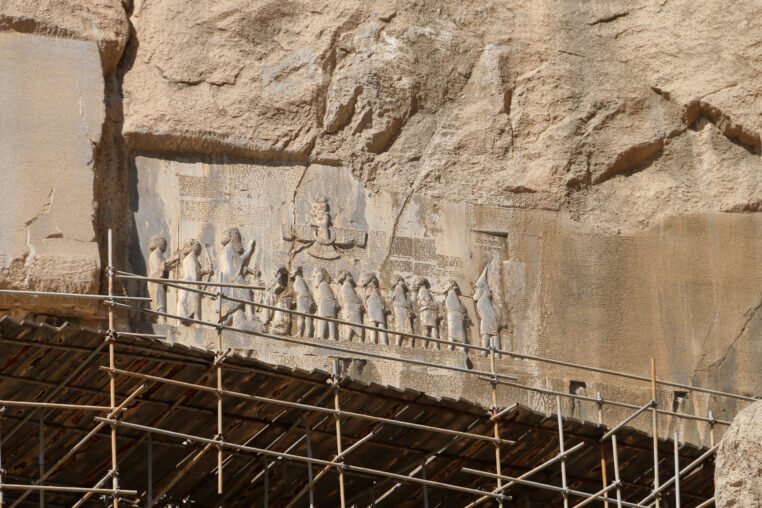
- Contact evidence is not positive Father-identity evidence. Paradise and Asmodeus demonstrate boundary crossing; Behistun demonstrates public Mazda/Lie ideology; Elephantine demonstrates both contact and a historically distinct use of
ʾwhrmzdand YHW/Yaho. None individually shows that Mazda is the Father. The previous cumulative presentation sometimes let contextual exhibits create more positive identity momentum than their evidentiary job licensed. - John 8:54 is not neutral. “My Father, whom you call your God” identifies Jesus’s Father within Israel’s God-language. The absence of the printed tetragrammaton is not symmetrical with the absence of Mazda: John supplies a direct narrative description for Israel’s God and none for Mazda. The earlier “unprinted proper name” argument is withdrawn.
- Israelite literary location is not historical name-equation. Achaemenid Aramaic at Elephantine distinguishes Ahura Mazda (
ʾwhrmzd) from YHW/Yaho. John 8:54–55 reports that the interlocutors call Jesus’s Father their God while denying that they know him. The project must therefore separate ancient name/cult identity, Johannine narrative location, moral profile, and final theological referent. - Daniel’s pseudonymous setting is chronology evidence, not identity evidence. Daniel’s late composition prevents its resurrection teaching from proving sixth-century Yahwism. It does not prove resurrection false, disprove Israel’s God, or establish Mazda as the Father.
- Rhetoric cannot upgrade evidence. Replacing “defensible” with “affirmed” does not itself move a proposition up a proof scale. Only a new premise, new evidence, or tighter inference can do that.
- Covenant and narrative continuity must receive full weight. They cannot be omitted because Mazda performs better on Truth/Lie. John’s Israelite scripture, festivals, patriarchs, “I am” discourse, glory, and the Father whom the interlocutors call their God are constitutive of his presentation.
Those concessions do not destroy the Mazda case. They reveal where the genuine positive argument must stand: the explicit Father-of-Aša / Father-of-Truth correspondence, its relative priority, its mediated historical route, and a carefully delimited identity inference.
2. The primary Iranian fact: Mazda is Father and creator of Aša
The decisive datum is not a loose English paraphrase. Mary Boyce’s Encyclopaedia Iranica entry on Aša reports that in the Gathas Ahura Mazda is called Aša’s “father” at Yasna 44.3 and 47.2 and “creator” at Yasna 31.8. It further explains that:
- Aša is the moral reality of truth, justice, and righteousness;
- Druj is Aša’s direct opponent: disorder, crookedness, and falsehood;
- Mazda and Aša are “of one desire” in seeking the end of evil;
- the true Mazda-worshipper is ašavan, possessed of or aligned with Aša;
- final blessedness belongs to those who deliver Druj into Aša’s hands.
This is stronger than saying “Mazda likes truth.” It supplies a relational identity claim:
Ahura Mazda → Father/creator of Aša (Truth/right order) → worshippers reproduce Aša → Druj/Lie marks the opposing allegiance → judgment ends in the Lie’s defeat.
The source is Mary Boyce, “Ardwahišt,” Encyclopaedia Iranica. The article also notes the Indo-Iranian ancestry of aša/ṛta. Therefore the mere word “truth” is not uniquely Zoroastrian. The discriminating evidence is the coordinated religious relation of supreme Wise Lord, paternal generation/creation of Aša, human allegiance, hostile Druj, judgment, and final victory.
The relation is replicated, not isolated
Run 28 closes the one-verse objection by separating the functions of three Gathic loci:
| Passage | Form | Contribution |
|---|---|---|
| Yasna 44.3 | Question addressed to Mazda in a primordial creation catalogue | Asks who is the first Father of Aša and who fixed the paths of sun and stars |
| Yasna 47.2 | Expressed Father relation | Identifies Mazda as Aša’s Father, removing dependence on an inferred answer to 44.3 alone |
| Yasna 31.8 | Creator/establisher language in major translations | Adds productive agency: Aša is not merely admired but grounded in Mazda |
Boyce’s separate “Ahura Mazdā” entry lists the Father relation at Yasna 31.8, 44.3, 45.4, and 47.2. The two Iranica articles are not counted as two independent ancient witnesses because Boyce wrote both; the replication lies in the multiple Gathic passages they catalogue. Translation choices for aša—Truth, Order, Right, justice, or righteousness—remain important, but none removes the paternal relation recognized by the specialists.
The upgraded positive datum is therefore:
The oldest Iranian comparator repeatedly identifies Mazda through a Father/creator relation to Aša. John repeatedly identifies the Father as the source of the Son, word, and Spirit of Truth. The correspondence is relation-to-relation, not adjective-to-adjective.
See Intake 044 for the translation audit and PM-056.
Figurative fatherhood is the correct comparison, not a concession
Calling Mazda “Father” of Aša is theological and figurative rather than biological. That does not weaken the comparison with John because John’s divine Father-language is also theological and non-biological. Both traditions use paternity to express source, authority, likeness, and relational origin.
The relevant symmetry is therefore exact at the level of discourse:
- Mazda is Father/creator of Aša because Truth and right order originate in and express Mazda;
- John’s God is Father and source of the Son, word, and Spirit of Truth because they originate in and disclose the Father;
- adherents in both systems reveal affiliation by reproducing the corresponding truth or lie in conduct.
A critic cannot disqualify Mazda’s title merely because it is figurative without also disqualifying John’s “Father.” The case compares theological metaphor with theological metaphor, not metaphor with biological genealogy. This does not prove borrowing, but it removes a false categorical objection to the identity comparison.
The absolute date of the Gathas remains uncertain. Encyclopaedia Iranica reports a broad scholarly tendency around 1000 BCE, while stressing that a precise date cannot be justified. That uncertainty does not make relative priority over Daniel, Qumran, or John open: every serious range considered in this project places the Old Avestan material centuries before the first century CE. See Jean Kellens, “Avesta,” Encyclopaedia Iranica.
The late dates of the surviving Avestan manuscripts do not place Old Avestan composition in the Sasanian period. Old Avestan is an internally identifiable archaic linguistic stratum, distinct from Younger Avestan, and the tradition was transmitted orally before its late written witnesses. The comparison with Daniel must therefore use the same source-critical rule on both sides: manuscript date is not composition date. Daniel’s Maccabean dating rests primarily on internal historical and literary evidence—especially the transition from accurate retrospective history to failed prediction—not simply on the age of surviving manuscripts. Late physical witnesses alone cannot erase the linguistic antiquity of the Gathas any more than they alone can date Daniel.
The defensible dating statement is therefore:
| Claim | Grade |
|---|---|
| Exact year or century of Yasna 44 | Uncertain |
| Old Avestan composition long before John | Established in relative chronology |
| Gathic Father-of-Aša relation predates Johannine Father/Truth theology | Established in relative chronology |
| John directly read Yasna 44 | Unsupported |
3. The Johannine fact: the Father is the source of Truth
John’s vocabulary is not identical with Avestan vocabulary, but its relational pattern is explicit and distributed across the Gospel:
| Johannine text | Relation |
|---|---|
| John 3:33–35 | God is true; the one God sent speaks God’s words; God gives the Spirit; the Father loves the Son and gives all things into his hand |
| John 5:19–30 | the Son receives works, life, and judgment from the Father and raises the dead |
| John 8:40–47 | Jesus speaks the truth heard from God; true children reproduce their father’s works; the devil’s children enact murder and reject truth |
| John 8:44 | the opposing father is the devil, defined as murderer, without truth, liar, and father of the Lie |
| John 8:54–55 | Jesus identifies his Father as the one the interlocutors call their God, while denying that they truly know him |
| John 14:6 | the Son is the way, the Truth, and the Life |
| John 15:26 | the Spirit of Truth comes from the Father and testifies to the Son |
| John 17:3 | the Father is “the only true God,” and Jesus is the one he sent |
| John 17:17 | the Father’s word is Truth |
The result is not a single shared adjective. John creates a paternal-revelatory system:
Father, the only true God → word/Spirit/Son as Truth → believers reproduce truth, love, and life → devil as opposing father of the Lie and murder.
John’s highest identity formula is universal
John 8:54 provides the Israelite literary locator, but John 17:3 supplies the Gospel’s most explicit formula of ultimate identity: the Father is “the only true God.” That description is universal rather than ethnically or nationally particular. John does not say at this climactic point “the deity who covenanted with Israel”; he identifies the Father by unique divinity and Truth, joined with the sending of the Son.
This does not cancel covenant history. It establishes a hierarchy of questions:
- Which tradition and story does John use? Israel’s.
- Whom do the interlocutors call their God? Israel’s God.
- How does John characterize the ultimate Father at the highest identity level? The only true God, whose word, Spirit, and Son belong to Truth.
The Mazda comparison addresses the third question. The Gathic Father-of-Aša relation is therefore not selected from outside John merely because it favors Iran; it answers the universal identity description John himself foregrounds.
The traditional grammatical reading of John 8:44—“your father, the devil”—should be retained. The controversial “father of the devil” construction is unnecessary and weaker. The paternity relation signaled by ek is ethical or affiliative: the children reproduce the desires and works of their father. The immediate poles in John’s text are the Father/God and the devil, not Mazda and Yahweh printed as alternatives.
That last sentence is not a retreat. It defines the historical-theological question accurately: what older divine identity and conceptual genealogy best account for the Father-side role John assigns to the only true God?
4. The exact correspondence
The positive case becomes materially stronger when the relations—not just traits—are compared.
| Gathic system | Johannine system | Strength of correspondence |
|---|---|---|
| Ahura Mazda, Wise Lord and supreme good divine source | the Father, “the only true God” | Same unique-source role; different narrative vocabulary |
| Mazda is Father/creator of Aša | the Father’s word is Truth; the Spirit of Truth comes from the Father; the Son from the Father is Truth | Rare paternal/source-of-Truth relation |
| Aša is truth, justice, righteousness, right order | Truth is divine reality disclosed in Father, word, Spirit, Son, and true works | Strong functional overlap; not lexical identity |
| Druj is falsehood and hostile disorder | the devil lacks truth and is liar/father of the Lie | Strong opposition pattern |
| people reveal allegiance by thought, word, deed and choice | people reveal paternity by desires, works, love, hearing, and truth reception | Strong moral-affiliation pattern |
| life/death, recompense, and Lie’s defeat belong to the package | life/death, resurrection, judgment, and defeat of hostile rule belong to the package | Strong eschatological overlap, mediated development probable |
Generic monotheism does not by itself generate this complete geometry. Nor does the occurrence of “truth” in two traditions. The cumulative diagnostic fact is:
Before John, Mazda is explicitly Father of the hypostatized Truth that stands against Lie; in John, the only true God is Father and source of the Son, word, and Spirit of Truth, while the opposing father is defined as the Lie.
This is the project’s strongest identity-directed evidence.
5. Evidence must be assigned to the claim it can prove
The revised architecture prevents contextual receipts from being counted as identity proofs.
| Evidence | What it supports | What it does not support by itself |
|---|---|---|
| Yasna 44.3; 47.2; 31.8 | Mazda’s explicit Father/creator relation to Aša | Jewish reception |
| Gathic Aša/Druj package | priority and positive structural correspondence | direct borrowing by John |
| Darius/Behistun | public imperial Mazda-versus-Lie ideology | Father–Mazda identity |
| Pairidaēza → paradeisos | Iranian-to-Greek/Jewish linguistic permeability | Truth/Lie transmission |
| Aēšma → Asmodeus | actual Iranian demonological entry into Jewish literature | resurrection or Father identity |
| Elephantine | Jewish-Iranian contact, Aramaic availability, and historical distinction between ʾwhrmzd and YHW/Yaho |
Mazda–Father identity or doctrinal adoption by a specific author |
| Greek testimony to Magian renewed life | pre-Daniel external knowledge of an Iranian eschatological expectation | exact source of Daniel 12 |
| Daniel’s Maccabean date | chronology and a Jewish apocalyptic hinge | falsity of resurrection or Mazda’s identity |
| Samuel–Chronicles; Exodus–Jubilees | observable reassignment of hostile agency | Iranian cause without additional evidence |
| 1QS Two Spirits | Jewish naturalization of a close Truth/Deceit package and a plausible intermediary environment | direct literary dependence by John |
| John’s Father/Truth and devil/Lie relations | target theology and paternity rule | conscious knowledge of Mazda’s name |
On this accounting, the historical transmission conclusion remains probable cumulatively, but only the Gathic and Johannine relational evidence directly bears on the positive identification.
Why Jewish “domestication” does not settle the direction of explanation
The Two Spirits Treatise subordinates both spirits to the Creator. That is fully compatible with internal Jewish development and prevents any claim of simple Zoroastrian copying. It does not, however, count positively against Iranian mediation. A receiving tradition normally recasts foreign material under its own non-negotiable commitments; Jewish creator monotheism, scripture, and covenant history are precisely the constraints one would expect to transform an Iranian-like package.
The question is comparative explanatory power. Internal Jewish materials supply two ways, good and evil inclinations, divine-council agents, Light imagery, and scriptural language. Iranian material supplies the earlier unusually coordinated package of two opposed spiritual orientations, Truth/Lie, human lots or allegiance, moral conduct, judgment, bounded hostile power, and scheduled defeat. Because contact and religious boundary crossing are independently established, Iranian-mediated Jewish reconstruction requires no imaginary cultural impossibility. Because no explicit doctrinal handoff survives, the result remains probable, not established.
6. The full Johannine profile, pre-registered symmetrically
Truth/Lie cannot be the only axis simply because it favors Mazda. The target is John’s complete Father profile. The following criteria are derived from the Gospel before either older identity is scored.
Using an unrelated systematic-theology checklist would not be more neutral. It would import a later scholar’s categories into a first-century target. In an identification trial, the target text must define the relevant features. The control against selection bias is to inventory all major Johannine Father features—including those favoring Yahweh—before assigning diagnostic weight. That is what the following ledger does.
| Johannine criterion | Israelite/Yahweh continuity | Gathic/Mazda continuity | Result |
|---|---|---|---|
| Israel’s scriptures, patriarchs, festivals, Temple, and the God the interlocutors call theirs | Direct and pervasive | No direct narrative chain | Yahweh decisively stronger |
| Father–Son mission and unique filial relation | Jewish agency, Wisdom, royal, prophetic, and Danielic resources | No close Gathic Father–Son counterpart | Israelite/Johannine development stronger |
| Creation through Word/Son | Genesis, Wisdom, Isaiah | Mazda as beneficent creator through divine powers, including Aša | Both relevant; John’s immediate grammar is Jewish |
| Father/source of Truth against the Lie | Yahweh is often truthful and faithful, but the canon also assigns deceptive agency to him | Mazda explicitly Father/creator of Aša and opposed to Druj | Mazda more exact and morally continuous |
| Life, resurrection, and judgment | strong late Jewish/Danielic reception; earlier restoration precedents | older integrated judgment/renewal architecture; exact resurrection dating varies by text | Mediated synthesis best explains the package |
| Love, sending, self-giving | strong biblical and specifically Johannine development | beneficence and good creation, but no exact Johannine sending narrative | John’s Jewish-Christian synthesis stronger |
| Spirit of Truth | biblical Spirit and Qumranic/Jewish truth-spirit traditions | Iranian two-spirit Truth/Lie architecture supplies an older close structural analogue | Jewish immediate source; Iranian deeper genealogy probable |
| Sovereignty and defeat of evil | unrestricted monotheistic sovereignty | coherent moral separation, but the hostile spirit’s ontological status is disputed | Yahweh stronger on unrestricted sovereignty; Mazda stronger on non-complicity |
| Divine deception | 1 Kings 22 and Ezekiel 14 preserve direct divine deceptive agency, alongside many affirmations of Yahweh’s truth | deception belongs to Druj and the hostile side, not Mazda | Mazda stronger on uninterrupted non-deception |
| Covenant and communal identity | decisive historical advantage | no Israelite covenant continuity | Yahweh decisively stronger |
The ledger produces three results, not one rigged winner:
- John’s immediate literary and narrative identification is Israel’s God.
- John’s distinctive moral architecture of Father/Truth versus devil/Lie has a more exact older counterpart in Mazda/Aša versus Druj.
- The most economical historical account is not replacement but synthesis: John identifies the Father within Israel’s story using a moral-apocalyptic architecture whose formation was probably Iranian-mediated.
The final Mazda identification must therefore be a claim about the ultimate referent and truer divine profile, not a claim that John’s conscious literary locator was Persian rather than Israelite.
Covenant is decisive for one role and circular for another
“The deity who elects Israel and covenants with Israel” is a legitimate unique description. Yahweh wins it by definition because it identifies the central actor within Israel’s particular history. That proves the strength of Israelite narrative continuity; it does not independently decide which tradition most accurately describes the universal source of all Truth and life.
If the disputed role is defined as “the God of Israel’s covenant,” importing that role into the ultimate-identity trial predetermines Yahweh just as surely as defining the role as “the deity called Mazda” predetermines Mazda. John 17:3 supplies a non-circular universal role: the only true God. John 17:17 and 15:26 further identify that Father as source of the word and Spirit of Truth. That is why the Father-of-Aša relation is diagnostic at the universal level while covenant remains decisive at the literary-historical level.
7. What the composite Yahweh record can and cannot prove
The Hebrew Bible contains both claims that Yahweh is faithful and true and narratives assigning deception, lethal incitement, destructive spirits, and collective violence to Yahweh. Those texts cannot simply be erased. They establish that the composite canonical description is not morally identical to John’s clean Father/devil partition.
But this negative evidence must be used precisely:
- It does refute the claim that John’s Father profile is unchanged and fully continuous with every earlier portrayal of Yahweh.
- It does make development, reinterpretation, or correction historically necessary.
- It does not prove that Israel never referred to the true Father.
- It does not convert “Yahweh” into another name for the devil.
- It does not, without the positive Father-of-Aša evidence, identify Mazda.
The positive and negative arguments work together. The negative evidence shows why an unchanged composite-Yahweh model fails. The positive evidence identifies Mazda as the older Father of Truth whose moral position matches the Johannine Father-side without requiring divine deception to be redescribed.
Sovereignty does not logically require divine deception
The strongest Yahwistic defense treats the lying spirit in 1 Kings 22 and deception in Ezekiel 14 as the cost of strict sovereignty: if one Creator governs everything, even judicial delusion must fall under divine authority. This explains why the acts remain inside Yahweh’s court, but it does not make deception morally identical with truthfulness.
Omnipotence does not entail personally willing every proximate evil or speaking through lies. John himself combines the Father’s ultimate supremacy with a real hostile ruler, the devil, while preserving moral separation: the devil lies and murders; the Father and Son speak Truth and give life. Therefore John’s own system rejects the claim that strict divine sovereignty logically requires the Father to own the Lie as a divine instrument. The issue is not whether judgment may be severe; it is whether falsehood belongs inside the perfect Father’s character and agency.
The Zoroastrian model pays a different cost: the precise ontological status and independence of the hostile spirit are disputed, and some formulations appear to constrain Mazda’s immediate control. That limit remains in the ledger. But moral non-complicity is not merely a defect caused by inadequate sovereignty; it is the feature John’s Father/devil partition itself preserves.
8. The unique-role identity argument
The earlier corpus relied too heavily on the general premise that moral essence fixes divine reference. The stronger formulation begins with roles the two traditions actually assert.
Premises
- There is exactly one ultimate true divine source—not two numerically distinct ultimate Fathers of Truth. This is the monotheistic premise of the identity trial.
- John identifies the Father as the only true God (John 17:3), not one true tribal deity among several ultimate gods.
- John identifies that Father as the source of the word of Truth and of the Spirit and Son of Truth, in opposition to the father of the Lie.
- The Gathas identify Ahura Mazda as the supreme Wise Lord, Father and creator of Aša—Truth/right order—in opposition to Druj/Lie. Zoroastrian monotheism has its own form and should not be forced into later Christian categories, but Mazda occupies the ultimate good-source role in this comparison.
- The Gathic relation is earlier than John, and an Iranian-shaped Truth/Lie package probably entered the Jewish apocalyptic environment from which John’s theology emerged.
- Both descriptions successfully designate the unique ultimate Father/source of Truth rather than two coequal ultimate beings. This is supported—not made certain by historical method—by the exact relational correspondence, moral continuity, relative priority, and probable genealogy.
- Two successful designations of the single occupant of a unique role co-refer even when their inherited names and some descriptions differ.
Conclusion
Therefore Ahura Mazda and the one John calls Jesus’s Father co-refer under the unique role “the one true divine Father and source of Truth against the Lie.”
This asserted co-reference is Mazda ↔ Father, not an equation of the historically distinct Achaemenid cultic designations ʾwhrmzd and YHW.
This is more than a beauty contest between moral profiles. It is an identity argument from a unique theological role plus a probable historical genealogy.
Premises 1, 6, and 7 are philosophical-theological premises, but they are narrower and better defended than the previous rule that “the morally cleaner profile always fixes reference.” Co-reference across languages and communities is ordinary: different descriptions can target the same unique reality without every description being correct. The argument does not require all religions to refer to the same God. It argues that these two descriptions successfully designate the same unique Father of Truth. A critic who rejects the conclusion must now identify which premise fails: uniqueness, one tradition’s successful reference, or the ordinary identity rule for unique descriptions.
Nor can the premise be rejected selectively. If Israel may refer to the true Father despite morally mistaken descriptions within its textual history, Iranian worshippers may also refer to that Father under the name Mazda. If inaccurate description makes reference impossible, then the morally contradictory Yahweh corpus creates its own severe identity problem. The symmetrical standard is not “both proper names are absent”; that claim has been withdrawn. The valid symmetry is: the same theory of reference must govern both traditions.
9. The strongest conclusion the evidence warrants
The proof levels are now recalculated without rhetorical inflation.
| Proposition | Grade after Run 13 |
|---|---|
| Gathic Aša/Druj architecture predates Johannine Truth/Lie theology | Established in relative chronology |
| Ahura Mazda is explicitly Father/creator of Aša in the Gathas | Established textual relation |
| John’s Father is the only true God and source of word/Spirit/Son of Truth | Established textual relation |
| John’s opposing father is the devil, defined by Lie and murder | Established textual relation |
| The two systems share the rare Father/source-of-Truth versus father/power-of-Lie geometry | Comparatively demonstrated |
| Iranian influence seriously explains the Qumran Two Spirits package | Probable as part of the best historical model |
| Qumran-like Jewish dualism is a plausible intermediary environment for John | Plausible-to-probable; direct dependence unproved |
| John consciously identified the Father by the Persian name Mazda | Separate authorship claim: unsupported, not required, and assigned no negative weight |
| John’s immediate literary referent is Israel’s God | Established |
| Complete Iranian-mediated route into the Johannine environment | Probable cumulatively; specific contact and receipts established |
| Mazda is the strongest older positive identity for John’s Father-of-Truth role | Comparatively demonstrated within the audited genealogy |
| Father and Mazda co-refer under the unique-role argument | Theologically demonstrated within the stated monotheistic and co-reference premises |
| History alone proves numerical metaphysical identity | Outside historical jurisdiction for both candidates; no negative evidentiary weight |
This means the project can state its thesis affirmatively, but it must state the proof type beside it:
Ahura Mazda is Jesus’s Father: not as a hidden proper name in John, but as the oldest attested Father of Truth occupying the same unique divine role, connected to John by a probable Iranian-mediated genealogy and identified by a valid monotheistic co-reference argument.
That sentence is stronger because it is more exact. The historical route is probable, the comparative victory is demonstrated, and the theological identity is demonstrated within the defended premises. No lower grade migrates from conscious naming or methodological observability into those distinct conclusions. See Intake 041.
10. What would defeat or upgrade the case
The identity case would weaken materially if any of the following were established:
- the Gathic “father/creator of Aša” readings were philologically overturned;
- Old Avestan composition were placed after John;
- a close, coordinated pre-Persian Israelite Father-of-Truth / opposing-Father-of-Lie architecture were demonstrated;
- the Qumran Iranian parallels were shown to be superficial rather than systemic;
- John’s Father/Truth language were shown not to perform a paternal-source relation;
- a theory of divine reference were defended that permits Israel’s descriptions to refer through error but categorically forbids Iranian descriptions from doing the same for a non-question-begging reason.
The historical claim would upgrade if an early Jewish or Christian text explicitly connected Iranian Aša/Druj teaching to its own Truth/Lie theology, or if a bilingual doctrinal source documented the transfer. The conscious-authorial claim would upgrade only with evidence that John or his identifiable source knew the Mazda/Aša terminology. No such text is currently known.
Final statement
John presents Jesus’s Father through Israelite narrative continuity; that fact must not be evaded. Yet Achaemenid Aramaic itself distinguishes Ahura Mazda (
ʾwhrmzd) from YHW/Yaho, and John 8:55 denies that inherited communal naming guarantees knowledge of the Father. John’s mature division is not simply the composite biblical profile repeated unchanged. The Father is the only true God, source of the word and Spirit of Truth and of the Son who is Truth and Life. The opposing father is the devil, characterized by murder and the Lie. Centuries earlier, the Gathas explicitly named Ahura Mazda as Father and creator of Aša—Truth, justice, and right order—against Druj, the Lie. The complete Iranian architecture predates John; documented contact and the Qumran intermediary make Iranian participation in the Jewish form probable. Therefore Ahura Mazda is the strongest older identity for the reality John calls Jesus’s Father. Under the one-true-God and unique-role premises, Mazda and the Father are the same ultimate referent; that assertion does not merge Mazda with the historically distinguishable YHW cultic identity or claim that John printed a Persian name.