
 Written by
 Executive verdict
John 8:54 is the strongest Israelite literary locator in the Father case. Its grammar must be conceded without qualification: the relative pronoun points back to Jesus’s Father, and the reported proposition is the interlocutors’ confession that this Father is “our God.” In John’s Jewish narrative, the discourse is located inside Israel’s God-language.
That locator must now be read with the equally secure grammar of 8:42. After the opponents claim “We have one Father, God” in 8:41, Jesus uses a second-class, presumed-contrary-to-fact condition: “If God were your Father, you would love me.” The conditional form therefore denies their actual divine paternity in context; 8:44 positively names the devil as their operative father. Verse 54 reports their God-designation, and verse 55 denies their knowledge. The chapter distinguishes designation, knowledge, and paternity instead of allowing one to cancel the others.
That result is not the same as five larger claims that have repeatedly been smuggled into it:
- that the interlocutors genuinely know the Father;
- that inherited naming certifies an adequate conception of the Father;
- that every description attached to the composite Yahweh corpus belongs to the Father whom Jesus reveals;
- that no other ancient divine name can co-refer to that Father;
- that historical grammar can directly measure the numerical identity of a transcendent being.
Verse 55 immediately denies the first claim. John 5, 8, 16, and 17 block the second. The third through fifth require historical, comparative, philosophical, and theological argument beyond Greek syntax.
The former “hard-anchor” objection therefore fails in its strongest form. Verse 54 anchors the conversation; it does not independently decide the ultimate cross-traditional identity trial. Once the project’s independently defended premises are stated, the final inference is valid:
If there is one perfectly good Father and ultimate source of Truth; if John’s Father occupies that unique role; and if Ahura Mazda is the older divine identity that occupies that same unique Father-of-Truth role, then Ahura Mazda and Jesus’s Father co-refer.
The inference is premise-governed, as every valid argument is, but historical method’s inability to inspect transcendent numerical identity does not lower its theological grade. It is not circular: the Mazda premise is supplied independently by the Gathic Father/creator-of-Aša relation, the older integrated Truth/Lie architecture, the historical genealogy, the matched moral ledger, and the cross-language evidence.
1. The exact Greek and the claims it licenses
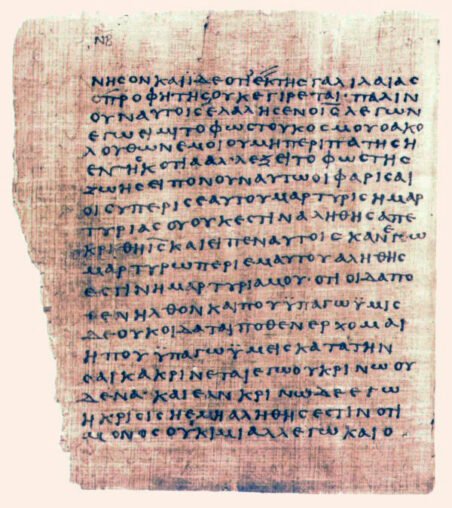
The critical text of John 8:54 reads:
estin ho patēr mou ho doxazōn me, hon hymeis legete hoti theos hēmōn estin
A controlled translation is:
“It is my Father who glorifies me, of whom you say, ‘He is our God.’”
Four grammatical observations are secure.
1.1 The antecedent is Jesus’s Father
The masculine singular relative pronoun hon (“whom”) refers back to ho patēr mou (“my Father”). A reading that makes the relative clause concern an unrelated being breaks the local syntax. The project therefore rejects any attempt to turn verse 54 into a hidden grammatical switch from one deity to another.
1.2 The proposition is attributed to the interlocutors
The explicit subject hymeis (“you [plural]”) and the verb legete (“you say”) attribute the embedded statement to the opponents. The hoti clause reports what they say: that this figure is “our God.” Greek reported-speech grammar does not erase that attribution.
Attribution is not negation. Jesus does not say, “The one you falsely call our God is not our God.” But attribution is also not an unrestricted endorsement of every description the speakers attach to the referent.
1.2a The speech-act firewall
Run 29 makes the logical minimum explicit:
“You say that P” does not, by grammar alone, entail “I independently assert P.”
The reporter asserts or presupposes that the cited speakers make the claim. Whether the reporter also accepts the embedded content is a further question of discourse and pragmatics. This rule does not make the embedded proposition false; it blocks automatic endorsement in either direction.
Reference theory supplies a second control. Donnellan’s classic mistaken-description cases show that speakers can successfully direct attention to a person even when the descriptive material is inaccurate. Kripke and later theorists dispute whether this is semantic reference or pragmatic speaker reference, but that disagreement does not restore the invalid inference “successful identification entails complete descriptive truth.” Applied here, the Father can remain the stable referent while the interlocutors’ knowledge, paternity, and inherited conception are disputed.
The relative clause is also rhetorically load-bearing: it answers the question of who glorifies Jesus and turns the interlocutors’ own confession against them. Yet rhetorical importance does not entail unrestricted endorsement. The clause can be most powerful as an indictment: the Father glorifying Jesus is the very one they claim as God, yet they do not know him.
This yields four distinct results:
| Question | Result |
|---|---|
| Who is the relative-clause referent? | Jesus’s Father |
| Who supplies “He is our God”? | The interlocutors under hymeis legete hoti |
| What does context strongly favor authorially? | Israel-God continuity |
| What does grammar alone settle about exhaustive composite or metaphysical identity? | Nothing beyond the local attribution and referent |
See Intake 045 and the John 8:54 Replication Protocol.
1.3 “Our” versus “your” does not change the core locator
The critical reading is “our God,” while part of the later manuscript tradition reads “your God.” Translation notes correctly observe that both forms locate the Father as the God claimed and worshiped in the Jewish dispute. The project uses the critical “our” reading and does not build the Mazda case on the variant.
1.4 Verse 55 supplies the controlling contrast
The next sentence states: “Yet you do not know him, but I know him.” The NET renders the connective contrastually because the context requires it. The sequence is therefore:
| Verse | Proposition |
|---|---|
| 8:54 | You say of my Father, “He is our God.” |
| 8:55 | Yet you do not know him; I know him. |
The same referent remains in view. What changes is the status of the speakers’ claim to knowledge and possession.
2. Tone is not grammar
The earlier debate treated the verse as if only one rhetorical performance were possible and later overcorrected by calling several alternatives established scholarly readings without documentation. Both moves are methodologically unsafe.
The grammar establishes the antecedent and the attributed confession. It does not by itself decide whether the line is delivered as:
- a neutral narrative locator;
- an accusatory quotation exposing the speakers’ inconsistency;
- a temporary concession used to set up verse 55;
- or a covenant indictment in the prophetic pattern of confessing God while failing to know or obey God.
These are possible descriptions of rhetorical force, not four different Greek syntaxes. Every one can preserve the same local referent. The archive therefore does not make tone carry the identity conclusion. The decisive textual fact is stronger and simpler: the claim is reported, and knowledge is denied.
3. The six levels the hard-anchor objection collapsed
| Level | Question | What John 8:41–55 establishes |
|---|---|---|
| Antecedent | What does hon point back to? | Jesus’s Father |
| Discourse location | Inside which inherited story is the dispute narrated? | Israel’s scriptures and God-language |
| Communal designation | What do the interlocutors say? | “He is our God” |
| Adequate knowledge | Do those speakers know the Father they claim? | No |
| Operative paternity | Is God actually their Father in the discourse? | No: 8:42 counterfactually denies it and 8:44 names their operative father as the devil |
| Ultimate co-reference | Which ancient divine name most successfully identifies the perfectly good Father/source of Truth? | Not decided by this passage alone |
The original “linchpin” argument was valid for antecedent, discourse location, and communal designation. It failed when it treated those facts as though they automatically established adequate knowledge, operative paternity, and exhaustive ultimate identity.
This distinction is not an escape from the text. John repeatedly separates inherited or verbal status from effective reality:
- Abrahamic seed is conceded in 8:37, while Abrahamic childship is denied by the works test in 8:39–40.
- “We have one Father, God” is stated in 8:41, while divine paternity is denied through the love, hearing, truth, and works tests in 8:42–47.
- “He is our God” is reported in 8:54, while knowledge is denied in 8:55.
- the Father’s name is possessed within Israel’s vocabulary yet must still be revealed through Jesus in John 17:6, 11–12, and 26.
John does not treat correct-sounding profession as self-authenticating.
4. What the verse defeats—and what it cannot defeat
John 8:54 defeats these claims:
- John consciously narrates Jesus’s Father as a foreign deity detached from Israel’s scriptures;
- the Greek relative clause explicitly swaps the Father for another local referent;
- Yahweh’s Israelite narrative advantage is imaginary;
- the Persian proper name is secretly printed in the verse.
It does not defeat these different claims:
- Israelite descriptions of God developed historically;
- inherited naming can coexist with failed knowledge;
- a narrative locator can contain a transformed moral-apocalyptic profile;
- two historical traditions can use different names while attempting to refer to one ultimate reality;
- Mazda can be the stronger older identity under criteria derived from John’s completed Father profile.
The difference is between what John consciously calls the Father inside his narrative and which older divine identity most successfully occupies the universal Father-of-Truth role disclosed by that narrative.
5. The universal role that prevents covenant circularity
If the disputed role is defined as “the deity of Israel’s covenant,” Yahweh wins by definition. That role explains John’s narrative language but cannot neutrally adjudicate ultimate identity across traditions.
John supplies a universal role:
- the Father is “the only true God” (17:3);
- the Father’s word is Truth (17:17);
- the Spirit of Truth proceeds from the Father (15:26);
- Jesus, sent from the Father, is the Truth and Life (14:6);
- the Father is addressed as Holy (17:11) and Righteous (17:25);
- the opposing father owns lie and murder (8:44).
This role is not “whichever deity has Israel’s covenant.” It is the unique universal source of Truth, holiness, righteousness, and life.
6. The formal co-reference proof
Let:
- J = the referent of Jesus’s Father-language in John;
- M = the referent of the Gathic name Ahura Mazda;
- F(x) = x is the one perfectly good, ultimate Father and source of Truth against the Lie.
The argument is:
- Uniqueness premise: exactly one reality satisfies F.
(\exists!x,F(x)) - Johannine premise: J satisfies F.
(F(J)) - Mazda premise: M satisfies F.
(F(M)) - Therefore: J and M are identical in reference.
(J=M)
The inference is valid by uniqueness. The debate must therefore concern one or more premises, not the validity of the conclusion.
Premise 1: one perfectly good Father
The project derives this from Johannine monotheism and the one-true-Father framework, together with the necessary-goodness premise stated in the case charter. A critic may reject perfect-being theology or one-Father monotheism, but then the disagreement is explicit. Merely repeating John 8:54 does not answer this premise.
Premise 2: John’s Father occupies the role
John 14–17 directly supplies the Truth, Life, Holy, Righteous, Spirit, Word, and only-true-God predicates. John 8 supplies the opposed Lie/murder father. This premise is textual rather than imported from the Avesta.
Premise 3: Mazda occupies the role
This is not inferred from one English word. Its independent support includes:
- the Gathic designation of Mazda as Father and creator of Aša;
- Aša’s range of truth, righteousness, justice, and right order;
- Mazda’s opposition to Druj/Lie;
- the older coordinated moral architecture;
- Mazda’s non-ownership of deception in the core profile;
- judgment, beneficent creation, life, and the final defeat of evil;
- the historically probable Iranian genealogy of the later Jewish package;
- the full matched ledger, including criteria on which Yahweh or Johannine development wins;
- ancient evidence that Mazda could be designated across languages without a single fixed spelling or title.
Premise 3 is therefore a cumulative historical-comparative conclusion. It is not manufactured by inserting “Mazda” into John 8:42 or 8:54.
7. The shared-description objection
Two beings can both be called good, wise, father, or true without being identical. Generic resemblance does not prove co-reference.
The present argument does not rely on generic resemblance. It relies on:
- a unique role rather than an ordinary property;
- a pre-registered full-profile comparison rather than one favored word;
- independent historical evidence of priority, contact, transformation, and naming permeability;
- the target text’s own criteria for the universal Father;
- an explicit premise that there is one—not several—perfect Fathers/source of Truth.
If a critic denies that Mazda successfully occupies the unique role, the critic must defeat the Father-of-Aša evidence or supply a better explanation of why the older integrated profile does not count. If a critic denies uniqueness, the critic has abandoned the project’s Johannine one-Father premise. If a critic denies cross-language co-reference in principle, the critic must also explain ancient practices that rendered Mazda as Ahuramazda, Oromasdes, Zeus, and Bēl.
None of those disputes is settled by the relative pronoun in John 8:54.
8. The strongest rival model
The strongest alternative is not sealed Israelite continuity. It is a synthesis model:
John consciously narrates Israel’s God as Father using Jewish scripture, Wisdom, Daniel, covenant, and Logos traditions, while the underlying moral-apocalyptic architecture has been historically transformed through substantial Iranian participation. The final Father remains Yahweh because narrative-historical continuity fixes reference despite conceptual development.
This model explains John’s immediate language well. Its remaining burden is to explain why inherited name-chain continuity must control ultimate reference even when:
- John makes moral reproduction and knowledge decisive;
- the composite earlier profile contains acts assigned to the opposed side in John;
- Mazda supplies the older exact Father/creator-of-Truth relation;
- historical divine identities already developed through absorption, translation, and reinterpretation;
- and the universal role is “only true God/source of Truth,” not merely “covenant actor.”
The rival can still win by defending a causal-historical theory of divine reference that survives those facts. It cannot win by calling verse 54 self-interpreting and refusing the remaining argument.
9. Burden-sensitive verdict
| Proposition | Grade |
|---|---|
| Hon refers to Jesus’s Father | Established |
| The interlocutors’ “our God” confession is reported | Established |
| The scene is located in Israel’s God-language | Established |
| The interlocutors know the Father they claim | Explicitly denied |
| Verse 54 certifies every inherited Yahweh description | Does not follow |
| Verse 54 makes cross-traditional co-reference impossible | Does not follow |
| The rhetorical tone is uniquely determined by grammar | Unsupported |
| John defines a unique universal Father/source-of-Truth role | Established as Johannine theology |
| Mazda is the strongest older occupant of that role | Comparatively demonstrated within the audited genealogy |
| The co-reference inference is valid under uniqueness and necessary-goodness premises | Logically demonstrated |
| Complete Iranian-mediated historical route | Probable cumulatively; specific contact and receipts established |
| Ahura Mazda is Jesus’s Father | Comparatively demonstrated within the audited genealogy; theologically demonstrated within the defended premises |
| Historical method directly measures transcendent numerical identity | Outside historical jurisdiction for both candidates; no negative evidentiary weight |
10. Falsification and reversal conditions
The last bridge would fail or weaken if:
- John’s Father were shown not to occupy a unique Truth/Life/holiness role;
- the one-Father or necessary-goodness premises were rejected on independent grounds;
- the Gathic Father/creator-of-Aša relation were philologically overturned;
- a matched corpus showed Mazda intrinsically owning Lie, deception, and murderous destruction in the same identity-defining manner as the opposed Johannine father;
- the historical genealogy and transmission controls collapsed;
- or a stronger theory explained why Yahweh’s inherited name-chain fixes ultimate reference while Mazda’s older Father-of-Truth reference necessarily fails.
None of those conditions is supplied by John 8:54 alone.
Final verdict
John 8:54 was a hard anchor only because several different questions were compressed into one. Once antecedent, narrative location, communal claim, adequate knowledge, and ultimate reference are separated, the result is stable:
John’s Father is narrated inside Israel’s God-language; the claimants do not know him; and the grammar does not adjudicate the independently constructed ultimate-identity case. John supplies the universal Father-of-Truth role and the moral-paternity test. The historical genealogy and matched profile identify Ahura Mazda as the strongest older occupant of that unique role. Under the project’s stated premises, the two co-refer.
Intake 043 supplies the final grammatical consolidation: 8:42 is a presumed-contrary-to-fact denial of the opponents’ divine paternity, while 8:54–55 preserve their Israelite designation and deny their knowledge.
Intake 045 adds the final speech-act consolidation: stable reference, embedded description, rhetorical load, and speaker endorsement are distinct. It preserves the strong authorial locator while removing verse 54 as a grammatical or metaphysical knockout.
This is the final bridge. The critic must now attack a named premise, not reinstall a relative clause as a metaphysical verdict.