
 Written by
Ahura Mazda, Cosmic Aša, and the Ancient Identity of the Father
The Gathas, the Stone, and the Gospel of John
The Father-of-Aša Investigation | eFireTemple Dossier
A name can be inherited. A title can be claimed. But the character of the Father must be established by Truth.
I. BEFORE THE GOSPELS, THERE WAS A FATHER OF AŠA
Long before the Gospel of John was written, an ancient Iranian hymn asked a question that stands at the center of this investigation.
Yasna 44.3 — the Gathas of Zarathustra
D. J. Irani’s translation, published by the Federation of Zoroastrian Associations of North America, asks:
In the beginning, who was the father and creator of Asha, the Truth?
The question is addressed to Ahura Mazda.
The larger hymn proceeds through questions concerning the sun, stars, moon, earth, heavens, plants, waters, and the structure of creation.
This is not an isolated reference to a truthful person.
It concerns the origin of the order governing reality.
In another translation, preserved by the Yale Forum on Religion and Ecology, the expression is rendered Father of Right.
The variation matters.
Aša cannot be reduced to the ordinary English meaning of a factually correct statement.
It encompasses truth, righteousness, rightful order, and the cosmic structure within which reality is properly understood.
In the Gathic tradition, Ahura Mazda stands in a generative relationship to that order.
And this association is repeated elsewhere.
Yasna 31.8 describes Mazda as the father of Good Mind and creator of Aša.
Mary Boyce, writing in Encyclopaedia Iranica, identifies Yasna 31.8, 44.3, 45.4, and 47.2 among the passages using fatherhood language for Ahura Mazda’s relationship to Aša and Good Mind.
The evidence therefore does not depend upon extracting an unusual phrase from one verse.
Fatherhood and cosmic Truth-Order belong to the ancient theological profile of Ahura Mazda.
This is the first foundation of the case.
Before comparing Jesus’ Father with any other deity, we have an independently identifiable ancient figure associated with the fatherhood and creation of Truth-Order.
His name is Ahura Mazda.
II. AŠA IS NOT MERELY TELLING THE TRUTH
This distinction is fundamental.
Aša is not simply the opposite of making an incorrect statement.
It represents properly ordered reality.
Its opposing concept, Druj, encompasses falsehood, deception, and distorted order.
Jean Kellens, in Encyclopaedia Iranica, explains the opposition in terms of real order against illusory or deceptive order.
That gives this investigation a broader standard.
An individual lie is an act.
Druj concerns the distortion of reality within which acts of falsehood arise.
Aša represents the righteous cosmic order against that distortion.
The Gathic opposition therefore has implications for truthfulness, conduct, judgment, and ultimate destiny.
This is why Father of cosmic Aša is a more precise description of the theological claim than simply Father of Truth.
The Father is associated with the structure of truthful reality itself.
And the opposition between Aša and Druj gives us a method for evaluating claims of divine identity.
The question becomes:
Which works preserve Truth-Order, and which works establish or perpetuate deception?
That question will become especially important when we reach John 8.
But first, the Iranian evidence must be anchored in history.
III. THE HISTORICAL CHALLENGE: HOW OLD ARE THE GATHAS?
The Gathas are traditionally attributed to Zarathustra.
Their exact date of composition remains debated.
Linguistic studies place Old Avestan within a very ancient Indo-Iranian language environment. Several scholars situate the hymns in the second millennium BCE, although competing reconstructions of their date and authorship exist.
The poems were transmitted orally for centuries.
The surviving Avestan manuscripts are much later than the language and the compositions they preserve.
Consequently, we must distinguish three claims.
Claim one: The Gathas preserve ancient Iranian religious language.
This is well supported by historical linguistics.
Claim two: Their language and oral tradition substantially predate Christianity.
This is strongly supported by scholarship.
Claim three: We possess a physically dated copy of Yasna 44.3 from before Christianity.
We do not.
The early transmission was oral, and surviving written witnesses are much later.
That limitation must be preserved.
It prevents the investigation from assigning an invented archaeological date to a manuscript that does not exist.
Fortunately, the Iranian argument does not depend entirely upon dating the surviving Gathic text.
There is another source.
An inscription carved into a mountain under Darius I.
And unlike the Gathas, it belongs to a securely identifiable historical reign.
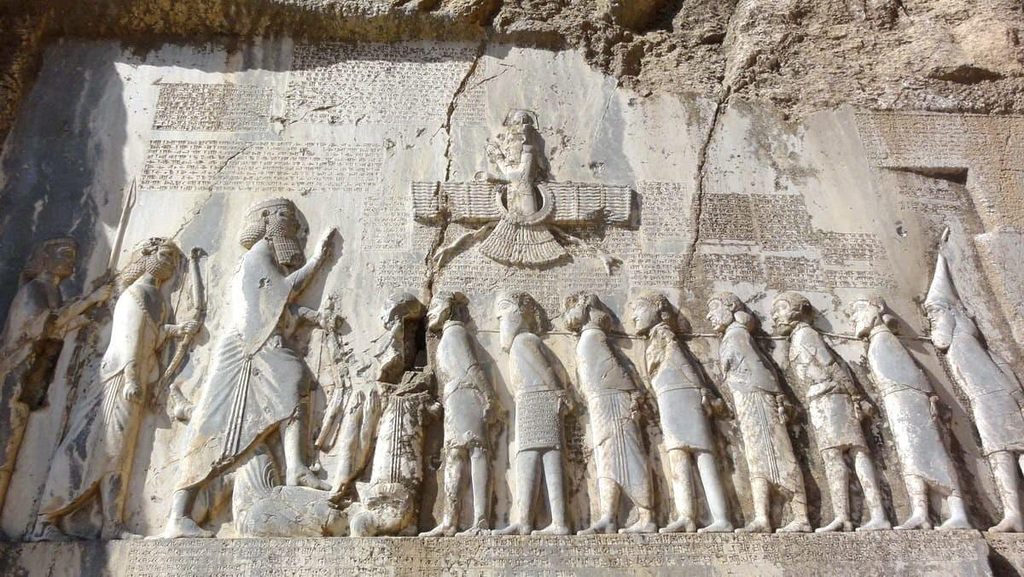
IV. THE STONE: BEHISTUN, c. 520 BCE
In western Iran, near modern Kermanshah, stands the Behistun inscription.
Commissioned by Darius I as he consolidated his kingship in 522–520 BCE, it records his claimed victories and justification for rule.
Its monumental inscriptions preserve versions in Old Persian, Elamite, and Babylonian.
The exact chronology of the different stages of inscription is complex, but the monument’s initial construction belongs to the opening years of Darius’ reign.
Here is the essential fact.
Ahuramazda is repeatedly named in the inscription, and the Lie is repeatedly condemned.
Darius attributes his kingship and victories to Ahuramazda.
He presents rebellion as the product of deception.
He commands future rulers to guard themselves against lies.
He also calls upon Ahuramazda to witness the truthfulness of his account.
The monument therefore documents a religious and political worldview in which the struggle against falsehood is explicitly linked with Ahuramazda.
This was not written by Christians looking backward.
It was not a medieval Zoroastrian explanation.
It was an imperial declaration composed roughly five centuries before Jesus.
The critical passage: Behistun IV.54–55
Darius attributes the rebellious provinces’ actions to lies that deceived their populations.
He says Ahuramazda delivered the rebels into his hands.
Then he instructs future kings to guard themselves against lying.
The underlying Old Persian concept is drauga—the Lie.
This is not identical in spelling to the Gathic word druj, but the words belong to the same Iranian linguistic family.
The linguistic connection matters: the opposition to the Lie was not invented by later translators who noticed similarities between Persian religion and Christianity.
It is embedded in ancient Iranian vocabulary.
The inscription does not prove that Darius personally embodied perfect truthfulness.
Indeed, his charges against rebels were part of a political defense of his violent seizure and consolidation of power.
But the historical existence of the vocabulary is indisputable.
The royal claim may be investigated.
The stone’s existence is not in doubt.
V. THE SECOND INSCRIPTION: AHURAMAZDA CREATED HAPPINESS
Another inscription of Darius strengthens the positive theological profile.
DNa — Darius’ tomb at Naqsh-e Rostam
The inscription describes Ahuramazda as the creator of the earth, heavens, humanity, and happiness for humanity.
That last attribution is particularly important.
Ahuramazda is not merely presented as a powerful ruler of the cosmos.
He is expressly associated with the creation of human well-being.
The same inscription connects the divine will with Darius’ rule, showing its political purpose.
But the religious vocabulary remains significant.
The inscriptions preserve a recognizable profile:
- Ahuramazda as cosmic creator.
- Ahuramazda as the divine source of blessing and well-being.
- Righteousness as an ideal.
- The Lie as something to be resisted.
- Truthfulness as a claimed qualification for legitimate authority.
Darius’ companion tomb inscription, DNb, adds an ethical declaration attributed to the king.
He describes himself as favorable to what is right, opposed to injustice, and unwilling to let the strong wrong the weak.
He also describes opposition to followers of the Lie.
Again, these are royal self-descriptions, not independent proof that Darius always acted justly.
But they demonstrate that the imperial presentation of Ahuramazda was tied to an ethical vocabulary involving right conduct and falsehood.
We now have something substantially stronger than an undated theological resemblance.
We have ancient Iranian religious language, an identifiable divine figure, and physical inscriptions from the fifth and sixth centuries BCE.
VI. THE LINGUISTIC BRIDGE: AŠA, ARTA, DRUJ, AND DRAUGA
The linguistic evidence deserves special attention.
| Avestan | Old Persian | Meaning or relationship |
|---|---|---|
| Aša | Arta | Truth, right order, righteousness |
| Druj / draoga | Drauga | The Lie, falsehood, deception |
| Ahura Mazda | Ahuramazda | The Wise Lord |
Avestan and Old Persian are different ancient Iranian languages.
Their terminology should not be treated as interchangeable in every context.
But the related forms matter.
They establish that the Gathic religious vocabulary and the imperial Persian vocabulary belong to a common Iranian linguistic and conceptual environment.
Aša and Arta are historically related forms.
Druj, Avestan draoga, and Old Persian drauga belong to the Iranian terminology of falsehood.
That relationship provides a firmer historical foundation than an argument based only upon modern English translations.
The concepts have ancient linguistic roots independent of the New Testament.
And those concepts are directly relevant to the proposed identification of the Father of Truth.
VII. THE PERSIAN CONNECTION TO JUDEA
Now consider how this Iranian worldview could have intersected with Jewish religious history.
In 539 BCE, Cyrus conquered Babylon.
During the ensuing Persian period, Judea belonged to the Achaemenid imperial system.
The reconstruction of the Jerusalem temple, the activities associated with Ezra and Nehemiah, and developments within Second Temple Jewish literature belong to this wider historical setting.
Jewish communities also lived outside Judea, including in Babylon and Egypt.
Persian imperial authority therefore supplied sustained political and cultural contact.
This establishes a historically plausible environment for the transmission of Iranian religious ideas.
It does not automatically establish that any particular Jewish doctrine originated in Zoroastrianism.
Similarity is not sufficient proof of borrowing.
A persuasive transmission case requires chronological order, contact, distinctive conceptual parallels, and evidence that the proposed direction of influence is more convincing than alternatives.
But the first two conditions are substantial.
The Iranian religious tradition was already old.
The Jewish communities of the Persian period existed within an empire in which Ahuramazda and the struggle against the Lie were publicly invoked.
The route for cultural contact was real.
The remaining question is which ideas, if any, were transmitted and transformed.
This is where the larger investigation of resurrection, judgment, angels, and Daniel becomes relevant.
Those subjects deserve their own evidence rather than being treated as already proven by the inscriptions.
For this article, the key finding is simpler:
A Mazda-centered religious conception existed within the historical world that preceded and interacted with Second Temple Judaism.
VIII. JESUS ENTERS THE RECORD
Centuries later, the Gospel of John presents Jesus in conflict with religious interlocutors over the identity and knowledge of his Father.
The critical issue is not simply that Jesus calls God Father.
It is that he repeatedly connects knowledge of the Father with truth, conduct, and recognition of his own message.
John 1:17 (KJV)
For the law was given by Moses, but grace and truth came by Jesus Christ.
John distinguishes the Mosaic law from the grace and truth revealed through Jesus.
The statement does not by itself identify two different gods.
But it makes the revelation associated with Jesus central to the Gospel’s account of truth.
John 1:18 (KJV)
No man hath seen God at any time; the only begotten Son, which is in the bosom of the Father, he hath declared him.
John presents Jesus as the authoritative revealer of the Father.
John 5:37 (KJV)
And the Father himself, which hath sent me, hath borne witness of me. Ye have neither heard his voice at any time, nor seen his shape.
Jesus denies that his interlocutors have heard or seen the Father.
Then in John 5:45–47 he identifies Moses as an accuser of those who claim to trust him, while also saying Moses wrote concerning Jesus.
The Gospel therefore does not present Jesus as indifferent to the Jewish scriptures.
It presents him as claiming authority to reveal their true significance and the Father they have failed to recognize.
Now the dispute reaches its sharpest point.
IX. JOHN 8: THE TEST OF THE FATHERS
The following statements must be read in sequence.
John 8:19 — The disputed Father
Ye neither know me, nor my Father: if ye had known me, ye should have known my Father also.
Jesus challenges his interlocutors’ claim to know the Father.
John 8:38 — The distinction through works
I speak that which I have seen with my Father: and ye do that which ye have seen with your father.
The contrast concerns instruction and conduct.
Fatherhood is tied to what people do.
John 8:41 — The claim
Ye do the deeds of your father. Then said they to him, We be not born of fornication; we have one Father, even God.
His opponents claim God as their Father.
John 8:44 — The accusation
Ye are of your father the devil, and the lusts of your father ye will do. He was a murderer from the beginning, and abode not in the truth, because there is no truth in him. When he speaketh a lie, he speaketh of his own: for he is a liar, and the father of it.
Jesus identifies the devil through the rejection of Truth and through murderous conduct.
The accusation concerns the conduct and spiritual allegiance of the specific interlocutors in the narrative, not Jewish ancestry as a whole.
Now read the final exchange.
John 8:54 — Their claim concerning his Father
Jesus answered, If I honour myself, my honour is nothing: it is my Father that honoureth me; of whom ye say, that he is your God:
Jesus identifies his Father as the one his opponents claim as their God.
John 8:55 — Their claimed knowledge is denied
Yet ye have not known him; but I know him: and if I should say, I know him not, I shall be a liar like unto you: but I know him, and keep his saying.
Their claim to know the Father does not establish their knowledge.
Jesus insists that denying what he knows would make him a liar.
The conventional historical reading understands Jesus as revealing the true knowledge of Israel’s God rather than introducing a different deity.
The Father-of-Aša investigation advances an additional comparative question:
Does the moral profile Jesus gives of his Father correspond to the ancient Iranian Father of cosmic Aša?
That is where the independent Mazda evidence becomes relevant.
X. TWO ANCIENT PROFILES OF DIVINE TRUTH
The comparison can now be made without relying on an invented historical claim.
| Ancient Iranian witness | Johannine witness |
|---|---|
| Ahura Mazda is described as Father and creator of Aša | Jesus repeatedly speaks of the Father as the source of his revelation |
| Cosmic Aša represents rightful Truth-Order | Jesus identifies himself with truth and life |
| Druj represents falsehood and deceptive disorder | Jesus identifies the devil through lying and opposition to truth |
| Ahura Mazda is associated with the origin and preservation of order | The Father is described as the source of true revelation |
| Darius invokes Ahuramazda while condemning the Lie | Jesus refuses to become a liar by denying the Father he knows |
These correspondences are meaningful.
They are not demonstrations that the figures are historically identical.
The terms father and truth are used in different languages, genres, and theological contexts.
In the Gathas, Aša is a cosmic and divine principle.
In John, the Father is primarily revealed through his relationship to Jesus.
A comparative theological argument must explain that distinction rather than ignoring it.
Yet the shared emphasis is significant.
Both religious frameworks place truth at the center of divine understanding.
Both treat falsehood as more than an ordinary mistake.
Both link spiritual identity with the quality of conduct and relationship to truth.
This creates an affirmative basis for comparison that exists independently of disputed biblical passages concerning Yahweh.
XI. THE WORKS TEST APPLIED TO THE COMPETING CLAIMS
The wider dossier has assembled passages involving divine deception and harmful agency in the Hebrew Scriptures.
These include:
1 Kings 22: Yahweh authorizes a lying spirit.
Ezekiel 14:9: Yahweh describes involvement in a prophet’s deception or enticement.
2 Samuel 24 and 1 Chronicles 21: The same census is attributed to Yahweh’s instigation in one account and Satan’s in another.
Isaiah 6 and John 12: Divine judgment is described through impaired perception and blindness.
2 Thessalonians 2:11: God sends an influence of delusion resulting in belief in falsehood.
These texts create a genuine moral and theological problem concerning divine agency.
The Father-of-Aša hypothesis argues that the ultimate divine source should be assessed through works consistent with cosmic Truth-Order.
But the strongest Mazda case does not require every negative Yahweh argument to succeed.
Even if a particular deception narrative can be reconciled with divine justice, the independent Gathic and Persian evidence remains.
The positive identification of Ahura Mazda with Aša is not created by criticism of Yahweh.
It predates the criticism.
That is the critical distinction.
The Iranian evidence stands independently. The biblical works test is a subsequent comparison.
XII. WHAT WE MUST NOT CLAIM WITHOUT EVIDENCE
A serious historical argument must know its boundaries.
We cannot claim that Behistun quotes Yasna 44.3 directly.
It does not.
We cannot claim that the date of Behistun proves the exact date of the Gathas.
It establishes an early, securely dated Iranian religious witness.
We cannot claim that every reference to Truth in John derives from Iranian theology.
The Jewish scriptural tradition also contains extensive language concerning divine truth, righteousness, and fidelity.
We cannot claim that the Gospel explicitly names Ahura Mazda.
It does not.
Nor can we claim that the creation of physical darkness is itself evidence of moral deception. Yasna 44.5 also asks about the making of light and darkness.
The moral opposition between Aša and Druj must not be confused with the ordinary physical contrast between day and night.
These distinctions do not destroy the case.
They define what remains to be demonstrated.
The case for Ahura Mazda is strongest when its historical evidence is presented accurately and its theological implications are argued separately.
XIII. THE EVIDENCE LADDER
The investigation can now establish its findings in order.
1. The ancient theological identity
The Gathas identify Ahura Mazda with the fatherhood and creation of cosmic Aša.
2. The linguistic continuity
Avestan Aša and Druj belong to the same ancient Iranian linguistic environment as Old Persian Arta and Drauga.
3. The archaeological anchor
Behistun and the other Achaemenid inscriptions independently establish the public invocation of Ahuramazda, righteousness, and opposition to the Lie centuries before Christianity.
4. The historical contact
Judea and Jewish communities lived within the Persian imperial world for generations.
5. The Gospel comparison
John presents Jesus’ Father through truth, revelation, life, and works, while defining the devil through deception and murderous conduct.
6. The proposed identification
The Father-of-Aša hypothesis argues that Ahura Mazda’s ancient theological profile provides a candidate for comparison with the Father revealed through Jesus.
7. The remaining historical burden
The argument must still show whether the apparent correspondences reflect transmission, a shared moral vocabulary, independent development, or an actual intended identification.
The first five findings are supported to differing degrees by identifiable textual, linguistic, and historical evidence.
The sixth is the dossier’s theological proposal.
The seventh defines the further research necessary to establish it.
XIV. THE HISTORICAL ORDER CANNOT BE REVERSED
The chronology matters.
The Gathas preserve an ancient Iranian theology of Aša.
By the reign of Darius I, Ahuramazda and opposition to the Lie appear in monumental imperial inscriptions.
This is hundreds of years before the ministry of Jesus and the composition of the Gospel of John.
The existence of that earlier religious worldview does not prove that Christianity copied it.
But it rules out the claim that the Iranian conception of Ahuramazda as the divine source of Truth-Order was created retrospectively to resemble Jesus.
The Iranian tradition already possessed its own independent theological history.
Mazda’s association with cosmic Aša is not a Christian invention.
That is the chronological fact from which the investigation must proceed.
XV. THE CONCLUSION: THE FATHER BEFORE THE QUESTION
In the Gospel of John, Jesus disputes his opponents’ knowledge of his Father.
He speaks of Truth.
He challenges religious claims through conduct.
He identifies the devil through falsehood.
And he refuses to deny his knowledge of the Father.
Centuries before this Gospel was written, the ancient Iranian tradition had already addressed Ahura Mazda in connection with the origin of Aša.
The Persian inscriptions independently establish Ahuramazda’s place in an imperial worldview that condemned the Lie.
The comparison is therefore not between a historically documented Christian theology and a modern imaginary figure.
It is between two ancient bodies of religious evidence.
One identifies Ahura Mazda with the creation and preservation of cosmic Truth-Order.
The other presents Jesus declaring that he knows the Father, speaks Truth, and distinguishes spiritual fathers by their works.
The Father-of-Aša investigation proposes that these records should be examined together.
It does not need to assume that Jesus said the name Ahura Mazda.
It must ask whether historical evidence can demonstrate that his conception of the Father reflects, shares, or intentionally invokes the earlier Iranian profile.
That is a demanding question.
But it is a legitimate one.
THE FINAL QUESTION
When Zarathustra’s hymns ask about the Father of Aša, they address Mazda.
When Darius invokes the divine power standing behind his claimed victory over the Lie, he invokes Ahuramazda.
And when Jesus, centuries later, speaks of the Father he knows, he makes Truth central to the dispute.
The existence of these correspondences is evidence.
Their meaning remains the subject of historical and theological examination.
The Father-of-Truth investigation begins not with an accusation against Yahweh, but with an ancient positive witness for Ahura Mazda.
The Gathas establish the theological language.
The inscriptions establish an early historical anchor.
The Gospel supplies the later comparison.
First, identify the Father of Aša.
Then examine the works.
Then test the proposed connection to Jesus.
That is the case.
Primary evidence and research references
Ancient Iranian texts
- Yasna 31.7–8; 43.6; 44.3–7; 45.4; 47.2.
- Behistun inscription (DB), especially IV.54–57 and IV.63–64.
- Darius I, inscriptions DNa and DNb, Naqsh-e Rostam.
- Darius I, inscription DPd, Persepolis.
New Testament
- John 1:17–18.
- John 5:37–47.
- John 8:19, 23, 38–47, 54–55.
- John 14:6; 17:17.
- 1 John 1:5; James 1:17.
Scholarly references
- Mary Boyce, “Ahura Mazdā,” Encyclopaedia Iranica.
- Jean Kellens, “Druj,” Encyclopaedia Iranica.
- Gherardo Gnoli, “Ašavan,” Encyclopaedia Iranica.
- Prods Oktor Skjærvø, “Achaemenid Religion,” Religion Compass (2014).
- Prods Oktor Skjærvø, “The Gathas, a Forgotten Masterpiece” (2020).
- UNESCO World Heritage Centre, “Bisotun.”
- Federation of Zoroastrian Associations of North America, Yasna selections.
- Yale Forum on Religion and Ecology, “Zoroastrianism: Sacred Texts.”
- Livius, translations of the Behistun, DNa, DNb, and DPd inscriptions.
Research classification: Affirmative comparative theology grounded in ancient Iranian textual and archaeological evidence. Historical influence and specific identification with Jesus’ Father are hypotheses requiring further demonstration.