
 Written by
From Behistun to Babylon to Elephantine: The Transmission Was Real
The Archaeological Evidence for Iranian Religious Ideas in the World of Ancient Yahwism
The Father-of-Aša Investigation | eFireTemple Dossier
The mountain preserved the proclamation. Babylon preserved fragments. Elephantine preserved the language. And the evidence survived more than two thousand years.
I. THE QUESTION IS NO LONGER WHETHER CONTACT WAS POSSIBLE
For generations, scholars have examined the possibility that Iranian religious traditions influenced the development of Jewish theology during and after the Persian period.
The discussion has often centered upon similarities between Zoroastrian and Jewish beliefs concerning angels, judgment, resurrection, the final renovation of the world, and the cosmic conflict between Truth and the Lie.
The central historical question has been how these ideas could have moved between religious communities.
The surviving archaeological record now permits a more specific investigation.
Under Darius I, an imperial proclamation invoked Ahuramazda, condemned the Lie, and identified legitimate kingship with divine assistance.
Darius declared that the proclamation had been circulated across his empire.
Fragments of copies were later discovered in Babylon.
An Aramaic translation survived at Elephantine, Egypt, the location of a substantial community devoted to Yahu, a form of the divine name Yahweh.
These findings do not independently prove that the Yahwists adopted Zoroastrian resurrection theology.
But they establish something essential.
Iranian religious-political language invoking Ahuramazda was physically transmitted beyond Persia and preserved in a Yahwistic historical environment.
We are not dealing solely with a hypothetical trade route.
We possess the texts.
II. THE ORIGINAL WITNESS: BEHISTUN, c. 520 BCE
The Behistun inscription stands in western Iran, commissioned during the early reign of Darius I.
Its monumental inscription appears in Old Persian, Elamite, and Babylonian.
The accompanying relief depicts Darius standing over the defeated Gaumata, with other captive rebel leaders before him and a winged divine symbol above the scene.
The winged symbol is widely associated with Ahuramazda.
The inscription records Darius’ version of the rebellions that followed his seizure of the Persian throne.
Again and again, he attributes his victories to Ahuramazda.
He identifies false claims to kingship with the Lie.
He warns future rulers against deception.
It is royal propaganda, and Darius’ accusations against his enemies cannot simply be assumed true.
But the religious vocabulary is historically significant.
In approximately 520 BCE, an Achaemenid king was publicly presenting divine favor, legitimate authority, righteousness, and opposition to the Lie as interconnected principles.
The original Iranian Truth–Lie framework was not invented by later Christian commentators.
It existed in the Persian imperial world centuries before Jesus.
And Darius did not intend the proclamation to remain confined to one mountainside.
III. DARIUS SAYS HE SENT THE TEXT THROUGHOUT HIS EMPIRE
The crucial evidence appears in Behistun, paragraph 70.
Darius describes the preparation of written versions of the proclamation, including copies on portable materials.
He states that the inscription was sent throughout the provinces.
This declaration changes the investigation.
The original monument was a public demonstration of royal power.
The portable copies made its message capable of reaching administrators and populations far from the Zagros Mountains.
The proclamation itself claims imperial dissemination.
That declaration is not, by itself, proof that every province received a copy.
Fortunately, archaeology provides independent confirmation that copies did circulate.
One location is particularly important.
Babylon.
IV. EXHIBIT ONE: THE BABYLONIAN COPIES
Fragments of the Behistun proclamation have been recovered from Babylon.
Rüdiger Schmitt’s study in Encyclopaedia Iranica identifies two important discoveries.
The first, originally designated BE 3627 and subsequently Berlin VA Bab. 1502, comes from a basalt block.
It preserves portions of two columns of the proclamation.
The second, Bab. 41446, was a much smaller fragment and is reportedly lost.
The fragments are incomplete.
They do not preserve the entire original proclamation.
Nevertheless, they establish that the Behistun narrative was reproduced in Babylon.
That fact matters because Babylon was a major center of Jewish life following the deportations of the sixth century BCE.
In 539 BCE, Cyrus conquered Babylon.
In the decades that followed, Jewish communities existed within the Achaemenid imperial system.
By the reign of Darius, the Persian administration had become a central political reality for those communities.
Now we possess archaeological evidence that Darius’ proclamation reached Babylon.
The proclamation carried claims concerning Ahuramazda, legitimate kingship, and the Lie.
This establishes the presence of that imperial message in the same major city where Jewish communities lived.
It does not identify a particular Jewish reader of the Babylonian fragments.
Nor does it demonstrate Jewish adoption of the proclamation’s theology.
But it closes one historical gap.
The message reached Babylon.
That is no longer merely a proposed route.
It is an archaeologically documented destination.
V. EXHIBIT TWO: THE ELEPHANTINE PAPYRUS
The most consequential evidence for the Jewish transmission question survives far from Persia.
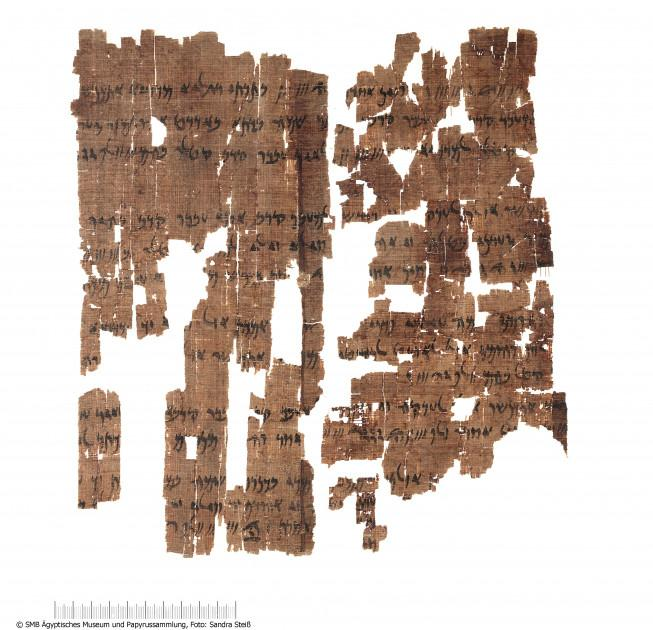
At Elephantine, near modern Aswan in Egypt, an Aramaic translation of the Behistun proclamation has survived.
The manuscript is cataloged as:
Papyrus Berlin P. 13447
It belongs to the fifth century BCE, commonly dated to approximately 420 BCE.
Its language is Imperial Aramaic.
The papyrus is fragmentary, with substantial textual losses.
But the surviving remains are identifiable as an Aramaic version of Darius’ proclamation.
This is important because Aramaic was a major language of imperial administration and communication.
An Iranian royal message was no longer confined to Old Persian or monumental inscriptions.
It had entered an international administrative language used by different populations throughout the empire.
And where did this particular witness survive?
At Elephantine.
The settlement contained a community that worshipped Yahu and maintained a temple dedicated to that deity.
The papyrus’s provenance connects it to the same environment studied through the famous Elephantine Aramaic documents.
The precise history of the papyrus’s possession and readership cannot be established merely from its discovery location.
But its presence creates direct material evidence of an Iranian imperial religious-political text circulating within that environment.
Ahuramazda’s name had traveled from the Persian imperial proclamation into an Aramaic textual witness preserved at Elephantine.
The implications are substantial.
VI. THE NAME AHURAMAZDA IS IN THE ARAMAIC TEXT
The strongest evidence is not merely the identification of the document.
The museum’s published transcription preserves the divine name.
In Aramaic script:
אהורמזד — Ahuramazda
The surviving text repeatedly associates the king’s successful actions with Ahuramazda’s help.
The manuscript also preserves language concerning lies, false claims, and the moral-political consequences of deception.
This is the essential combination.
The divine name survived.
The proclamation’s struggle against the Lie survived.
The message was transmitted into Aramaic.
And the manuscript survived in the setting of a Yahwistic community.
The name of Ahuramazda was therefore not restricted to inaccessible Iranian religious literature.
It was present within an imperial textual tradition that extended into regions inhabited by Yahwists.
This is a different evidentiary situation from speculating about what travelers might have discussed.
The surviving manuscript is a physical witness to the circulation of the words.
The further question is what readers did with them.
VII. THE OTHER SIDE OF THE PAPYRUS
The Berlin papyrus contains another detail of interest.
Its reverse also preserves assorted memoranda.
These refer to people, vessels, transfers, and other administrative matters.
Some names belong to the Semitic naming environment known from Elephantine.
This is relevant because the papyrus is not simply a monumental inscription removed from its original context.
It became part of a reused documentary object within a functioning community.
Christine Mitchell’s 2017 study in the Journal of Near Eastern Studies specifically examines Berlin Papyrus P. 13447 in relation to the library of the Yehudite colony at Elephantine.
That is a scholarly investigation of the manuscript’s cultural and scribal setting.
The exact ownership history cannot be reconstructed with certainty.
But the documentary context places the material within the lived world of Aramaic-speaking administrators and scribes.
The inscription was not preserved solely as a carved proclamation in Iran.
It became a written document capable of being copied, retained, reused, and encountered far beyond its original audience.
This is how imperial texts travel through cultures.
VIII. THE 2025 SCHOLARSHIP: THE QUESTION HAS ADVANCED
Recent studies make the implications even more important.
In 2025, Gad Barnea published:
Some Achaemenid Zoroastrian Echoes in Early Yahwistic Sources.
The study appeared in Iran, the journal of the British Institute of Persian Studies.
Barnea examines possible Zoroastrian and Avestan elements reflected in Yahwistic sources, particularly documents from Elephantine.
His argument considers linguistic, personal-name, ritual, and archaeological evidence.
He also proposes evidence of Iranian religious practices associated with structures in the Elephantine temple environment.
Some of these interpretations require further independent evaluation, especially his proposed identification of fire-related ritual structures.
But the larger research development is significant.
Scholars are no longer limited to asking whether Persians and Jews ever encountered each other.
They are examining specific Iranian religious traces within surviving Yahwistic documents.
In another study, published in 2024, Barnea examines Papyrus Berlin 13464 in connection with Yahwism and Achaemenid Zoroastrianism.
This is a separate papyrus from the Behistun copy, P. 13447.
The distinction matters because it shows that the research extends beyond one manuscript.
The possibility of Iranian religious interaction is being examined through multiple ancient documents.
That is a significant change in the evidentiary landscape.
IX. THE OXFORD CONNECTION: JEWISH SCRIBES AND IMPERIAL IDEOLOGY
Another important contribution appeared in 2025.
Mark Leuchter’s chapter, The Priestly Scribes of Elephantine and Jerusalem in the Fifth Century BCE, was published in An Empire Far and Wide: The Achaemenid Dynastic Myth and Jewish Scribes in the Late Persian Period, by Oxford University Press.
Leuchter examines the influence of Achaemenid imperial ideology on Jewish scribal cultures.
His argument specifically includes the Elephantine Behistun papyrus.
He also explores how Persian imperial concepts may have shaped aspects of Jewish literary culture in Jerusalem.
His conclusions represent a scholarly interpretation, not a universally established demonstration that specific Gathic doctrines were adopted into the Torah.
Nevertheless, the study directly addresses a question central to this dossier.
How did the imperial world shape the texts and institutions of Jewish communities living under Persian authority?
The argument is now being investigated through ancient manuscripts, literary forms, administrative conventions, and shared political environments.
It is not merely a comparison of two later religious traditions.
It is research into documented communities that existed during the period of possible transmission.
X. THE DIFFERENCE BETWEEN TRANSMISSION AND CONVERSION
This distinction is essential to the credibility of the argument.
The evidence establishes the circulation of Persian imperial religious-political language.
It does not automatically establish that the receiving communities adopted Ahuramazda as their own god.
A Yahwist could read a Persian proclamation without converting to Mazdayasnian worship.
A Jewish scribe could borrow an administrative form without adopting a Persian doctrine of resurrection.
A community could adopt certain religious concepts while retaining its own divine name and institutions.
These are different possibilities.
Transmission can occur without conversion.
Cultural influence can occur without complete theological agreement.
And borrowing can be selective rather than comprehensive.
Therefore the strongest historical finding is not that the Elephantine Yahwists became Zoroastrians.
It is that Iranian ideas and texts were available within their documented imperial and scribal environment.
The next stage is identifying which features of those ideas, if any, appear in independently datable Jewish compositions.
XI. WHY THIS MATTERS FOR SECOND TEMPLE JUDAISM
The chronological sequence is now especially important.
539 BCE: Cyrus conquers Babylon.
c. 520 BCE: Darius commissions the Behistun proclamation invoking Ahuramazda and condemning the Lie.
Fifth century BCE: The proclamation circulates in imperial administrative environments; copies survive at Babylon and Elephantine.
c. 420 BCE: The Aramaic Behistun witness at Elephantine belongs to the period of the Yahwistic community there.
c. 164 BCE: The final apocalyptic material of Daniel, including the clear resurrection statement in chapter 12, belongs to the Maccabean crisis under the widely accepted critical chronology.
The sequence creates a historically meaningful research question.
The documented circulation of Iranian religious-political language predates the developed resurrection teaching preserved in Daniel 12.
That does not prove Daniel borrowed its resurrection doctrine from Iranian religion.
To establish such borrowing, scholars must examine the dating and content of particular Iranian afterlife teachings and identify a plausible chain of conceptual transmission.
But the historical environment of contact is real.
And the documentary evidence makes it unsound to dismiss Iranian influence merely because the surviving Avestan manuscripts are medieval.
The age of a manuscript is not necessarily the age of its underlying language or tradition.
Nor does a late surviving manuscript erase earlier inscriptions and translations containing related religious vocabulary.
XII. THE FATHER OF AŠA CONNECTION
The broader Father-of-Aša investigation begins with an ancient Iranian theological claim.
In Yasna 44.3, Zarathustra addresses Mazda through the question of who originally fathered Aša.
Aša represents cosmic Truth-Order: the righteous and properly ordered reality opposed to Druj, the Lie.
The Gathas preserve this theological framework.
Behistun provides an independently dated imperial witness to Ahuramazda and opposition to falsehood.
The Babylonian and Elephantine discoveries show the circulation of the imperial proclamation.
These witnesses are not identical.
Behistun does not directly reproduce Yasna 44.3.
The Elephantine papyrus does not prove that its readers studied the Gathas.
And the identification of particular imperial practices as specifically Zoroastrian remains a subject of scholarly debate.
But together, the sources establish a historical environment in which Mazda-centered religious language could circulate widely before the emergence of Christianity.
The question for this dossier is whether particular aspects of that worldview entered Jewish religious thought and were subsequently reflected in the language and theology of Jesus’ era.
The argument must proceed from attested concepts to demonstrable correspondences.
It must not begin by assuming the final identification.
XIII. THE CHALLENGE TO APOLOGETIC CHRONOLOGY
Some modern apologetic discussions emphasize the late dates of surviving Avestan manuscripts.
Others favor a sixth-century date for Zarathustra and assume that the Jewish scriptures containing relevant doctrines were composed many centuries earlier.
These arguments require examination.
But the Behistun transmission record establishes a separate point that cannot be erased by manuscript dating disputes.
Ahuramazda was invoked in a royal inscription in approximately 520 BCE.
Copies of that proclamation reached Babylon.
An Aramaic version survived at Elephantine.
Its language preserved the name of Ahuramazda and the condemnation of falsehood.
And recent scholarship has examined additional Iranian religious echoes in Yahwistic sources from the same period.
That does not establish that all Zoroastrian doctrines existed in their final forms in 520 BCE.
But it does refute any implication that Iranian religious influence was historically impossible because later Avestan literature survives in comparatively recent manuscripts.
The archaeological witnesses existed long before those manuscripts were copied.
The actual question is not whether Iranian religious ideas could reach Jewish communities.
It is which ideas reached them, and whether their reception can be demonstrated in particular texts.
XIV. THE EVIDENCE LADDER
The findings can be classified according to their strength.
| Finding | Evidentiary status |
|---|---|
| Darius publicly invoked Ahuramazda and condemned the Lie | Directly established by the Behistun inscription |
| Darius claimed to distribute his proclamation | Explicit in Behistun paragraph 70 |
| Copies reached Babylon | Archaeologically established |
| An Aramaic version reached Elephantine | Established by Berlin P. 13447 |
| The Aramaic manuscript names Ahuramazda | Established by its published transcription |
| Elephantine contained a Yahwistic community and temple | Established by its documentary record |
| Jewish scribes encountered Persian imperial ideology | Strong historical context; particular cases examined in recent scholarship |
| Specific Avestan religious elements influenced Yahwistic practices | Advanced in specialist research; individual identifications remain debatable |
| Iranian doctrine directly produced Daniel’s resurrection teaching | Not demonstrated by these artifacts alone |
| Jesus consciously identified Ahura Mazda as his Father | Not demonstrated by these artifacts alone |
The essential finding is the documented circulation of the original imperial message.
The further questions concern how that message was interpreted, transformed, or incorporated by its recipients.
XV. CONCLUSION: THE WORDS LEFT THE MOUNTAIN
In approximately 520 BCE, Darius commissioned an inscription declaring the assistance of Ahuramazda and condemning the Lie.
He ordered his message to be distributed.
Its words did not remain on the mountain.
They traveled through the empire.
Babylon preserves evidence of their arrival.
Elephantine preserves an Aramaic witness.
Within that manuscript, the divine name Ahuramazda survives.
And the same documentary environment belongs to the history of a community that worshipped Yahu.
This does not mean every Yahwist accepted the religious claims of Darius.
Nor does it mean every later Jewish doctrine was borrowed from Iranian religion.
But it establishes that the two worlds were not isolated.
Their political, linguistic, and documentary environments intersected.
The argument has moved from mere possibility to archaeological evidence of transmission.
The original was carved in Iran.
Copies reached Babylon.
An Aramaic text survived at Elephantine.
Ahuramazda’s name appears in the surviving record.
And the next stage of the investigation is no longer whether the two cultures could have communicated.
It is the historical examination of what those communications meant.
THE FINAL FINDING
The transmission of the Behistun proclamation is documented.
The reception of Iranian religious-political language within the historical environment of Yahwistic communities is a legitimate and increasingly researched question.
The adoption of specific doctrines must be established separately.
The stone remained on the mountain.
But the words traveled.
And the surviving record proves they did.
Primary documentation
1. Behistun, paragraph 70. Darius’ declaration concerning the distribution of the proclamation.
https://www.livius.org/sources/content/behistun-persian-text/behistun-t-42/
2. Berlin Papyrus P. 13447. Museum catalog, Aramaic transcription, English translation, and manuscript provenance.
https://elephantine.smb.museum/objects/object.php?o=306603
3. Rüdiger Schmitt, “Bisotun iii. Darius’s Inscriptions.” Encyclopaedia Iranica. Documentation of the Babylonian fragments and Elephantine copy.
https://www.iranicaonline.org/articles/bisotun-iii/
Modern scholarship
4. Christine Mitchell (2017). “Berlin Papyrus P. 13447 and the Library of the Yehudite Colony at Elephantine.” Journal of Near Eastern Studies 76(1): 139–147.
https://doi.org/10.1086/690226
5. Gad Barnea (2024). “P. Berlin 13464, Yahwism and Achaemenid Zoroastrianism at Elephantine.” In Yahwism under the Achaemenid Empire.
https://doi.org/10.1515/9783111018638-001
6. Mark Leuchter (2025). “The Priestly Scribes of Elephantine and Jerusalem in the Fifth Century BCE.” In An Empire Far and Wide, Oxford University Press.
https://doi.org/10.1093/oso/9780197772744.003.0003
7. Gad Barnea (2025). “Some Achaemenid Zoroastrian Echoes in Early Yahwistic Sources.” Iran 63(2): 234–243.
https://doi.org/10.1080/05786967.2025.2494602
Research classification: Primary archaeological evidence for imperial textual transmission; documented Yahwistic context; developing scholarship on religious and scribal interaction; specific doctrinal borrowing remains subject to independent verification.