
 Written by
From Ahuramazda’s Truth–Lie Proclamation to the Resurrection of Daniel
The Transmission Test | The Father-of-Aša Investigation
eFireTemple Dossier — Historical Evidence Series
The inscription establishes the message. The papyrus establishes its transmission. The Iranian testimony establishes resurrection before Daniel. The question is whether the theological ideas crossed the same historical frontier.
I. THE THREE WITNESSES
A historical argument concerning Zoroastrian influence upon Judaism must answer three questions.
Did the Iranian religious ideas exist before the relevant Jewish developments?
Could those ideas reach Jewish communities?
Is there evidence that particular Jewish doctrines were influenced by them?
For the first two questions, the evidence has become substantial.
We possess an Achaemenid inscription from approximately 520 BCE invoking Ahuramazda and condemning the Lie.
We possess a surviving Aramaic adaptation of that proclamation, recovered from Elephantine, where a community worshipped Yahu.
And we possess ancient Iranian testimony to the resurrection of the dead, corroborated by a Greek historian who wrote in the fourth century BCE.
The third question is more difficult.
Daniel 12, written in its final form during the Maccabean crisis of approximately 164 BCE, contains a clear declaration of resurrection and differentiated destinies.
The chronology is compatible with Iranian influence.
But compatibility and transmission are not identical to demonstrated dependence.
The purpose of this investigation is to identify precisely what the evidence proves and what remains to be established.
II. EXHIBIT A: THE ORIGINAL PROCLAMATION
Behistun, approximately 520 BCE
Darius I commissioned his monumental inscription following his rise to power.
The king repeatedly invokes Ahuramazda.
He depicts the rebellions against him as consequences of the Lie.
In the Old Persian text, the recurring term is drauga.
This is closely related to the Iranian religious vocabulary of Druj, the Lie and distortion opposed to cosmic Aša.
The inscriptions preserve an ancient Iranian relationship between divine authority, truthfulness, legitimate action, and falsehood.
Three paragraphs are particularly important.
Behistun IV.54
Darius accuses rebellious leaders of misleading their populations and attributes his victories to Ahuramazda.
Behistun IV.55
Darius warns future kings to protect themselves against lies and punish those who spread them.
Behistun IV.57
Darius invokes Ahuramazda as a witness to the truthfulness of his royal account.
These declarations are not independent proof that Darius was truthful.
He was defending his kingship, and the inscription must be understood as imperial propaganda.
But the religious vocabulary is preserved in a securely ancient monument.
By approximately 520 BCE, an Achaemenid monarch was explicitly associating Ahuramazda with his claimed struggle against falsehood.
This was long before Christianity.
And Behistun did not remain solely a mountain inscription.
III. EXHIBIT B: THE PROCLAMATION REACHES ELEPHANTINE
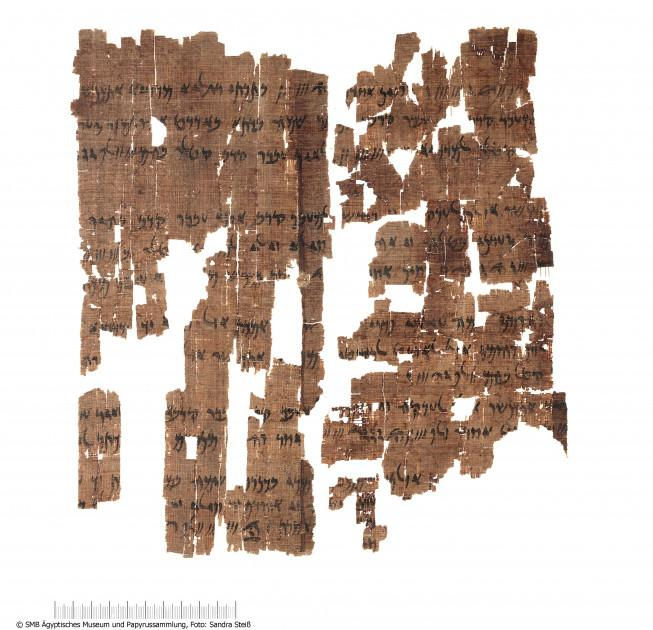
The manuscript known as Berlin Papyrus P. 13447 preserves an Imperial Aramaic adaptation of the Behistun proclamation.
It was recovered at Elephantine, Egypt, during excavations in the early twentieth century.
Its ancient provenance is documented, although the object’s exact ownership history remains uncertain.
Elephantine contained a community devoted to Yahu and possessing a temple.
That environment is historically important.
An Iranian royal proclamation had entered an Aramaic textual environment associated with a Yahwistic community.
The divine name survived in the Aramaic text:
אהורמזד — Ahuramazda
It appears repeatedly in the manuscript.
The document also preserves accusations of lying, warnings against falsehood, and promises of divine favor associated with the preservation and communication of the king’s record.
This establishes the physical movement of a text containing Iranian divine and ethical vocabulary.
It does not prove that every member of the Elephantine community read it.
It does not prove that they adopted Ahuramazda as their god.
But the proclamation was present within their wider textual environment.
That is a concrete historical finding.
IV. THE MANUSCRIPT IS NOT A MECHANICAL COPY
Christine Mitchell’s 2017 study of Berlin P. 13447 reveals an important feature of the transmission.
The Elephantine version is not a completely verbatim rendering of the mountain text.
It reorganizes material.
It combines and omits certain Behistun paragraphs.
It incorporates material from another inscription of Darius, known as DNb, at Naqsh-e Rostam.
And it changes the practical application of some of the king’s instructions.
This is particularly significant because it shows that imperial messages could be translated and editorially adapted.
Consider the comparison.
| Theme | Old Persian source | Elephantine Aramaic adaptation |
|---|---|---|
| Divine name | Ahuramazda | Name preserved in Aramaic |
| Falsehood | Warning against the Lie | Warning against liars and falsehood |
| Ethical instruction | Protect legitimate rule | Incorporates instruction about conduct and listening to others |
| Preservation | Protect the royal monument | Emphasizes making the message known |
| Divine blessing | Ahuramazda grants favor | Ahuramazda blesses faithful transmitters |
| Divine curse | Punishment for destroying or suppressing the record | Punishment for concealing its message |
The Aramaic version also inserts ethical material associated with Darius’ tomb inscription.
This adaptation is not proof of a change in religion.
But it shows something central to historical transmission.
The imperial message was not merely transported. It was also reshaped into a form usable in another linguistic environment.
That is direct evidence of a scribal process capable of moving concepts across cultural boundaries.
V. THE WORD FOR LIE CROSSES A LANGUAGE BOUNDARY
The original Old Persian uses drauga.
The Aramaic adaptation uses words from the Semitic root K-D-B, including forms meaning to lie or deceive.
The translator does not simply reproduce an Iranian word phonetically.
The concept is expressed through an Aramaic vocabulary intelligible to the receiving audience.
This distinction is important.
The transmission of a religious concept does not require the borrowing of its original foreign word.
A concept may be translated.
The original language can disappear while the underlying idea survives.
In this particular case, the transmitted message still concerns falsehood, proper conduct, royal legitimacy, and divine favor.
And the divine name Ahuramazda remains identifiable.
We can therefore document both the preservation of a foreign divine name and the translation of ethical terminology.
This is evidence of conceptual communication.
It does not establish that a distinctively Gathic doctrine was accepted by the translators.
But it demonstrates the mechanism by which Iranian vocabulary and concepts could move into Aramaic.
VI. THE PAPYRUS WAS REUSED IN A YAHWISTIC ENVIRONMENT
The reverse of Berlin P. 13447 contains administrative memoranda.
These include personal names associated with the Yahwistic and West Semitic population of Elephantine.
Mitchell identifies connections between the memoranda, temple-related objects, and the administrative environment of the local Yahu temple.
She suggests that the proclamation may have been used within a scribal training environment associated with the temple.
That reconstruction remains a hypothesis.
The manuscript cannot establish the identity of every ancient reader.
Nor should its copy date be treated as precisely fixed at 420 BCE: Mitchell describes the Elephantine Behistun copy as undated and considers a broader fifth-century context.
But its reuse matters.
An Aramaic adaptation of a proclamation invoking Ahuramazda became part of an object subsequently used for other records.
The document was not destroyed immediately upon arrival.
It remained within the documentary life of the community.
The archaeological evidence supports textual contact. A scribal-school setting is a further, historically plausible interpretation.
That is already an important result.
But the resurrection investigation requires a separate ancient Iranian witness.
VII. EXHIBIT C: THE DEAD WILL RISE
Yasht 19.89 — The Zamyad Yasht
The Zamyad Yasht contains one of the clearest ancient Iranian statements concerning the final renovation of existence.
It describes the victorious Saošyant and the restoration of the world.
The future condition is one in which decay and death are overcome.
The dead rise.
Immortality comes.
Creation is restored.
The following verse describes the triumph of the good creation and the defeat of Druj.
The theological structure is important.
The resurrection is not presented as a disconnected miracle.
It belongs to a larger cosmic transformation.
The victory over death is connected to the final defeat of disorder.
This is the Iranian concept of frašō.kərəti, the making of existence wonderful or renewed.
It is a restoration of reality, not merely the survival of disembodied souls.
And it forms part of the wider religious world associated with Ahura Mazda, Aša, and the defeat of the Lie.
However, the dating requires precision.
The surviving manuscripts of the Avesta are much later than the ancient compositions and oral traditions they preserve.
Specialists regard major portions of the Younger Avesta as pre-Christian, but the precise date of every passage and layer is not independently established.
We therefore must not assign Yasht 19.89 an exact year simply because its language preserves ancient material.
Fortunately, another witness supplies an independent chronological anchor.
VIII. EXHIBIT D: THE GREEK HISTORIAN THEOPOMPUS
Theopompus of Chios was a Greek historian of the fourth century BCE.
His original writings survive only in fragments and later quotations.
One of the most consequential references appears in Diogenes Laertius, Lives of Eminent Philosophers, Book I, section 9.
Diogenes attributes to Theopompus a statement concerning the beliefs of the Persian Magi.
According to that report, the Magi expected human beings to live again and become immortal.
The Greek uses the verb anabiōsesthai, referring to coming back to life.
That is the significant point.
Theopompus was writing in the fourth century BCE.
Daniel’s final apocalyptic material was composed in the second century BCE.
Even allowing for the fact that Theopompus is preserved through a later author, the testimony attributes resurrection expectations to Persian Magi before the Maccabean period.
This provides an external witness independent of the surviving Avestan manuscripts.
Mihaela Timuş’s 2022 scholarly treatment of Zoroastrian resurrection expressly recognizes the importance of the Younger Avesta and Theopompus for the antiquity of the doctrine.
The report cannot prove the exact wording of an Iranian hymn from the fourth century.
But it strongly challenges the suggestion that the Magian expectation of revived, immortal human beings must have been invented under Christian influence centuries later.
The fourth-century Greek witness is the critical chronological anchor for the resurrection case.
IX. THE SECOND GREEK WITNESS: THE DEFEAT OF EVIL
Plutarch’s On Isis and Osiris, chapters 46–47, supplies another preserved account of Iranian eschatological ideas.
Plutarch discusses Oromazes and Areimanius, Greek renderings of the opposing divine powers associated with good and evil.
He attributes to Theopompus an account of prolonged cosmic struggle followed by the defeat of the evil power and a transformed condition of humanity.
This material is not identical to Daniel 12.
But it supplies an important additional context.
The Magian eschatological vision involved more than individual survival after death.
It included the termination of evil’s dominion and a final transformation of the world.
The connection with Yasht 19 becomes clearer.
Resurrection and the renewal of creation belong to a larger Iranian scheme of cosmic restoration.
The evidence therefore supports a pre-Christian Iranian expectation involving revived life, immortality, and the ultimate defeat of evil.
The next question is where developed resurrection appears in the Hebrew Bible.
X. EXHIBIT E: DANIEL 12, c. 164 BCE
Daniel 12:2 (KJV)
And many of them that sleep in the dust of the earth shall awake, some to everlasting life, and some to shame and everlasting contempt.
This is one of the Hebrew Bible’s clearest declarations of resurrection.
The dead awaken.
Their future destinies differ.
Some receive everlasting life.
Others receive shame and contempt.
The historical setting is crucial.
Daniel 7–12 belongs, according to the prevailing critical chronology, to the crisis under Antiochus IV Epiphanes during the second century BCE.
Oxford’s scholarship identifies Daniel 12:1–3 as the first clear statement of resurrection in the Hebrew Bible.
The final form of Daniel dates to approximately 164 BCE.
This is later than the reign of Darius.
Later than the Persian period.
Later than the Elephantine manuscript’s fifth-century environment.
And later than Theopompus’ fourth-century account of Magian resurrection belief.
The historical sequence is therefore substantial.
An Iranian resurrection expectation is independently attested before the final apocalyptic composition of Daniel.
And Jewish communities had already experienced centuries of contact with the Iranian imperial world.
These are facts that must be incorporated into any serious investigation of resurrection’s historical development.
XI. THE COMPARISON: YASHT 19 AND DANIEL 12
The parallels are more precise when the entire eschatological pattern is examined.
| Iranian tradition | Daniel 12 |
|---|---|
| A future divine renovation of existence | Final divine intervention at the culmination of the crisis |
| The dead rise | Those sleeping in the dust awaken |
| Immortality and deathlessness | Everlasting life for some |
| The victorious Saošyant participates in renewal | Deliverance associated with Michael and the vindication of God’s people |
| The defeat of Druj and destructive disorder | The defeat of oppressive powers and the vindication of the faithful |
| Transformation of the world’s future condition | A decisive transition in the destiny of the righteous and wicked |
The relationship is significant.
But the differences are equally important.
Daniel emphasizes the vindication of those suffering persecution and distinguishes resurrection destinies.
The Iranian material places resurrection within a cosmic renovation that ultimately defeats decay and evil.
The texts do not use identical theological language.
Daniel does not name Ahura Mazda or the Saošyant.
Yasht 19 does not name Daniel or the Maccabean martyrs.
A historical argument must therefore establish more than resemblance.
It must demonstrate why influence is a better explanation than independent development, shared Near Eastern traditions, or parallel responses to suffering and death.
Nevertheless, the parallels exist within a chronology and historical environment in which Iranian-to-Jewish transmission was possible.
XII. THE FIVE-CENTURY TRANSMISSION FRAMEWORK
Consider the evidence in sequence.
c. 520 BCE — Behistun
Ahuramazda and the opposition to the Lie appear in a securely dated imperial proclamation.
Fifth century BCE — Babylon and Elephantine
The Behistun proclamation circulates in multiple languages, including Aramaic, within regions containing Yahwistic populations.
Fourth century BCE — Theopompus
A Greek historian reports that Persian Magi expect revived and immortal human life.
c. 164 BCE — Daniel 12
A Jewish apocalypse contains a clear doctrine of resurrection and differentiated eternal destinies.
The chronology establishes the precedence of documented Iranian resurrection expectations over Daniel’s final composition.
The Elephantine evidence separately demonstrates a mechanism through which Iranian religious-political language could reach Yahwistic environments.
These are two independent historical findings that reinforce the plausibility of cultural influence.
But they must not be combined into a false claim.
The Behistun papyrus does not contain the doctrine of bodily resurrection.
The Aramaic copy proves the movement of a proclamation invoking Ahuramazda and warning against deception.
Theopompus and the Younger Avesta supply evidence of resurrection expectations.
The missing step is direct evidence connecting a particular Iranian resurrection teaching with the authors or sources of Daniel.
XIII. THE POSSIBLE ROUTES OF INFLUENCE
If Iranian resurrection expectations influenced Jewish thought, the transmission need not have occurred through one inscription or one priest.
Several routes existed.
Persian imperial administration brought together people speaking different languages and following different religions.
Jewish communities lived in Babylon and other regions within the Achaemenid imperial world.
Aramaic provided a widely used channel of written communication.
Religious concepts could circulate through oral discussion, bilingual scribes, court traditions, and contact between communities.
The Elephantine papyrus provides evidence of one such written communication environment.
But we cannot reconstruct a direct route from the Elephantine copy to the author of Daniel.
That route remains hypothetical.
The strongest historical model is therefore broader.
An established environment of Iranian–Jewish interaction existed before the composition of Daniel’s resurrection passage.
The specific transmission of resurrection theology must be investigated through additional comparative evidence.
XIV. WHAT ABOUT EARLIER HEBREW RESURRECTION PASSAGES?
A serious investigation cannot simply declare that every earlier Hebrew text knew nothing of resurrection.
Isaiah 26:19 contains language about the dead living.
Ezekiel 37 portrays dry bones returning to life, although its immediate interpretation concerns national restoration.
Job 19:25–27 has been interpreted by later readers as a promise of bodily resurrection, but its Hebrew wording is disputed.
These texts belong in the historical comparison.
They demonstrate that Israelite and Jewish traditions possessed their own developing language concerning life, death, vindication, and restoration.
Daniel 12 is distinguished not because it is the first passage to mention revival imagery, but because its depiction of postmortem awakening and contrasting destinies is unusually explicit.
Therefore, identifying Iranian influence requires examination of how the different strands of Jewish resurrection expectation developed.
The argument must not reduce the emergence of a complex doctrine to one foreign source without evidence.
XV. THE MANUSCRIPT-DATING ERROR
The historical evidence also clarifies a recurring problem in modern apologetic discussions.
Some arguments emphasize that the surviving Avestan manuscripts are medieval.
That fact is correct.
But the inference that Iranian resurrection beliefs therefore originated after Christianity is not justified.
There are three different chronological questions:
When was a manuscript copied?
When was the text or oral tradition composed?
When can a particular belief be independently attested?
These dates need not coincide.
For Iranian resurrection, the Greek testimony attributed to the fourth-century BCE Theopompus supplies an important independent witness.
Thus, the late date of surviving Avestan manuscripts cannot by itself establish late invention of the resurrection doctrine.
The same methodological rule must apply to biblical texts.
A biblical book set in the sixth century BCE cannot automatically be dated to the sixth century.
A second-century BCE manuscript cannot automatically establish that its text was composed centuries earlier.
And a fourth-century BCE testimony cannot be dismissed merely because the original work survives through later quotations.
Every source must be evaluated according to its own chain of transmission.
The historical standard must be consistent.
XVI. WHERE THE EVIDENCE STANDS
The findings can be separated into levels.
Established:
The Behistun inscription invokes Ahuramazda and condemns the Lie in the early Achaemenid period.
An Aramaic adaptation survived at Elephantine within a historical environment associated with Yahwistic communities.
The adaptation preserves the divine name, translates the ethical vocabulary, and modifies portions of the original royal instructions.
The Younger Avesta includes explicit resurrection and world-renovation material.
Fourth-century BCE testimony attributed to Theopompus describes Magian belief in renewed immortal life.
Daniel 12 contains an explicit resurrection statement composed in the second-century BCE setting.
Strongly supported:
Iranian resurrection expectations preceded Daniel’s final apocalyptic composition.
Iranian religious-political vocabulary was transmitted into regions containing Jewish communities.
The historical setting makes Iranian–Jewish religious interaction plausible.
Not yet demonstrated:
That the particular author of Daniel knew Yasht 19.
That the Elephantine Behistun copy transmitted resurrection theology.
That the resurrection teaching in Daniel originated exclusively in Iranian religion.
That Jesus consciously identified Ahura Mazda as his Father.
These distinctions do not make the historical investigation weaker.
They establish the exact frontier at which further evidence is necessary.
XVII. CONCLUSION: THE STONE, THE PAPYRUS, AND THE DEAD
The mountain preserves the original proclamation.
The papyrus preserves its adaptation.
The Aramaic text preserves Ahuramazda’s name.
The Iranian tradition preserves an expectation that the dead will rise and creation will be renewed.
The Greek testimony attributes renewed immortal life to the Magi before the Maccabean period.
And Daniel 12 later announces the awakening of the dead and their differing destinies.
The historical order is real.
The transmission of the imperial text is documented.
The pre-Christian existence of Iranian resurrection expectations is supported independently.
And the development of Jewish resurrection theology belongs to the centuries following extensive Persian–Jewish contact.
These facts do not compel the conclusion that Daniel copied the Iranian doctrine.
But they establish a serious case for investigating Iranian influence, one that cannot be dismissed by confusing the dates of manuscripts with the dates of their underlying traditions.
THE FINAL FINDING
The words traveled.
The religious vocabulary traveled.
The Iranian resurrection expectation existed before Daniel’s final composition.
Whether Daniel’s theology drew directly from that earlier tradition remains the decisive question.
The Father-of-Aša investigation must continue to examine that question through texts, languages, historical contacts, and demonstrable conceptual correspondences.
Not through inherited assumptions.
Not through selective chronology.
And not through claims unsupported by the surviving record.
The stone establishes antiquity.
The papyrus establishes transmission.
The Greek witness establishes pre-Christian resurrection expectations.
Daniel establishes the later Jewish comparison.
The evidence has brought the traditions into the same historical investigation.
The next task is to establish the precise relationship between them.
Primary documents and scholarly references
1. Behistun inscription, Darius I, especially Old Persian sections 54–57 and 70.
https://www.livius.org/sources/content/behistun-persian-text/behistun-t-36/
2. Berlin Papyrus P. 13447, Aramaic Behistun adaptation and administrative memoranda. Staatliche Museen zu Berlin.
https://elephantine.smb.museum/objects/object.php?o=306603
3. Christine Mitchell, “Berlin Papyrus P. 13447 and the Library of the Yehudite Colony at Elephantine.” Journal of Near Eastern Studies 76, no. 1 (2017): 139–147.
https://doi.org/10.1086/690226
4. Nicholas Sims-Williams, “The Final Paragraph of the Tomb-Inscription of Darius I (DNb, 50–60): The Old Persian Text in the Light of an Aramaic Version.” Bulletin of the School of Oriental and African Studies 44, no. 1 (1981): 1–7.
https://doi.org/10.1017/S0041977X00104355
5. Yasht 19.89–96, Zamyad Yasht, concerning the Saošyant and final renovation. See Encyclopaedia Iranica, “Saošyant” and “Eschatology i.”
6. Diogenes Laertius, Lives of Eminent Philosophers I.9, preserving a report attributed to the fourth-century BCE Theopompus.
https://penelope.uchicago.edu/Thayer/E/Roman/Texts/Diogenes_Laertius/Lives_of_the_Eminent_Philosophers/1/Prologue%2A.html
7. Plutarch, On Isis and Osiris 46–47, concerning Persian cosmic struggle and the eventual defeat of evil.
8. Mihaela Timuş, “Resurrection, Zoroastrianism,” Encyclopedia of Ancient History: Asia and Africa, 2022.
https://doi.org/10.1002/9781119399919.eahaa00043
9. Encyclopaedia Iranica, “Eschatology i. In Zoroastrianism and Zoroastrian Influence.”
https://www.iranicaonline.org/articles/eschatology-i/
10. Encyclopaedia Iranica, “Frašō.kərəti.”
https://www.iranicaonline.org/articles/frasokrti/
11. Oxford University Press, “Reading Daniel as Part of the Writings,” in The Oxford Handbook of the Writings, concerning Daniel’s Maccabean composition and resurrection teaching.
https://academic.oup.com/edited-volume/28060/chapter-abstract/212047368
Research classification: Archaeological transmission; comparative ancient Iranian and Jewish eschatology; fourth-century BCE external testimony; proposed doctrinal influence not yet established as direct borrowing.