
 Written by
War. Famine. The Lie. What Darius Asked Ahura Mazda to Prevent—and What the Hebrew Scriptures Attribute to Yahweh.
By Diesel the Magus
eFireTemple.com | The Father-of-Aša Investigation
Darius DPd · Ezekiel 14:13–21 · 1 Kings 22:19–23 · Ezekiel 14:9 · Isaiah 45:7 · 1 John 1:5 · Yasna 44
I. THREE THINGS THE KING FEARED
There is a prayer carved into the stone foundations of ancient Persepolis.
It was commissioned during the reign of Darius I, king of the Persian Empire, between 522 and 486 BCE.
And it identifies three things from which the king asks Ahura Mazda to protect his country.
An invading army.
Famine.
The Lie.
Three threats.
Two destructive conditions that endanger human life.
And one moral condition that can corrupt the order of human society itself.
But the most remarkable feature of this prayer becomes apparent when we compare it with the Hebrew scriptures.
Because those scriptures attribute the sending of the sword and famine to Yahweh.
And they also portray Yahweh authorizing a lying spirit.
Read that again.
Darius asks Ahura Mazda for protection from invasion, famine, and the Lie.
The Hebrew record portrays Yahweh sending the sword and famine and authorizing deception.
The comparison is not identical in historical circumstances. The Persian prayer seeks protection for Persia, while Ezekiel describes judgments against Jerusalem.
But the attributed divine actions are sufficiently explicit to deserve examination.
And unlike an argument built solely upon religious symbolism, this investigation begins with a surviving Old Persian inscription.
The stone has a location.
The inscription has a name.
The king has a date.
And the words can still be examined.
II. THE INSCRIPTION AT PERSEPOLIS
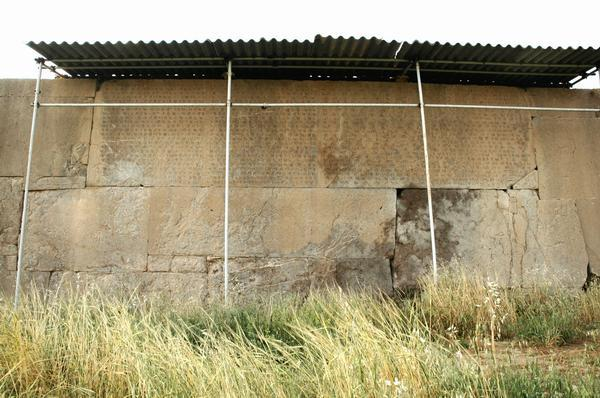
The inscription is designated DPd.
It was carved on the southern retaining wall of the great terrace at Persepolis.
This was not a private prayer preserved only in a much later religious manuscript.
It was a public royal declaration incorporated into one of the principal monumental complexes of the Achaemenid Empire.
The text begins by praising Ahura Mazda.
Darius describes Persia as a good country, with excellent horses and people.
He attributes his kingdom to Mazda’s favor.
Then he makes his appeal.
In the translation published by Livius, Darius asks:
“May Ahuramazda protect this country from invaders, from famine, and from the Lie!”
He continues by asking that none of the three come upon the country.
This is the central documentary witness.
Notice the direction of the prayer.
Darius does not ask Mazda to create famine.
He asks for protection from it.
He does not ask Mazda to bring hostile armies against Persia.
He asks that they be kept away.
And he does not ask Mazda to authorize a lie for the sake of his kingdom.
He asks that the Lie not enter it.
His royal ideal associates divine protection with deliverance from all three threats.
That does not mean Persia never suffered famine, warfare, or deception.
Nor does it establish that Darius himself never committed those acts.
Royal inscriptions are statements of ideology, not certificates of moral perfection.
But they reveal the religious character the monarch publicly attributed to his divine patron.
And that character is relevant to our Father-of-Aša investigation.
III. THE WORDS ON THE STONE
The Old Persian inscription gives us three important expressions.
| Old Persian | Meaning |
|---|---|
| Hainā | Hostile army, invading military force |
| Dušiyāra | Famine, crop failure, scarcity |
| Drauga | The Lie, falsehood, deception |
The inscription’s prayer contains the sequence:
hacā haināyā — hacā dušiyārā — hacā draugā
From the hostile army.
From famine.
From the Lie.
These are not three English words arbitrarily imposed upon an ancient text.
They are translations of identifiable Old Persian terms.
And one term has particular significance.
DRAUGA.
The Lie.
It belongs to the same Iranian linguistic family as the Avestan concept Druj.
This is not merely a coincidence of similar religious ideas.
It is a historical relationship between Iranian words.
The Avestan Druj stands opposed to Aša.
Cosmic Truth-Order against falsehood, deception, and disorder.
The Old Persian drauga appears prominently in royal declarations by Darius.
In that setting, the term frequently concerns false claims to political legitimacy and rebellion against the recognized king.
We should not pretend that every royal use carries the complete theological meaning of Gathic Druj.
But the linguistic continuity is real.
The Lie condemned in Avestan religion has a recognizable linguistic counterpart in the Persian royal inscriptions.
And here, on the foundation wall of Persepolis, it appears alongside famine and hostile invasion as a threat from which the king seeks divine protection.
IV. THE SWORD YAHWEH SENDS
Now turn to the Hebrew Bible.
Ezekiel 14:21 — King James Version
“For thus saith the Lord GOD; How much more when I send my four sore judgments upon Jerusalem, the sword, and the famine, and the noisome beast, and the pestilence, to cut off from it man and beast?”
Identify the speaker.
Yahweh.
Identify the agency.
“When I send.”
And identify the first two destructive instruments.
The sword.
The famine.
The text does not merely say that war and starvation happen in a world governed by God.
It attributes their sending to the divine speaker as judgments.
That is important.
A defender may explain that these are punishments for wrongdoing, not expressions of arbitrary cruelty.
That context belongs to the passage.
But it does not remove the attribution of agency.
The speaker claims to send the sword.
The speaker claims to send famine.
And the passage describes the cutting off of human and animal life.
Now return to Darius.
He asks Ahura Mazda to protect Persia from an invading army and famine.
We therefore have two ancient texts describing comparable destructive forces through opposite immediate actions.
One petitions a divine patron to keep them away.
The other depicts a divine ruler sending them as judgment.
The genres are different.
The locations are different.
The theological purposes are different.
But the contrast is unmistakable.
Protection from a destructive force is not the same action as sending it.
And if we are investigating divine character, the difference deserves examination.
V. THE FAMINE IN THE HAND OF GOD
Ezekiel’s statement becomes even more direct in verse 13.
The hypothetical scenario concerns a land that sins grievously.
Yahweh declares that he can break its supply of bread and send famine against it.
This is a judicial scenario.
The biblical author presents famine as an instrument of divine judgment.
Now recall the Old Persian expression.
Dušiyāra.
Famine.
A condition that destroys harvests, weakens communities, and endangers families.
Darius asks Mazda to keep it away.
Ezekiel’s Yahweh claims authority to send it.
What should we conclude?
Not that the two texts describe precisely the same historical situation.
Not that every ancient Persian believed Mazda would prevent every famine.
And not that the Hebrew God is incapable of providing food or protection elsewhere in scripture.
The Hebrew Bible also contains divine promises of abundance and deliverance.
The proper comparison is between the particular divine actions recorded in the passages before us.
The Persian prayer requests protection.
The Hebrew judgment oracle attributes the sending of famine to Yahweh.
A complete account of the divine character must consider both protective and destructive acts.
The question is what those acts reveal about the moral principles governing each divine identity.
And the third threat brings that question into its sharpest focus.
VI. THE LIE
War destroys bodies.
Famine consumes life.
But the Lie can corrupt the decisions through which whole societies are governed.
False testimony.
False prophecy.
Fraudulent authority.
Betrayal.
Distorted reality.
This is the domain of Druj.
And it is the third danger Darius names.
May Ahura Mazda protect the country from the Lie.
Now read the vision recorded in 1 Kings 22:19–23.
The prophet Micaiah describes Yahweh seated upon his throne.
The heavenly host stands around him.
The question concerns how Ahab will be persuaded to go into battle and fall.
A spirit proposes a method.
It will become a lying spirit in the mouths of Ahab’s prophets.
Yahweh permits and commissions the plan.
1 Kings 22:22 — KJV
“go forth, and do so.”
Then Micaiah declares that Yahweh has placed the lying spirit in the mouths of Ahab’s prophets.
This is not merely a metaphor for darkness.
It is not ordinary calamity.
It is not the physical absence of sunlight.
The proposed instrument is explicitly a lying spirit.
And the heavenly ruler authorizes the operation.
The narrative is presented as divine judgment upon Ahab.
That is the purpose assigned by the biblical author.
But purpose and means are different questions.
The claimed purpose is judgment.
The authorized means is deception.
And that distinction is central to the Father-of-Truth investigation.
VII. “I THE LORD HAVE DECEIVED”
The issue is not confined to one heavenly-council vision.
Ezekiel 14:9 — King James Version
“I the LORD have deceived that prophet”
The larger passage concerns false prophecy and the judgment of those who inquire through corrupt religious practices.
Translations differ over whether the verb should be expressed as deceived, enticed, persuaded, or induced.
But the divine speaker explicitly claims agency in bringing the prophet into that condition.
This is the evidence.
And it is independent of whether Isaiah 45:7’s raʿ is translated as evil or calamity.
We have a separate textual issue concerning deliberate falsehood and divine involvement.
Darius asks Mazda for protection from drauga.
First Kings describes Yahweh authorizing a lying spirit.
Ezekiel attributes deceptive agency to Yahweh.
The comparison therefore moves beyond the interpretation of physical catastrophe.
It reaches the moral question of the Lie itself.
And that is where the Father of Aša must be examined.
VIII. THE FATHER OF AŠA
The Old Persian word drauga has an older Iranian religious background.
The Gathas of Zarathustra present Aša and Druj as opposing principles.
Aša is cosmic Truth-Order.
It includes truthfulness, righteousness, justice, and the right ordering of existence.
Druj is the Lie.
Falsehood.
Deception.
Disorder.
A reality distorted away from what is right.
Ahura Mazda is associated with the creation and fatherhood of Aša.
In Yasna 31.8, Mazda is described in relation to Aša and Good Mind.
In Yasna 44.3, Zarathustra asks about the primordial Father of Aša.
This provides our independent Iranian identity evidence.
Ahura Mazda’s relationship with Truth-Order is not something we invented after reading John.
It belongs to an ancient religious framework that predates the Christian scriptures.
Now consider what Darius does with that Iranian vocabulary.
He invokes Ahura Mazda for protection against the Lie.
In other inscriptions, especially Behistun, he presents the Lie as a cause of political disorder and false claims to kingship.
He claims to oppose it.
We must distinguish the king’s actual conduct from his public declarations.
But the religious ideal remains visible.
Truth is desirable.
The Lie is dangerous.
Divine protection is sought against it.
That is the moral world represented by DPd.
And it is striking when placed beside the biblical portrayal of a divine ruler authorizing a lying spirit.
IX. THREE THREATS. TWO DIFFERENT ACTIONS.
We can now place the ancient evidence in one comparison.
| The threat | Darius’s prayer to Mazda — DPd | Yahweh’s attributed agency |
|---|---|---|
| Hostile army / sword | Protect Persia from invading forces | Ezekiel 14:17, 21: sends the sword as judgment |
| Famine | Protect Persia from famine | Ezekiel 14:13, 21: sends famine as judgment |
| The Lie | Protect Persia from drauga | 1 Kings 22: authorizes a lying spirit; Ezekiel 14:9 claims deceptive agency |
This comparison establishes a literary and theological contrast.
It does not establish that the inscription and the biblical texts are direct responses to one another.
Nor does it establish that Mazda personally promised to prevent these events.
Darius petitions Mazda. That is the action recorded in DPd.
There is a distinction between what a worshiper requests and what a deity is portrayed as doing.
We must preserve it.
Nevertheless, the contrast is valuable.
The Persian royal ideal seeks divine deliverance from these destructive forces.
The Hebrew prophetic and historical narratives attribute the employment of comparable forces to Yahweh.
The comparison asks what those different theological portrayals imply about divine character.
And particularly about the relationship between authority and Truth.
X. THE GREAT DIVIDE: SOVEREIGNTY OR TRUTH-ORDER?
Isaiah 45:7 presents Yahweh as sovereign over opposed conditions.
Light and darkness.
Peace and raʿ.
The speaker claims responsibility for all of them.
Ezekiel 14 places the sword and famine under divine judicial authority.
First Kings 22 depicts the authorization of deception within the heavenly court.
The cumulative biblical picture is of a divine ruler whose sovereignty extends even to harmful and deceptive instruments.
The Persian religious ideal reflected in DPd operates through a different emphasis.
The king asks his divine patron to protect the country from destructive conditions and the Lie.
His invocation belongs to a broader Iranian tradition in which Aša and Druj are opposed.
This does not establish that every Persian theological formulation was uniform or that every Persian king was truthful.
Darius himself invoked other gods alongside Ahura Mazda.
DPd calls Mazda the greatest of the gods.
And Achaemenid kings practiced warfare while professing devotion to justice.
These facts belong in the historical record.
But the underlying comparative question remains.
Must the supreme deity be the author or employer of every means available to exercise sovereignty?
Or can divine perfection be defined through necessary commitment to Truth-Order and opposition to the Lie?
These are different theological models.
And their difference has consequences for identifying the Father.
XI. THE GOD WHO IS LIGHT
Now bring the Johannine declaration into the investigation.
1 John 1:5 — KJV
“God is light, and in him is no darkness at all.”
The following verse associates darkness with lying and failure to practice Truth.
The moral meaning is explicit.
The issue is not whether a deity can create nighttime.
The issue is whether the divine character is compatible with the Lie.
That distinction is essential.
The Gathic tradition also concerns the fashioning of light and darkness in Yasna 44.5.
Physical darkness is not automatically Druj.
A shadow is not necessarily deceit.
But a lying spirit introduces a different kind of darkness.
It concerns false representation.
An intention to mislead.
A discrepancy between what is presented and what is true.
This is why First Kings 22 occupies such an important place in our investigation.
The biblical narrative does not merely describe divine control over the environment.
It describes authorization of falsehood.
And First John describes God as morally pure Light.
If the Father is defined by Truth, we are entitled to ask whether authorizing the Lie is consistent with his necessary character.
That is the real moral test.
Not whether the same deity can create a sunrise and a sunset.
XII. THE RECORD IS CARVED INTO A FOUNDATION
There is something symbolically powerful about the location of DPd.
The inscription is part of the southern terrace wall at Persepolis.
It belongs to the foundations of the Achaemenid royal complex.
The empire’s king had a prayer placed upon the structure of his monumental capital.
And among the things he asked his divine patron to keep away was the Lie.
The physical setting does not prove the truth of the royal prayer.
But it establishes how publicly the ideal was proclaimed.
This was not an obscure formula preserved only in a distant manuscript.
It was part of the official religious language of the Persian Empire.
And the same broader Iranian language of the Lie appears in the Behistun inscription.
The connection between Gathic Druj and Old Persian drauga is documented in historical linguistics.
The prayer itself survives.
Its location can be identified.
Its words can be examined.
The theological comparison must remain open to scrutiny.
But its historical foundation is concrete.
The Lie was named among the threats to the country.
And the king sought the protection of Ahura Mazda against it.
XIII. THE QUESTION OF THE FATHER
In John 8, Jesus confronts claims of spiritual paternity.
The opponents appeal to ancestry and divine identity.
Jesus challenges their genuine knowledge of the Father and the character of their deeds.
The dispute reaches its sharpest expression in the opposition between Truth and the Lie.
And in John 8:54–55, the distinction between what the opponents say about God and whether they truly know the Father remains central.
My Father-of-Aša investigation applies a moral-character test to the divine candidates.
It asks whether the attributes and actions associated with each identity satisfy the necessary character of the Father of Truth.
This is a comparative theological reading.
John does not explicitly identify Ahura Mazda by name.
The historical Jewish setting of the Gospel also cannot simply be erased.
But neither should an inherited divine title prevent examination of the actions attributed to that deity.
If a Father is to be known through Truth, then deception is morally relevant.
And when an older Iranian tradition identifies its supreme beneficial deity with Aša, that identity deserves serious consideration.
A name alone does not answer every moral question.
A claim of authority does not establish perfect truthfulness.
And the divine character must be examined through the complete record.
This is the method of our dossier.
XIV. WHAT THE PERSIAN STONE DOES NOT SAY
There is a final distinction worth preserving.
DPd is not a first-person revelation from Ahura Mazda.
It is a prayer by Darius.
The king asks Mazda, together with the gods of the royal house, to protect Persia.
Therefore, the inscription does not establish that Mazda personally declared, “I will never send famine,” or “I will never permit war.”
Those words are not there.
The prayer also does not prove that Ahura Mazda never exercised judgment or that all later Zoroastrian teachings are identical to those of Darius.
The record has boundaries.
But within those boundaries, its testimony is significant.
The king associates divine favor with protection from invasion, famine, and falsehood.
That is the religious ideal publicly expressed.
In the biblical passages, by contrast, the divine speaker or heavenly ruler is explicitly assigned agency over destructive judgments and deception.
These are not equivalent kinds of evidence.
A petition and a divine self-declaration must not be treated as identical.
But the contrast between the religious ideals and attributed actions remains legitimate.
That is why the broader Gathic evidence is indispensable.
The positive moral relationship between Mazda and Aša must be established independently of Darius’s prayer.
And that relationship is precisely what the Gathas supply.
XV. THE THREE EVILS
Now return to the three words.
Hainā.
The invading army.
Dušiyāra.
The famine.
Drauga.
The Lie.
Three threats named on an ancient Persian monument.
Three dangers against which a king requested the protection of Ahura Mazda.
Now open the Hebrew Bible.
The sword.
The famine.
The lying spirit.
All attributed, in different contexts, to Yahweh’s agency.
This is not evidence that the Persian king knew the Gospel of John.
He did not.
It is not evidence that Darius and Ezekiel were writing against one another.
We have not demonstrated that.
It is evidence that two ancient religious traditions preserved markedly different descriptions of divine involvement with destructive forces and falsehood.
And it provides a serious basis for comparing the moral character of their respective divine figures.
THE FINAL TESTIMONY
I am not asking the reader to believe that Darius was morally perfect.
I am not asking the reader to confuse the king’s prayer with the voice of Ahura Mazda.
I am not asking the reader to accept the identity of Jesus’s Father merely because an ancient inscription is impressive.
I am asking the reader to examine the evidence.
A Persian king asks for protection against invasion, famine, and the Lie.
A Hebrew prophet attributes the sending of sword and famine to Yahweh.
Another biblical account portrays Yahweh authorizing a lying spirit.
And the Gathic tradition presents Ahura Mazda as the Father of cosmic Aša, opposed to Druj.
These witnesses deserve comparison.
I find the Father-of-Aša profile the stronger moral correspondence to the God described as Light without darkness.
That is my theological conclusion.
And I will continue to test it against the historical and textual record.
Because Truth requires more than inherited titles.
More than claims of sovereignty.
More than divine authority.
Truth requires character.
The stone has survived.
The words have survived.
And the question has survived.
War.
Famine.
The Lie.
Three threats.
One ancient prayer for protection.
And a moral identity test that reaches across the Persian and biblical worlds.
My Father is Ahura Mazda.
The Father of Aša.
The Father of cosmic Truth-Order.
Truth knows Truth.
Aša knows Aša.
The son knows his Father.
— Diesel the Magus
eFireTemple.com
PRIMARY SOURCES AND DOCUMENTATION
Persian epigraphy
Darius I, DPd — The Persepolis prayer
Old Persian inscription on the southern terrace wall of Persepolis. The principal primary source for the threefold prayer.
Read the original transcription and translation — Livius
Photograph of the inscription wall — Livius
Ernst Herzfeld Papers — Smithsonian Institution
Archival paper impressions of the Old Persian inscription DPd, produced during the archaeological investigations of 1923–1934.
Smithsonian archival record, C-65
Historical linguistics
Jean Kellens, “Druj-,” Encyclopaedia Iranica.
Examines Avestan druj, Old Persian drauga, and the specific appearance of the three threats in Darius’s DPd inscription.
Hebrew and Christian texts
- Ezekiel 14:13–21 — Famine and sword
- 1 Kings 22:19–23 — The lying spirit
- Ezekiel 14:9 — Deceptive agency
- Isaiah 45:7 — Light, darkness, peace, and raʿ
- 1 John 1:5–6 — God is Light
- John 8:19–55 — Divine paternity and Truth
The Iranian religious tradition
- Yasna 31.8 — Ahura Mazda and Aša.
- Yasna 44.3–5 — The primordial Father of Aša and cosmic creation.
- Yasna 47.2 — The Father-of-Aša relationship.
Research qualification: DPd documents a royal petition for protection, not a divine guarantee or a declaration that Mazda never employs destructive force. Ezekiel depicts divine judgments, whereas Darius requests national protection; these different literary functions must remain visible. The direct relationship between Avestan druj and Old Persian drauga is independently supported by historical linguistics. The identification of Mazda as Jesus’s Father is the author’s comparative theological conclusion.
© 2026 Diesel the Magus — eFireTemple.com